
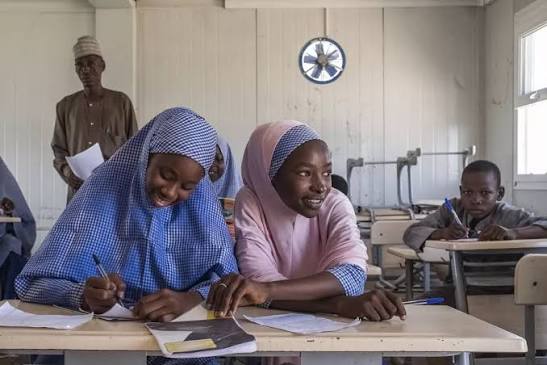

Nigeria has maintained a long-standing commitment to universal basic education, introducing the Universal Basic Education (UBE) programme in 1999 as a major reform aimed at expanding access to quality schooling across the country. The National Policy on Education provides the overarching framework for the sector, while the UBE Act of 2004 guarantees every child the right to free and compulsory basic education from primary through junior secondary school.
However, significant challenges continue to undermine these commitments. According to the Universal Basic Education Commission (UBEC), an estimated 10.2 million children of primary school age and 8.1 million children of junior secondary school age were out of school in 2018, highlighting persistent barriers to access.
Learning outcomes among enrolled students also remain a major concern. Data from UBEC and UNICEF show that in 2022, nearly half of Primary 3 pupils failed to reach minimum proficiency in mathematics, with the figure rising to 67 per cent among Primary 5 learners and 86 per cent among Junior Secondary 2 students. In addition, around 30 per cent of students who completed Junior Secondary 3 in 2021 lacked foundational reading skills that are typically expected to be acquired during Primary 2 and 3, according to the National Bureau of Statistics and UNICEF.
Experts attribute the twin challenges of limited access and poor learning outcomes largely to chronic underinvestment in the education sector. Government spending on education has steadily declined over the past decade, falling from 9.3 per cent of total public expenditure in 2015 to just 3.6 per cent in 2023, well below the internationally recommended benchmark of 15–20 per cent.
Acknowledging the funding gap, Nigeria has pledged to increase education spending to 4 per cent of gross domestic product (GDP) by 2025 and sustain that level through 2030. Policymakers and development partners argue that achieving this target will be critical to improving school enrolment, strengthening learning outcomes and ensuring that millions of Nigerian children are not left behind.


