
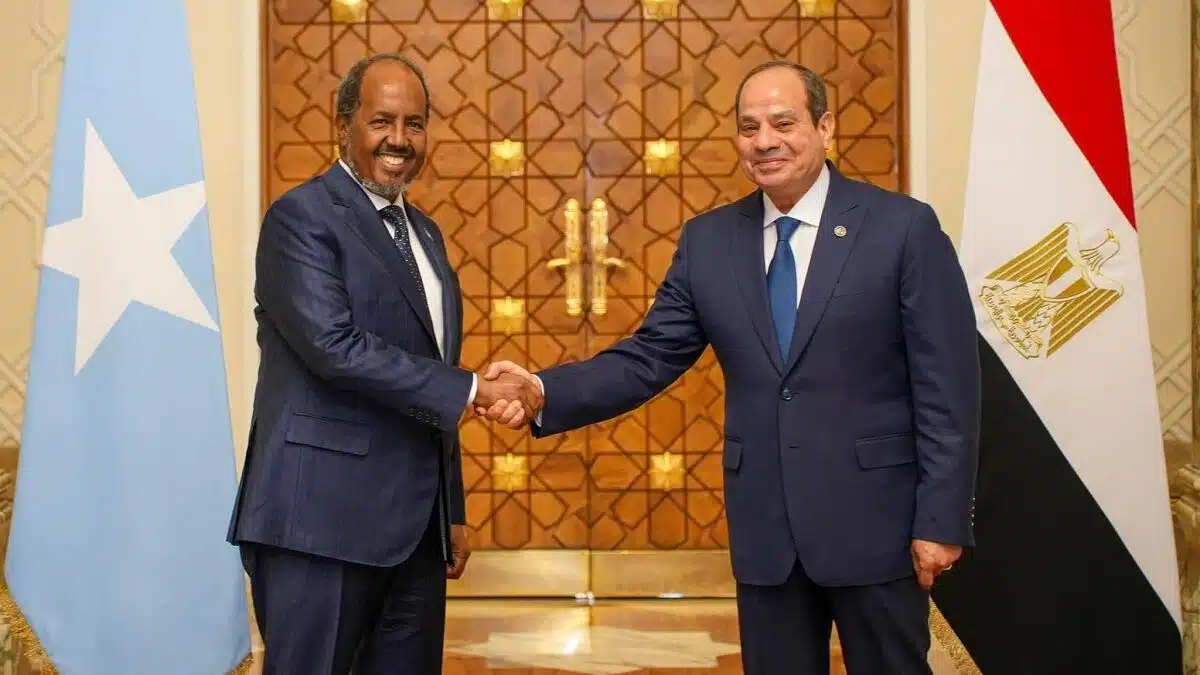

Somali analysts are defending a military cooperation agreement with Egypt, accusing Ethiopia of a “double standard” after its top general described the pact as a growing threat to national security.
The analysts maintain that Somalia is exercising its sovereign right to form alliances and that the Egyptian military presence is intended to support the government in Mogadishu, not to encircle Ethiopia. The commentary follows a warning from Field Marshal Berhanu Jula, Chief of the Ethiopian National Defense Forces, who told lawmakers on Saturday that foreign military deployments in Somalia pose serious risks to regional stability.

Abdiwahab Sheikh Abdisamad, a political analyst and director of the Afro Asian Institute of Strategic Studies, said Somalia is a sovereign state with the right to engage any country for security cooperation. He pointed out that Ethiopia maintains its own security pact with Israel, to which Somalia has never objected.
“Ethiopia has a security pact with Israel, yet Somalia has never objected, despite Israel’s unfriendly stance toward Somali unity,” Abdisamad told DNE Africa. “Now, Ethiopia is raising alarms over unconfirmed Egyptian military presence in Somalia. This reflects a double standard, especially when Somalia has not interfered in Ethiopia’s alliances. Somalia’s partnerships are based on its national interests, not foreign pressures or rumors.”
“The presence of Egyptian troops in Somalia should not be perceived as a threat to Ethiopia,” Abdikarin Dahir, a Somali political analyst, told DNE Africa. “Their mission is to support the government, not to engage in hostilities with Ethiopia.”
While Berhanu did not explicitly name Egypt in his briefing to the Ethiopian parliament in Addis Ababa, his remarks follow an August 2024 military agreement between Cairo and Mogadishu. The deal reportedly allows for the deployment of up to 10,000 Egyptian troops to Somalia. Half of the forces would serve under the African Union’s stabilization mission, known as AUSSOM, while the other half would operate under a separate bilateral arrangement that also includes provisions for weapons transfers.
“There are foreign forces inside Somalia whose strategic intent raises serious concerns for Ethiopia’s stability,” Berhanu said. “The threat is real.”
Analysts suggest Ethiopia’s apprehension is rooted in its long-standing geopolitical rivalry with Egypt, particularly over the Grand Ethiopian Renaissance Dam (GERD) on the Nile River.
“Ethiopia fears that if Egypt engages with Somalia through a new diplomatic mission or bilateral cooperation, it could pose a threat,” Dahir said, adding there are concerns in Addis Ababa that Egypt might support armed groups hostile to the Ethiopian government.
Dahir argued that Ethiopia’s past policies, which he said involved interfering in Somalia’s internal affairs and exploiting clan divisions, have pushed Mogadishu to strengthen its foreign relations, including with Cairo.
“Ethiopia’s policy toward Somalia has often been criticized for disregarding the county’s territorial integrity, exploiting clan divisions, and arming local militias, including groups resembling Al-Shabaab,” he said. “As a result, Somalia has been compelled to reconsider its foreign policy and deepen its ties with Egypt—a prospect Ethiopia views with anxiety.”
Another Somali political analyst, Suldan I. Mohamed, a former governance advisor at the Office of the Prime Minister, described Ethiopia’s reaction as “unsurprising.” He suggested Ethiopia was “emboldened by the current regime reigniting relations and pushing the Egypt-Eritrea-Somalia pact to the side.” Mohamed added, “I also support an increase of an Egyptian presence with mutual benefit of course in our defense cooperation.”

Somali officials have defended the military pact, stating it is aimed at rebuilding the Somali National Army and strengthening regional security. They maintain that Egypt’s participation in the AU mission was approved by the African Union and poses no threat to neighboring countries.
Berhanu also warned of broader forces working to block Ethiopia’s access to the sea in a region marked by land and maritime tensions. “We are ready to solve the region’s problems together,” he stated. “But there are forces that do not want Ethiopia to approach the sea gate.”
Ethiopian-Somali tensions following MoU with Somaliland
The timing of the Egypt-Somalia agreement has further complicated relations between Addis Ababa and Mogadishu, which were already strained. In January 2024, Ethiopia signed a memorandum of understanding with Somaliland, a breakaway region of Somalia, to gain access to a portion of the Red Sea coast. Somaliland leaders said the deal included a pathway toward formal recognition.
Mogadishu denounced the agreement as a violation of its sovereignty, recalled its ambassador from Addis Ababa, and declared the MoU null and void.
Ethiopia, which maintains its own troops in Somalia under both AU and bilateral agreements, is now reassessing its strategic position. Berhanu said defense officials are reevaluating their posture in light of “emerging regional threats,” including the extremist group Al-Shabaab.
He did not disclose the number of Ethiopian troops operating in Somalia under the bilateral terms.
According to Dahir, Ethiopia has recently shifted its approach to pursue de-escalation, a process in which Turkey has played a mediating role. Tensions between Ethiopia and Somalia had only started to ease in late 2024 following a Turkish-brokered dialogue, where both sides agreed to pursue future cooperation on maritime access.
“Somalia is an independent nation that determines its own path—no external actor can dictate the will of the Somali people,” Dahir said. “Both Ethiopia and Somalia must respect each other.”


