
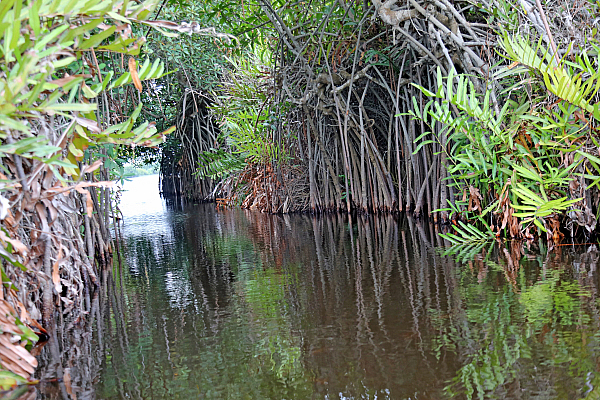

Benin has placed 110 hectares of mangroves under protection, restored 47 hectares, and reopened 14 kilometres of waterways as part of a community-led initiative that has revived local economies and wildlife across nine southern municipalities.
“One hundred and ten hectares of mangroves have been placed under protection, forty-seven hectares have already been restored, twenty-nine hectares reforested, and fourteen kilometers of waterways reopened,” National Project Steering Committee Chair Séverin Nsia said. He added that the momentum created by the Benin government and its partners has mobilised communities, which are now taking ownership of the restoration activities.
The project, titled “Strengthening the Resilience of Human and Natural Systems to Climate Change through the Conservation and Sustainable Use of Mangrove Ecosystems in Southern Benin,” focuses on Ramsar wetlands 1017 and 1018. It operates across the municipalities of Grand-Popo, Abomey-Calavi, Ouidah, Kpomassè, Bopa, Comè, Sèmè-Podji, Sô-Ava, and Aguégués.
The initiative is implemented with support from the Food and Agriculture Organization of the United Nations (FAO) and the Ministry of Living Environment and Transport in charge of Sustainable Development (MCVT), and is financed by the Global Environment Facility (GEF).
Once heavily exploited, Southern Benin region’s mangroves are undergoing a transformation in community practices. Luc Mouvi, President of the Ahémé Community Biodiversity Conservation Area (ACCB), noted a shift in local attitudes.
“Recently, a resident entered a mangrove ecosystem to cut down mangrove trees, as people used to do in the past. But the site had already been declared sacred,” Mouvi said, adding that the individual was stopped and required to replant the felled trees.
Conservation measures have been strengthened by the sacralisation of 18 sites in Southern Benin covering 144 hectares. At the entrance to some sites, the presence of the Zangbeto—an iconic figure in Beninese Vodun tradition and a guardian of social order—symbolises the renewed relationship between communities and the environment.
“We used to use mangrove wood to smoke fish without understanding the consequences,” ACCB Ahémé Treasurer and member Catherine Sianté said. “We now understand the importance of mangroves, and our practices have changed. No one dares to destroy them anymore.”
Beyond environmental restoration, the project aims to improve local livelihoods. National Project Coordinator Fiacre Codjo Ahononga stated that reopening waterways has improved mobility and trade, while planting fast-growing tree species has reduced pressure on forest resources.
“Six value chains (aquaculture, salt production, fisheries, market gardening, composting, and ecotourism) have been structured to help communities generate more sustainable incomes through training and the implementation of business plans developed by beneficiaries themselves,” Ahononga said. “Restoration efforts across municipalities and reforestation using fast-growing species have transformed community attitudes.”
Zoéwindé Henri Noël Bouda, FAO Representative in Benin, noted that the approach links environmental protection with sustainable development. “Restoring mangroves means acting for the environment. But it also helps revive fisheries and aquaculture production, improve nutrition, and increase people’s incomes,” Bouda said.
The ecosystem is already responding to the conservation efforts. In the Coastal Cluster, local ACCB President Gérard Djikpessé observed the return of several species that had become rare or disappeared altogether, including fish, crocodiles, vipers, monkeys, and birds.
This ecological recovery is creating new opportunities for ecotourism. In Comè, around Lake Ahémé, Mayor Edgar Tohouegnon has integrated ecotourism into the municipality’s development planning, noting that “fishing activities are more dynamic, and incomes are improving.”
The initiative is further investing in long-term conservation through the establishment of nine environmental clubs dedicated to training “Junior Mangrove Ambassadors,” supported by school nurseries, school plantations, and forest seedling production facilities.
Additionally, the project has facilitated the adoption of local natural resource management agreements, provided support to 33 cooperatives and associations, and promoted innovations such as solar-powered salt production to help reduce pressure on forest resources.
Distributed by APO Group on behalf of Food and Agriculture Organization of the United Nations (FAO): Regional Office for Africa.

