
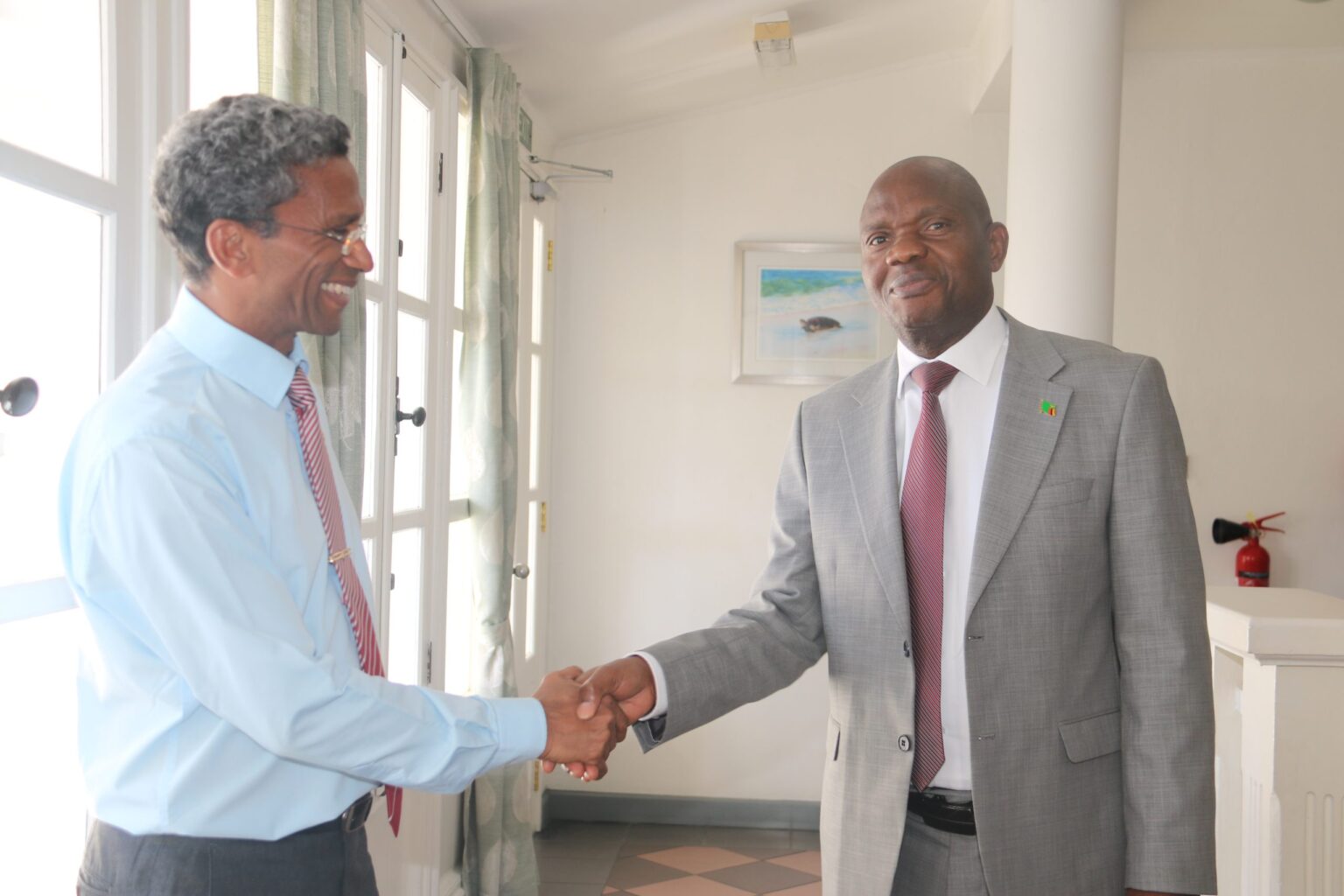

Seychelles and Zambia are moving to expand bilateral cooperation across trade, agriculture, and education, with Seychelles seeking to leverage Zambia’s agricultural sector to improve its domestic food security, the Ministry of Foreign Affairs and the Diaspora announced.
During a courtesy call on Monday 6 July at Maison Quéau de Quinssy ahead of his accreditation ceremony, Zambia’s High Commissioner-designate Alfred Musemuna met with Seychelles’ Minister for Foreign Affairs and the Diaspora Barry Faure to discuss revitalising dormant agreements and exploring new sectors of cooperation.
Faure pointed out that cooperation in agriculture and trade could significantly benefit Seychelles by utilising Zambia’s vast, fertile agricultural lands and its bovine industry, which produces high-quality meat to ensure food security.
Additionally, Faure thanked the Zambian government for its ongoing cooperation in education, where Zambian teachers currently contribute to the public school system, and expressed the government’s interest in expanding ties in this domain.
The diplomats also reviewed several existing Memoranda of Understanding (MoUs) that are currently inactive, including an agreement in the field of tourism. Faure expressed a desire to revitalise cooperation in the tourism sector to facilitate exchanges and promote the sharing of ideas, expertise, and best practices.
Musemuna welcomed the proposal, noting that enhanced cooperation through joint marketing initiatives and improved air connectivity would yield significant benefits for both nations.
Environmental issues and climate change were also on the agenda, with the two diplomats discussing their respective national efforts to transition to sustainable energy sources away from fossil fuels.
Faure appealed to the Zambian government to support advocacy for the Multidimensional Vulnerability Index (MVI). He noted that while Seychelles has a high GDP per capita, it remains highly vulnerable to external economic shocks from which recovery is slow, adding that Zambia faces its own distinct vulnerabilities as a landlocked country.
The meeting further covered both countries’ involvement in regional organisations—including the Southern African Development Community (SADC), the Common Market for Eastern and Southern Africa (COMESA), and the African Union—alongside upcoming presidential and parliamentary elections in Zambia, and mutual consular and diaspora engagements.


