
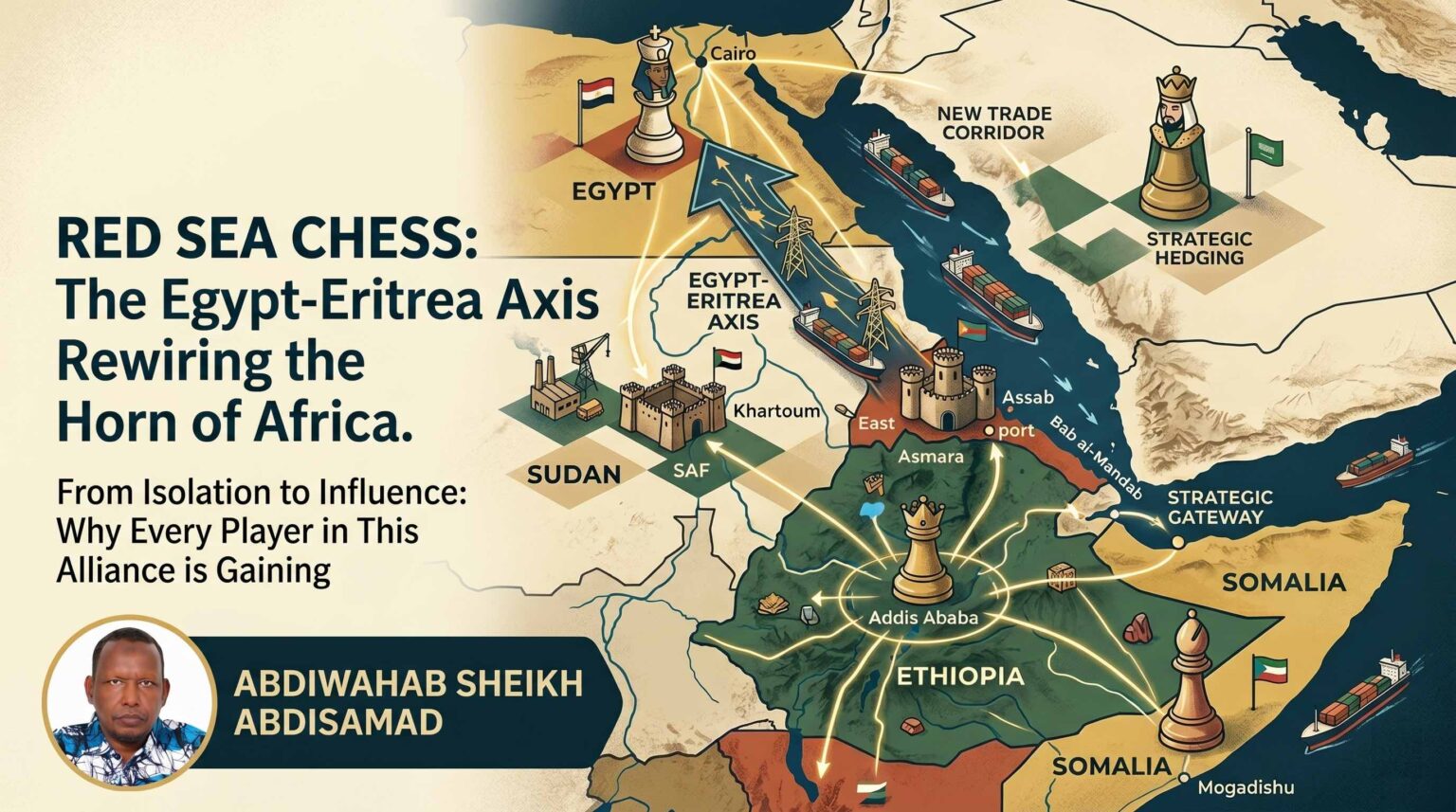

The Horn of Africa is no longer drifting through diplomatic turbulence. It is entering a profound geopolitical realignment — quietly, strategically, and with potentially enormous consequences. Egypt, Eritrea, Sudan’s military leadership, and Somalia are shaping a new regional bloc whose reach stretches from the Nile Basin to the Bab al-Mandab Strait.
Contrary to the simplistic narrative dominating much international analysis, this is not merely “Egypt versus Ethiopia.” That reading misses the deeper transformation underway.
The emerging Egypt-Eritrea partnership is proving resilient because every participant sees tangible strategic gains. Eritrea wins economic opportunity and diplomatic re-engagement. Sudan’s military leadership consolidates its battlefield and political position. Somalia acquires new security partnerships and leverage. Egypt secures strategic depth in the Red Sea while increasing pressure on Addis Ababa over Nile-related disputes.
This is not an alliance built on ideology. It is built on converging interests. And alliances rooted in mutual benefit tend to outlast those built on rhetoric alone.
Eritrea: From Isolation to Strategic Relevance
For years, Eritrea operated under severe geopolitical constraints. Sanctions, economic pressure, regional tensions, and scarce international partnerships left Asmara heavily isolated. Despite this, the Eritrean government maintained state continuity through resilience, tight internal control, and long-term strategic patience.
Then the regional landscape began to shift.
Egypt’s growing engagement with Eritrea has helped reposition Asmara from a diplomatically marginalised actor into a strategically significant Red Sea partner. The May 2026 Egypt-Eritrea Business Forum symbolises this transition. Cairo expanded cooperation discussions across mining, fisheries, pharmaceuticals, railways, logistics, manufacturing, and port development — sectors with substantial potential for Eritrea’s long-term economic revival.
This was more than symbolic diplomacy. For Eritrea, it represented a rare opening toward diversification and regional reintegration.
Egypt’s offers of technical expertise, industrial studies, vocational training, and infrastructure cooperation give Eritrea development opportunities that had long been foreclosed by isolation and instability. The benefits for Asmara are substantial: reduced diplomatic isolation, increased infrastructure investment, expanded employment, greater trade diversification, and enhanced strategic relevance in the Red Sea. Eritrea is no longer viewed primarily through the lens of conflict. It is increasingly recognised as a critical geographic and geopolitical gateway.
Assab: The Red Sea Asset Returning to Prominence
At the centre of Eritrea’s transformation lies Assab. For years, the port sat underutilised despite its position along one of the world’s most consequential maritime corridors. Today it is re-emerging as a key regional asset attracting renewed international attention.
Egypt’s growing interest in Assab reflects long-term geopolitical calculation as much as economic cooperation. Yet one of the most overlooked dimensions of this story is that Eritrea’s infrastructure revival could eventually benefit the wider region — including Ethiopia itself.
Should relations between Addis Ababa and Asmara improve, Ethiopia may once again seek access to Assab to reduce its heavy dependence on Djibouti. In that scenario, Eritrea would stand to gain economically and strategically from investments being laid down today. This places Asmara in a uniquely advantageous position: whether regional tensions persist or reconciliation eventually emerges, Assab’s value keeps rising. That is the kind of strategic leverage few states in the Horn currently possess.
A New Red Sea Trade Corridor is Taking Shape
One of the region’s most significant yet underreported developments is the creation of direct cargo connections between Egyptian and Eritrean Red Sea ports. The implications are considerable.
For decades, Djibouti dominated regional trade logistics, particularly as Ethiopia’s primary maritime outlet, while Eritrea remained commercially sidelined. An alternative corridor is now gradually taking shape. Eritrea strengthens independent trade capacity. Egypt expands its footprint along Red Sea supply chains. Regional logistics become more diversified. Ethiopia’s dependence on a single corridor may, over time, ease.
This is not merely about commerce. It reflects the growing importance of infrastructure and maritime geography in shaping political influence across the Horn. Cairo understands this clearly.
Sudan’s Military: Egypt’s Strategic Security Partner
If Eritrea is gaining economically, Sudan’s SAF-led leadership is gaining strategically and militarily.
Egypt’s support for Sudan’s armed forces appears to have expanded well beyond diplomatic backing into deeper military coordination. Reports indicate Cairo provided logistical support, aerial cooperation, and military assistance that helped shift battlefield dynamics against the RSF. As a result, the SAF regained momentum and recovered strategically important territory — approximately 75 per cent of Sudan’s total land mass — including securing Khartoum.
But the more significant story may be the growing operational coordination between the two governments. Following Abdel Fattah al-Burhan’s December 2025 visit to Cairo, reports pointed to logistics sharing, intelligence cooperation, and joint battlefield planning. This is not ordinary alliance politics. It reflects strategic military integration.
For Sudan’s military leadership, the gains are clear: improved operational capability, greater diplomatic backing, enhanced international legitimacy, and stronger post-war political positioning. Egypt is not only helping Sudan survive militarily — it is helping shape what comes after.
Somalia: Seeking Sovereignty Through New Partnerships
For Somalia, cooperation with Egypt offers something Mogadishu has long pursued: strategic flexibility.
The Somali government has spent years navigating competing foreign influences — from Ethiopia and Gulf states to regional security actors. Egypt’s growing role has shifted that balance. Military cooperation between Cairo and Mogadishu includes support for rebuilding Somali security institutions, strengthening anti-al-Shabaab capabilities, and expanding Somalia’s role in Red Sea security architecture.
These efforts align closely with Somalia’s national priorities. Perhaps more importantly, Egypt gives Mogadishu an alternative regional security partner, broadening its external relationships and reinforcing its sovereignty. For Somalia, this is not about choosing sides. It is about expanding options.
Ethiopia’s Somaliland Agreement Accelerated Regional Realignment
Regional tensions sharpened considerably following Ethiopia’s controversial access agreement with Somaliland. Mogadishu viewed it as a direct challenge to Somali territorial integrity. Cairo saw it as an opportunity to increase pressure on Addis Ababa over the GERD dispute and broader Nile-related tensions.
Their interests quickly converged. Egyptian diplomatic opposition, reinforced through expanded security cooperation with Somalia, transformed the issue into a wider regional flashpoint. Combined with Eritrea’s longstanding grievances toward Ethiopia, a broader strategic alignment began to crystallise — built not around a formal treaty, but around overlapping security anxieties.
This is often how alliances form in the Horn of Africa.
Saudi Arabia’s Quiet Balancing Act
Perhaps the most measured player in this evolving landscape is Saudi Arabia. Unlike Egypt, Riyadh has avoided rigid alignment. Instead, Saudi diplomacy appears focused on maintaining working relationships with both Eritrea and Ethiopia while simultaneously exploring investment opportunities linked to Assab and wider Red Sea infrastructure.
This is strategic hedging in its most considered form. Riyadh understands that political dynamics may shift rapidly, but Red Sea trade and infrastructure will retain their value regardless of how the politics land. By positioning itself across multiple fronts, Saudi Arabia ensures it gains under nearly any scenario. That is long-term geopolitical insurance.
Why This Emerging Bloc Matters
The critical takeaway is this: this regional alignment should not be dismissed as temporary anti-Ethiopian positioning.
Each participant is gaining something concrete. Eritrea gains economic re-engagement. Sudan’s military leadership gains strategic backing. Somalia gains security partnerships. Egypt gains Red Sea depth and Nile leverage. Gulf actors gain commercial positioning. These overlapping interests create structural resilience, and coalitions built around mutual strategic advantage are frequently more durable than outside observers initially assume.
Ethiopia’s Challenge: Every Actor Has Independent Incentives
This presents Ethiopia with a genuinely complicated strategic challenge. Diplomatic pressure directed solely at Cairo may not be sufficient, because Egypt is no longer the sole driving force behind the emerging network.
Each participant now has its own logic. Eritrea seeks investment and regional relevance. Somalia seeks sovereignty guarantees. Sudan’s SAF seeks political and military survival. Gulf actors seek commercial access. Egypt seeks strategic containment and Red Sea influence. These interests overlap without depending entirely on one another — meaning the broader architecture could continue evolving even if some bilateral tensions eventually ease.
The Horn of Africa is Entering a New Strategic Era
The old regional order is giving way. For years, Ethiopia dominated the political and economic gravity of the Horn through population size, military weight, and rapid growth. A counterbalancing structure is now beginning to emerge — not necessarily strong enough to displace Ethiopia’s influence, but potentially strong enough to constrain it.
The Egypt-Eritrea partnership is therefore more than a bilateral relationship. It is becoming part of a wider Red Sea realignment stretching across Northeast Africa and the Gulf corridor.
Unless the underlying interests of each participant are addressed individually, this alignment is likely to deepen — because in geopolitics, the most durable coalitions are rarely built on emotion alone. They are built on shared interests, strategic necessity, economic opportunity, and hard security calculations.
Abdiwahab Sheikh Abdisamad Expert on Horn of Africa Geopolitics, Security and Diplomatic Trends


