
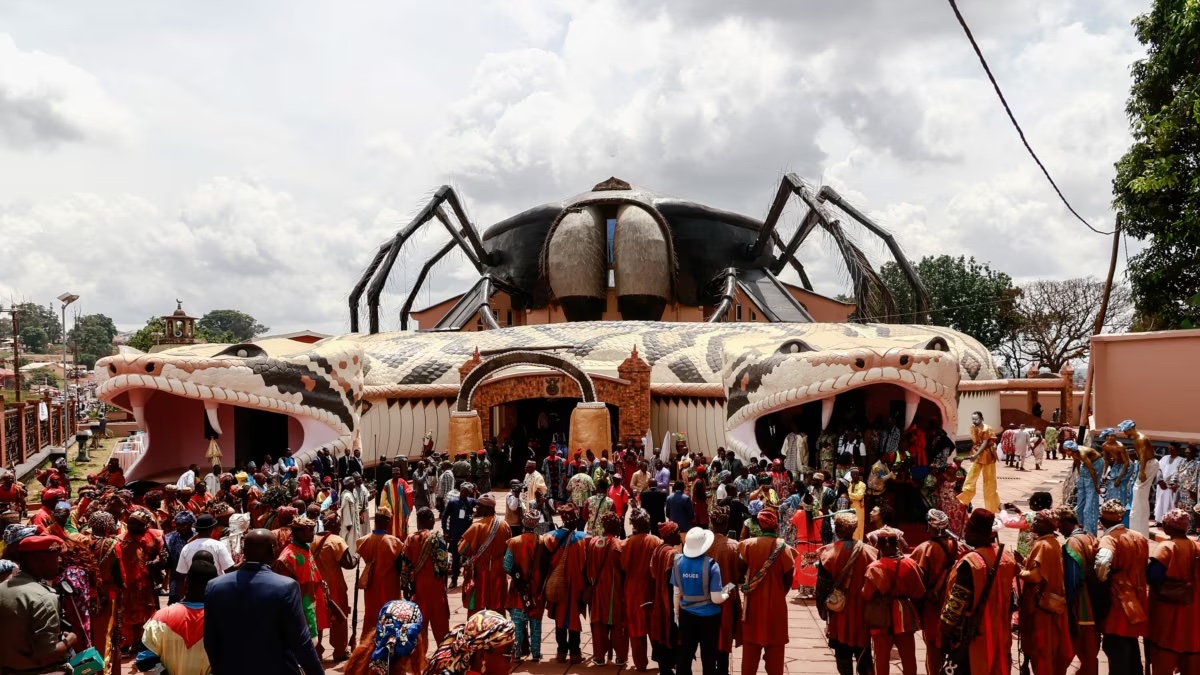

One of the most significant African museum openings of 2024 was the Musée des Rois Bamoun, or Museum of the Bamoun Kings, in Foumban, Cameroon.
Housing over 10,000 objects, it offers more than 600 years of history in its display of the treasures of the Bamoun kingdom, one of the oldest in sub-Saharan Africa. The museum’s striking architecture is dominated by a two-headed snake at its entrance and a spider perched on top of it.
Cameroonian archaeologist and heritage scholar Rachel Mariembe visited the museum and wrote a research paper on it. We asked her about it.
Who are the Bamoun kings?
The Bamoun (or Bamum) kingdom in western Cameroon was established in 1394 by the Tikar prince Nshare Yèn. Settling in the region from neighbouring territory, he established the palace at Foumban. The monarchy has survived through 20 reigns.
Nshare Yèn’s daughter became notable as the first female ruler of the kingdom. Her name means “skin of the sky”, a reference to her light complexion at birth. King Mônjù (1461–1498) introduced an eight-day week, advancing the idea of chronological organisation. After a period of some stagnation, Mo’Nguh (1568–1590) reconstructed the palace, preserving royal heritage. Kuotu (1672–1757) suppressed internal uprisings and ruled for an unprecedented 85 years.
The 11th king, Mbuombuo Mandù (1757–1814), expanded the kingdom through military campaigns but this was followed by a period of internal strife and massacres under Gbètnkom (1814–1817). When he died, power was left in the hands of his son, still a child.
Nguwuo (1818–1863) was a minister in the Bamum royal army who unexpectedly ascended to power. Despite not being from royal lineage, he restored the kingdom. He governed wisely for four decades until he was unseated in a coup by Nsangu, who was noted for his military skill and cruelty, but also his generosity. He met his demise in battle against the Nso people.
One of Bamum’s most illustrious leaders was Njoya Ibrahima (1889–1933), an innovator and cultural icon. He invented the A Ka U Ku script around 1896 and the Shümom language in 1912, promoting education and literacy. Njoya also established a hybrid religion, Nwet-Nkwete, blending Islam and Christianity with animist beliefs. His reign saw the construction of a magnificent palace in Foumban. Resistance to French colonial authority led to his exile in 1931.
His son, Njimoluh, restored stability to the Bamum kingdom. He reintroduced the Nguon festival and served in Cameroon’s parliament, but faced challenges during Cameroon’s transition to pluralist democracy. Mbombo Njoya Ibrahim (1992–2021) held various high-ranking positions and modernised the kingdom’s administration. He built a royal museum housing over 3,000 artifacts.
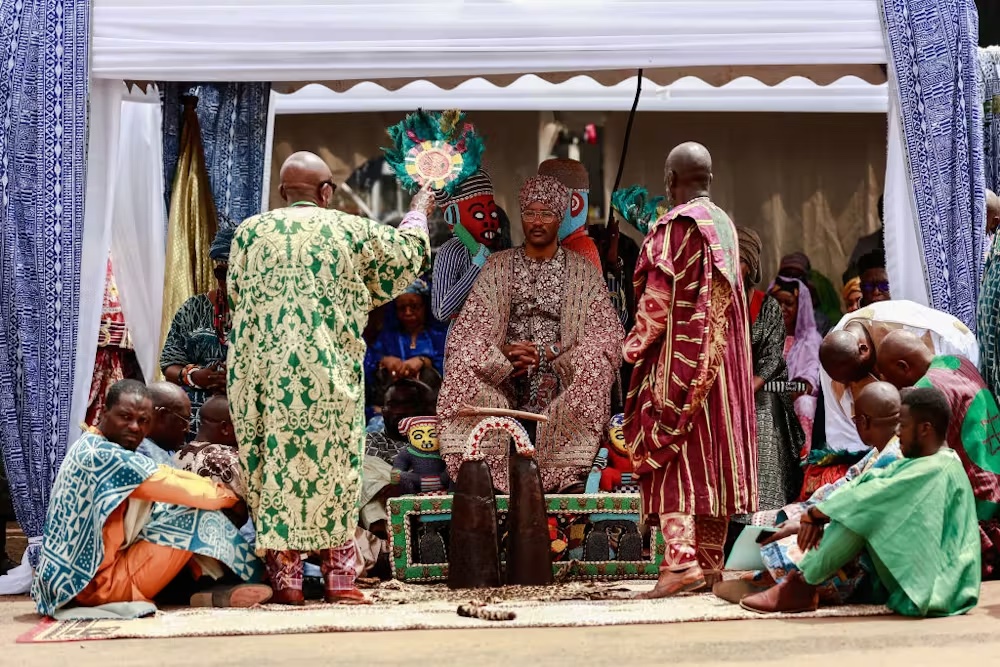
Nji Mforifoum Mbombo Njoya Mohammad Nabil (2021–) is the reigning monarch. His leadership represents the continuity of the heritage of the Bamum people into the modern era.
It’s this rich story that the museum tells.
Can you walk us through a visit?
A museum mediator accompanies visitors through almost a dozen key exhibition spaces, starting with the portrait gallery showing images of the 20 kings. This leads to vast murals, including one that illustrates the establishment of the kingdom. Artefacts include royal headdresses, a statue and parts of an ancient pirogue (canoe) and tree.
This leads to exhibits from the 2nd to the 10th kings. Items on show include Bamoun cloth. The first fabric was created from beaten tree bark and dyed with indigo.
King Mbuombuo’s space displays a large statue of the 11th king in traditional attire. The kingdom’s coat of arms, featuring a mygale spider, a two-headed snake, and a double-gong bell, decorates the wall. In the centre of the room, a human skull and calabash are displayed. War trophy costumes, Tu’molah crest masks, royal pipes and weapons are also exhibited.
Highlights of the 12th and 13th kings’ space include royal headdresses, umbrellas and handbags. One then arrives at a room with audiovisual projections that offer insights into the secret societies of Bamoun culture. There are then artefacts from these societies (the Nguri, Mut-Ngu, and Mbansié) including dance costumes and masks. Next one encounters a showcase of Bamoun craftsmanship and artistry. https://www.youtube.com/embed/BUbK4IRgt6I?wmode=transparent&start=0
The space of the 15th, 16th and 17th kings includes a beaded royal stool, weapons, a human skull, royal bed, King Njoya’s manuscripts, costumes, private chambers, Quranic artefacts, musical instruments, masks and portraits.
The space of the 18th, 19th and 20th kings features photographs, the 18th king’s prayer room and private rooms, a Quran translated into Bamoun, a throne, ceremonial stones, costumes, a sceptre and the like.
Museum of the Bamoun Kings: Why is it so effective as a place of memory?
The museum embodies both a tangible and symbolic place of memory. Its location and its treasures reflect the historical, cultural and artistic heritage of the Bamoun people. As French historian Pierre Nora suggested, such spaces become “places of memory” by intertwining material objects with symbolic meanings.
A pivotal moment in Bamum history was King Njoya’s decision to open royal treasures to the wider community, breaking with the tradition of exclusivity tied to specific cultural ceremonies. He also reformed Bamoun craftsmanship.
Originally located in the royal palace, itself an architectural marvel, the museum was relocated to a new building under King Ibrahim Mbombo Njoya, the 19th monarch. This shift allowed for a more modern exhibition. Each ruler has contributed to preserving and expanding this collective heritage.
Under the current monarch the museum has undergone further modernisation to align with contemporary practices.
Why does your study raise issues of looted heritage and restitution?
The restitution of cultural objects taken from places like the Bamoun kingdom during colonial rule is a multifaceted issue. It involves emotional, cultural, political, legal and economic dimensions. Beyond physical objects, restitution addresses the memory and stories of these items, their decolonisation, and their new context when returned.
The removal of Bamoun artefacts from their designated environments disrupted their cultural significance and function. In their new settings, they lost much of their meaning, becoming incomplete. This loss underscores the need for restitution and raises questions about the museum’s role both internally (in maintaining identity) and externally (in addressing colonial legacies).
In Bamoun society, cultural objects gain legitimacy through their use in socio-cultural practices under the authority of the palace, the pinnacle of the social structure. These objects serve dynamic roles, activated or deactivated depending on their context – be it rites, initiation ceremonies or public exhibitions. When these items are removed, the intricate universe that gives them meaning is shattered.
Restoring these artefacts to their rightful contexts is essential so that they continue to serve as markers of identity and history.
Rachel Mariembe, Senior Lecturer and Head of Department, Heritage and Museum Studies, Institute of Fine Art , University of Douala
This article is republished from The Conversation under a Creative Commons license. Read the original article.


