
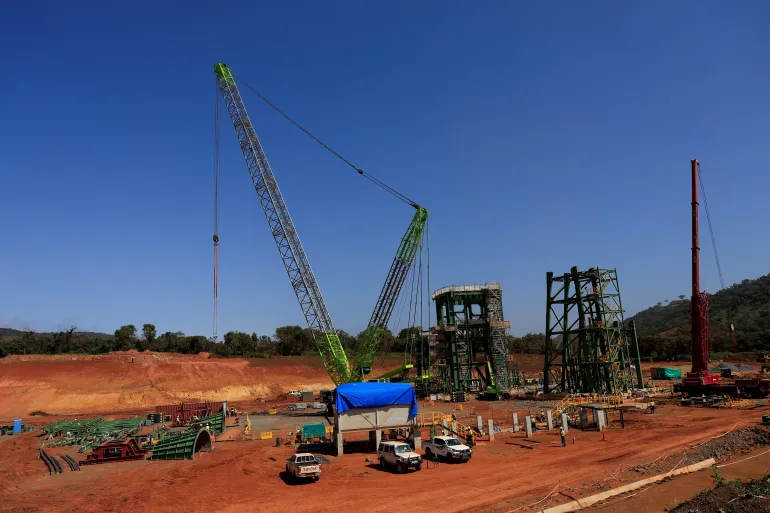

Guinea on Tuesday inaugurated the long-awaited Simandou iron ore mine, one of the world’s largest untapped deposits, marking a milestone for the West African nation’s economy and infrastructure ambitions.
The launch, hailed as “a historic turning point,” took place at the Morebaya Port south of the capital Conakry, in a ceremony attended by President Mamadi Doumbouya and his counterparts from Gabon, Brice Oligui Nguema, and Rwanda, Paul Kagame.
The first shipments of high-grade iron ore from the southeastern Nzérékoré region are already en route for export, as Guinea seeks to position itself as a key player in the global minerals market.
“A Dream of Generations”
Transport Minister Ousmane Gaoual Diallo described the project as “a dream of generations of Guineans,” stressing that it represents more than a mining venture. “It is about transforming Guinea’s destiny through new infrastructure — a 650-kilometer railway line and a deep-water port that will reshape the country’s logistics and economy,” he said.
The Simandou deposit, discovered decades ago, contains some of the world’s richest iron ore. Its development had been delayed for years by disputes over mining rights, allegations of corruption, and the enormous investment required in a region lacking basic infrastructure.
Strategic Partnerships
The mine is being developed jointly by Winning Consortium Simandou (WCS) — a Singaporean-Chinese partnership — alongside Simfer, a venture of Anglo-Australian mining giant Rio Tinto, and Chinese state-owned company Chinalco.
An aerial view shows a new 650-kilometer rail corridor connecting the mine to Morebaya Port, designed to carry millions of tonnes of ore annually. Officials said the project would also create tens of thousands of direct and indirect jobs.
Economic and Political Stakes
Analysts see the project as a political victory for President Doumbouya, who seized power in a 2021 coup and is now preparing to contest the December 28 presidential election. The Supreme Court recently confirmed his name on a preliminary list of nine candidates.
The government hopes the Simandou project will boost national revenues, attract foreign investment, and help integrate remote regions long cut off from economic activity.
For Doumbouya, the launch symbolizes both a promise of modernization and a message of stability to investors ahead of the polls — a bid to turn a long-delayed resource dream into a cornerstone of Guinea’s future.


