
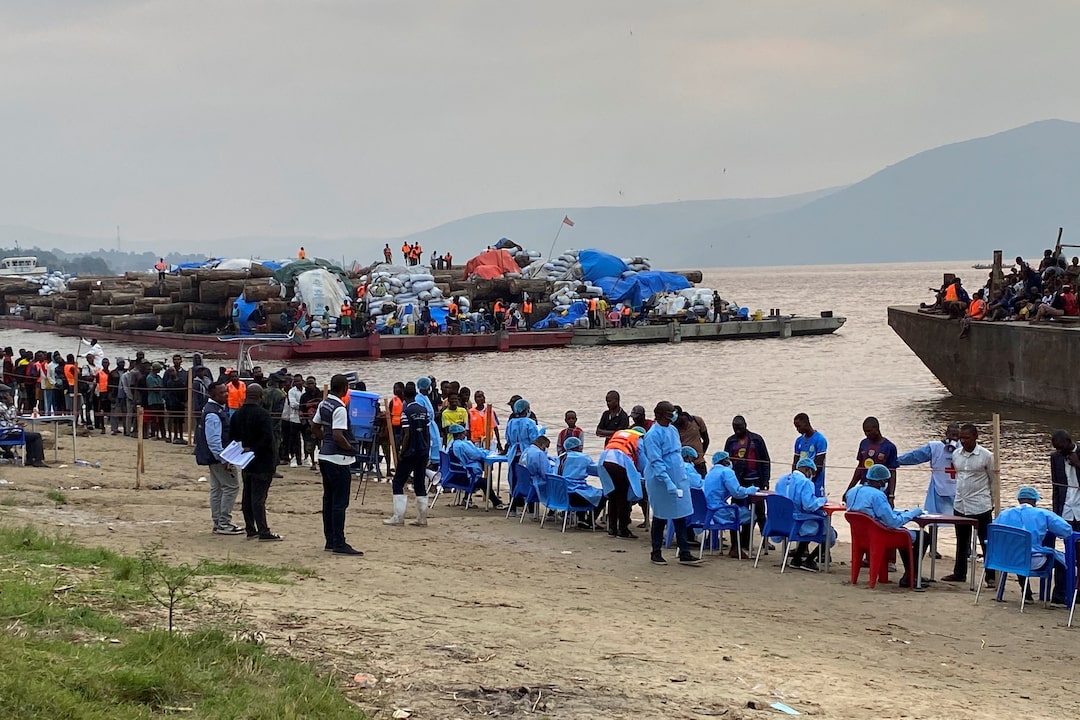

The Democratic Republic of Congo (DRC) has tested and isolated about 200 passengers from a river boat intercepted near Kinshasa after a traveller who had been on board died of suspected Ebola, as authorities intensified efforts to prevent the virus from reaching the capital.
The precautionary operation was launched after the vessel transported a 32-year-old man who later died of suspected Ebola, raising fears that the virus could spread along the heavily travelled Congo River route.
Africa Centres for Disease Control and Prevention (Africa CDC) Director-General Jean Kaseya said on Thursday that all passengers on the boat were screened, including those without symptoms, to ensure no infections were missed.
Pending laboratory analysis by the National Institute for Biomedical Research (INRB), the passengers were placed in precautionary isolation and prevented from entering Kinshasa.
Congolese health authorities later said all passengers underwent clinical screening and temperature checks, while seven people with fever-like symptoms were tested for Ebola. All seven tested negative, easing immediate concerns of transmission from the vessel. Authorities also disinfected the boat and ordered enhanced screening of all river traffic arriving in Kinshasa.
Kaseya said health authorities are considering expanding the use of vaccines originally developed against the Zaire strain of Ebola to help contain the current outbreak, which is caused by the Bundibugyo strain, for which there is no approved vaccine or specific treatment.
According to Africa CDC, preliminary evidence suggests that people previously vaccinated against the Zaire strain may still become infected with the Bundibugyo strain but are more likely to develop only mild illness.
More importantly, Kaseya said, no deaths have so far been recorded among vaccinated individuals, encouraging authorities to broaden the strategy while additional scientific evidence is gathered.
He further noted that officials are also considering deploying the antiviral drug remdesivir in affected areas as part of the response.
Kaseya also sought to reassure the public over recent strikes by healthcare workers in eastern DRC, saying the government had committed funds to pay frontline staff. He said Congolese authorities had assured Africa CDC that outstanding salaries would be paid, allowing response efforts to remain focused on surveillance, testing, vaccination and patient care.
The Ebola outbreak, declared on May 15, has become the second-largest ever recorded and the fastest-growing in the country’s history.
According to the latest figures cited by Congolese authorities, the outbreak has surpassed 4,000 confirmed cases and caused about 1,850 deaths across the eastern provinces of Ituri, North Kivu, South Kivu, Haut-Uele and Tshopo.
The World Health Organization (WHO) has classified the Bundibugyo Ebola outbreak in DRC and neighbouring Uganda as a Public Health Emergency of International Concern (PHEIC), warning that continued cross-border transmission and gaps in surveillance pose a significant regional risk.


