
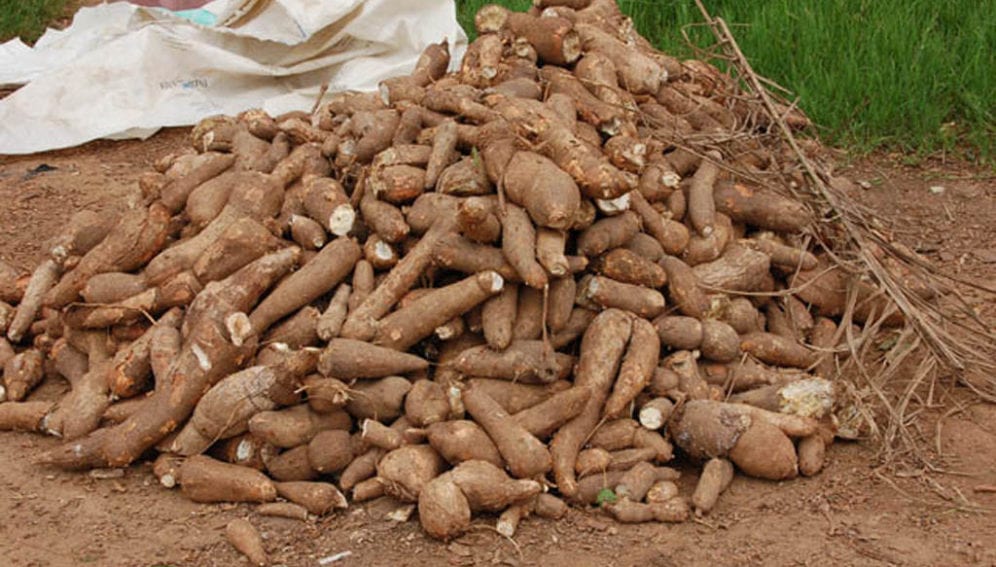

Cassava, a key food crop for millions of people in Africa, could grow in more areas as the climate warms. But a new study warns that a dangerous plant disease may spread even faster, putting food security at risk.
Cassava is a starchy root crop that feeds more than 800 million people worldwide. In sub-Saharan Africa, it is one of the most important staple foods. The region produces over 63% of the world’s cassava, with countries like Nigeria, Democratic Republic of the Congo, Ghana, Tanzania, Uganda and Mozambique leading production.
One of cassava’s strengths is its ability to grow in tough conditions. It can survive poor soil, low rainfall, and limited fertilizer use. This makes it especially valuable in regions facing climate stress.
But new research published in the East African Journal of Science, Technology and Innovation shows that climate change could create a double-edged effect.
Researchers used computer models and climate data to predict where cassava and a major disease affecting it—cassava brown streak disease—could spread by 2050 and 2080.
Their findings suggest that while cassava farming could expand, the disease may spread even more widely.
Cassava could grow across more of Africa
The study found that about 54.6% of Africa’s land area—around 16.2 million square kilometers—is currently suitable for cassava farming.
As temperatures rise, this could increase significantly. By mid-century, cassava-suitable land could expand by up to 56%–60%, covering nearly two-thirds of the continent.
New suitable areas are expected to appear in parts of West Africa, including coastal countries such as Guinea, Sierra Leone, Côte d’Ivoire, Ghana, Togo, Benin, and Nigeria. Expansion is also expected in Central and East Africa, and even along the eastern coast of southern Africa into northern Madagascar.
This could help farmers adapt to climate change, especially as other crops like maize and beans become harder to grow under rising temperatures.
A growing disease threat
However, the same warming conditions that help cassava spread also favor a serious disease.
Cassava brown streak disease, which damages the roots and makes them inedible, is already affecting about 33.7% of Africa’s cassava-growing areas.
The study warns that up to 55%–57% of the continent could be at risk of the disease by 2050.
The disease is spread by a small insect called the whitefly (Bemisia tabaci). Warmer temperatures allow these insects to survive and reproduce more easily, increasing the speed at which the disease spreads.
East Africa is currently the hardest-hit region, especially in Tanzania, Uganda, and southeastern parts of the Democratic Republic of the Congo.
But the models predict that the disease could move west into major cassava-producing countries that are currently less affected, including Côte d’Ivoire, Ghana, Benin, Nigeria, and Cameroon.
This is particularly worrying for Nigeria, which produces more than 60 million tons of cassava each year—making it the largest producer in Africa.
Why the disease spreads
The spread of cassava brown streak disease depends on two main factors.
First, farming practices play a role. Many farmers reuse planting material from previous harvests. If these plants are infected, the disease can easily spread to new fields.
Second, climate change is helping the whitefly vector expand its range. Warmer conditions make it easier for the insect to thrive and move into new areas.
This means that the same climate changes that help cassava grow in new places also create ideal conditions for its most serious threat.
Some areas may remain safer
The study also identified regions where cassava could grow well while the disease remains limited.
These include parts of central Africa, such as areas of the Democratic Republic of the Congo, and zones along the Sahel. Environmental conditions in these areas may slow the spread of the disease.
These regions could become important for future cassava production if managed carefully.
What needs to be done
Researchers say urgent action is needed to protect cassava and the millions of people who depend on it.
They recommend planting disease-resistant and heat-tolerant cassava varieties across all growing regions. Areas already affected by the disease should be replanted with improved crops.
They also stress the need for stricter controls on the movement of cassava planting materials across borders, to prevent the disease from spreading into new regions.
Mapping where cassava can grow—and where the disease is likely to spread—can help governments and farmers plan ahead.
Cassava has long helped communities cope with difficult conditions. But as the climate changes, experts say its future will depend on combining that natural resilience with better farming practices, stronger policies, and scientific innovation.
Without action, a crop that has supported food security for centuries could face growing threats in the years ahead.


