
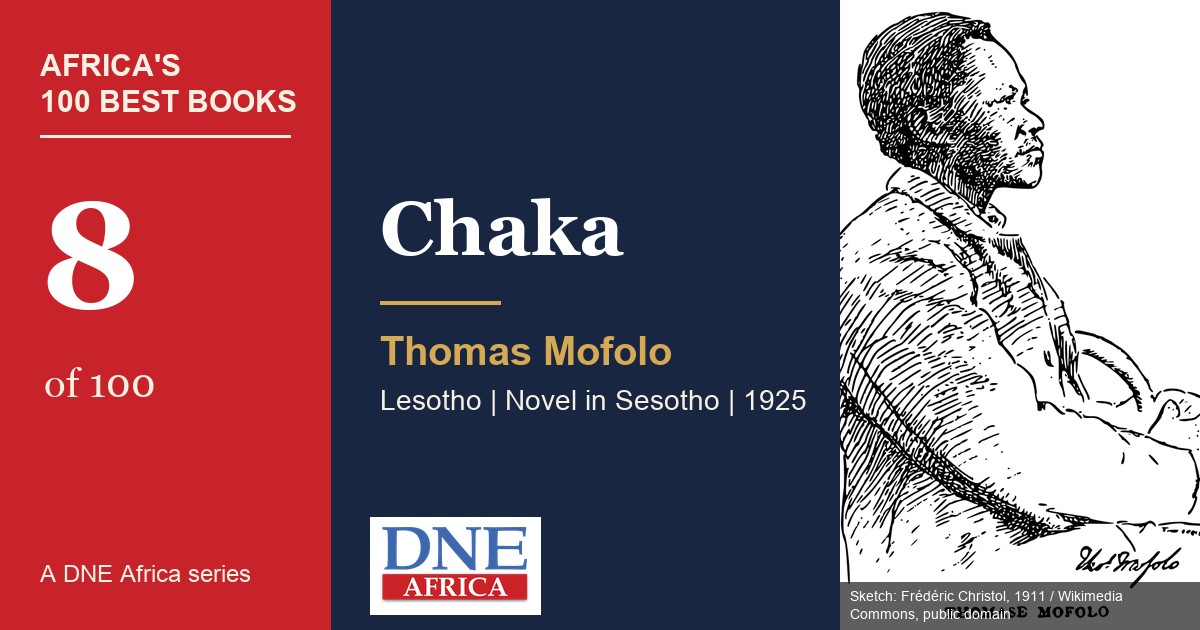

Chaka, the Sesotho novel by Lesotho’s Thomas Mofolo published at Morija in 1925, retells the life of the Zulu king Shaka as the story of a man who is offered a way back at every step and chooses his ruin.
Africa’s 100 Best Books, No. 8 of 100. See the full list and every article in the series.
The witch-doctor who guides Chaka to power, Isanusi, is easy to read as the villain, a tempter who bewitches a young man. Mofolo does not let him carry the blame. Before the decisive bargain Isanusi tells Chaka that the witch-doctors “do but give a man the medicine he desires, even if it brings his destruction” (chapter 16, p. 124), and then gives him nine months to change his mind. Chaka never does. Read closely, the book is less about magic than about a series of choices, each one freely made.
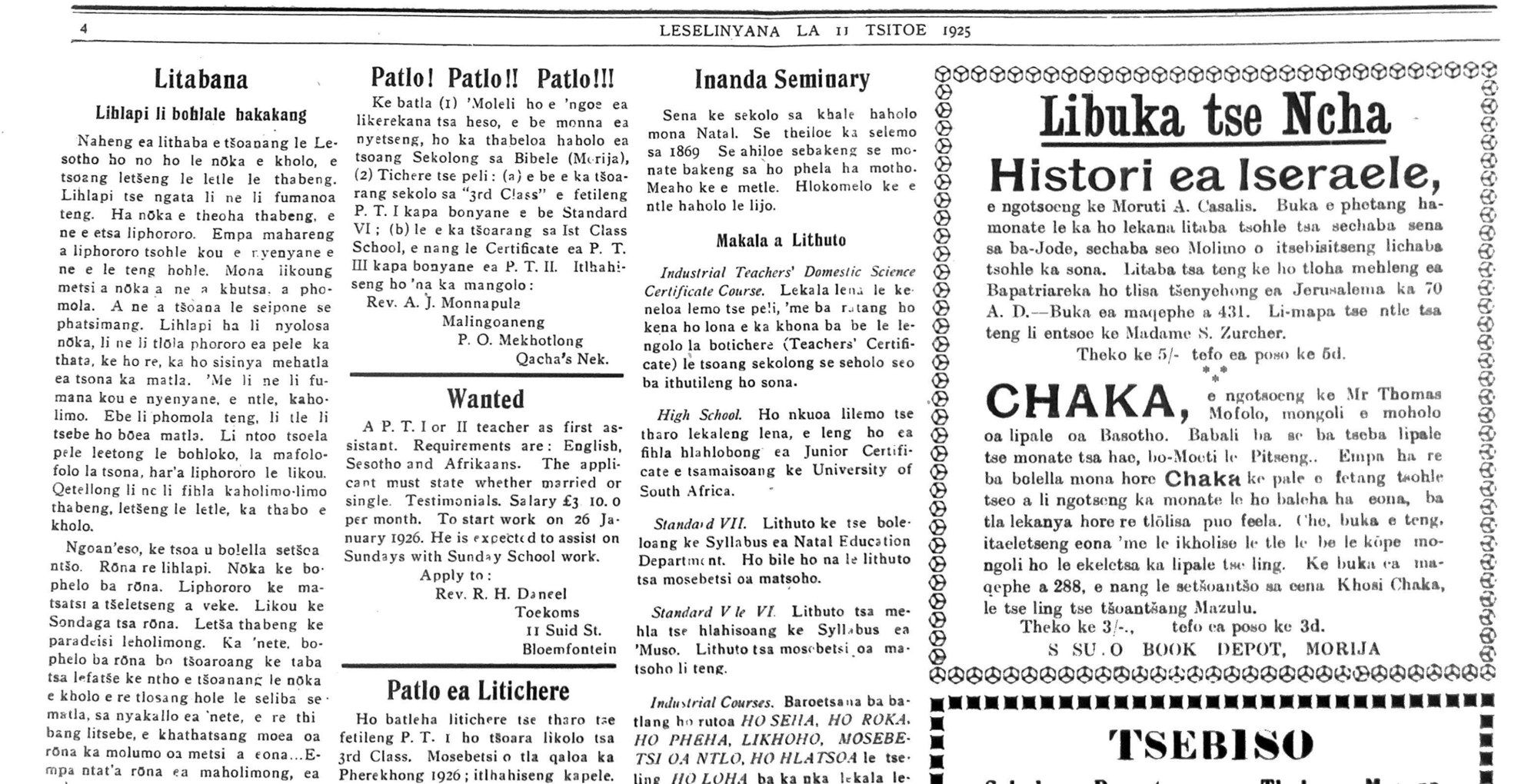
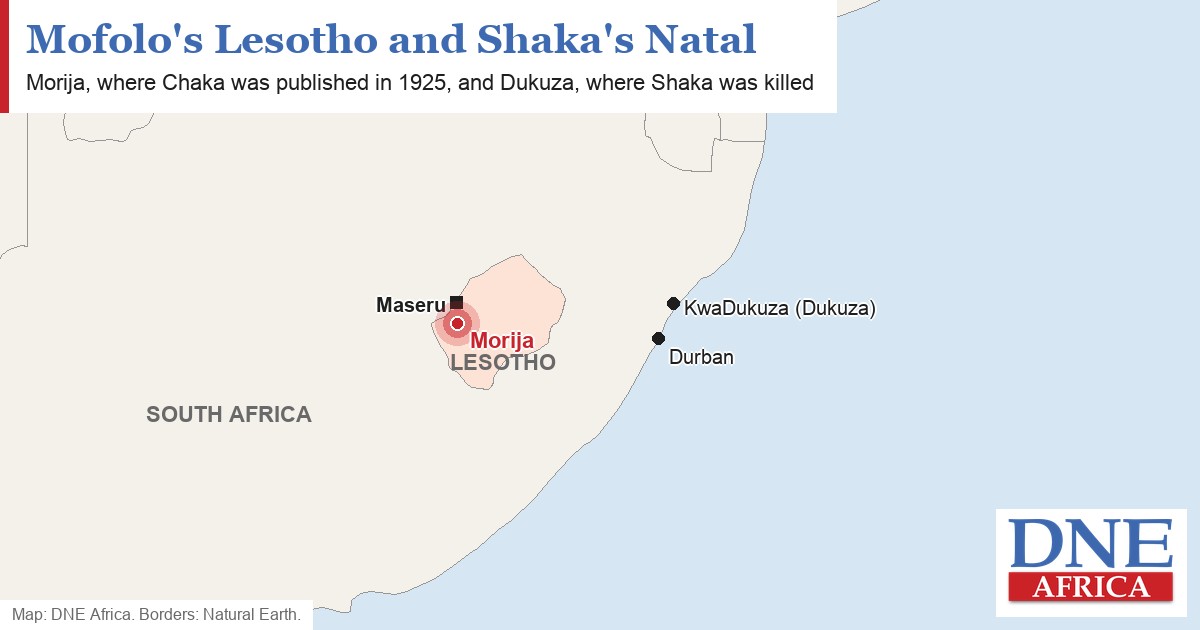
The standard account is short. Mofolo wrote the novel between about 1907 and 1910, submitted it to the Sesuto Book Depot at Morija, the press of the Paris Evangelical Missionary Society, and waited some 15 years to see it printed. F. H. Dutton’s English translation followed in 1931 and Daniel P. Kunene’s in 1981; there are versions in French, German, Afrikaans, Italian and other languages. The jury of Africa’s 100 best books of the 20th century, announced in Accra in 2002, placed it in its top 12, according to the African Studies Centre Leiden.
A note on method: no free copy of the Sesotho original was available. DNE Africa read Dutton’s 1931 translation (Oxford University Press for the International Institute of African Languages and Cultures) in the public-domain scan held by Duke University Libraries on the Internet Archive: Sir Henry Newbolt’s introduction and chapters 1 to 7, 16 to 18 and 23 to 26 in full. Page numbers refer to that edition.
Table of Contents
In this article
What is Chaka about?
The Zulu are still a small clan when Senzangakona, a young chief with no male heir, has a son by Nandi before their marriage is regular, and the boy is pushed aside once the senior wives bear heirs. He is bullied, made to sleep by the door where hyenas come at night, and driven from home after killing a lion and a hyena that grown men fled.
At a dark pool on the White Umfolosi a huge water snake winds round the boy, and a voice in the reeds promises that he will rule the nations, if he takes the right path. On the open veld he then meets Isanusi, a diviner who doctors him with medicines of chieftainship and gives him two servants, Ndlebe and Malunga. With their help Chaka serves the chief Dingiswayo, falls in love with Dingiswayo’s sister Noliwe, succeeds his father and builds the Zulu state: new regiments, a short stabbing spear in place of the thrown one, celibate soldiers, a capital at Umgungundlovu and a new royal greeting, Bayete.
Spoiler: the price of the widest kingdom is Noliwe’s life, taken by Chaka’s own hand in a scene Newbolt’s introduction calls unsurpassed “for tenderness and horror”. The last chapters follow a ruler who cannot stop killing, haunted by dreams of the gorge where he left his victims, until his half-brothers Dingana (Dingane) and Mhlangana stab him to death. Dying, he tells them that they will not rule for long, because the white man is coming.
Does Mofolo blame witchcraft or Chaka himself?
The text answers plainly. The turning point comes before Isanusi appears, in the bush after Chaka’s father orders his death. Reviewing his life, he concludes that “on earth man lives by might and not by right” (chapter 6, p. 42), and resolves to kill whomever he wishes. The diviner only finds a man who has already decided.
Isanusi then builds in exits. He describes the third medicine, the one for bloodshed, as evil and tells Chaka to choose; the narrator adds that Chaka chose death in place of life of his own free will. Before Noliwe’s death he asks twice more, warning that what follows cannot be undone. The servants, Newbolt notes, stand for faculties of Chaka’s own nature. In his last dreams Chaka sees himself undoing Dingiswayo’s attempts to make the tribe more humane.
That keeps the book from being a missionary tract. The narrator condemns the killings, but Mofolo gives the reasoning of power its full eloquence, lets Chaka build a working state, and ends with a Zulu lament for a lost empire: “Kingdoms wax and wane. Springs that once were mighty dry away” (chapter 26, p. 198). The verdict is moral; the sympathy is not withdrawn.
What do Sesotho scholars say about Chaka?
The most recent local reading comes from a centenary volume published as an open-access book by UJ Press in July 2026, Power, Resistance, Memory and Meaning: Centenary Reflections on Mofolo’s Chaka. Its introductory chapter, by Thabo Tšehloane of the University of Johannesburg, Elias Nyefolo Malete of the University of the Free State and Moeketsi Letuka of Walter Sisulu University, argues that the novel was written inside “missionary modernity”: the Morija press gave Mofolo literacy, print and an audience, and also limited what he could say. They read the gaps between Christian judgment and mythic excess as the marks of that pressure, not as flaws.
Mogomme Alpheus Masoga of the University of the Free State goes further in the same volume. He reads Chaka as an early critique of the cult of violent leadership, a story in which charisma, fear and national myth make brutality look like destiny, and which anticipates the strongman politics of many states after independence.
The older readings, notably the tragic epic, owe most to Daniel P. Kunene, the Sesotho-speaking scholar who retranslated the novel in 1981 and wrote Thomas Mofolo and the Emergence of Written Sesotho Prose (1989). He recorded that at least two chapters on Zulu history and custom were cut before publication. The volume’s preface, by the Kenyan-born writer Mukoma wa Ngugi of Cornell University, who studied in Kunene’s seminars, credits Kunene with showing that African literature was always broader and more multilingual than English-language syllabuses allowed.
Who was Thomas Mofolo?
Thomas Mokopu Mofolo was born in 1876 at Khojane in Basutoland, now Lesotho, to Christian parents, and died in 1948. An account by his schoolfellow, the Sesotho author Z. D. Mangoaela, printed in the 1931 edition, says he grew up in the Qomoqomong valley in Quthing district, qualified as a teacher at Morija in 1899, and then worked at the Morija Book Depot and printing works as a clerk and proofreader.
His first novel, Moeti oa Bochabela (The Traveller of the East), began as a serial in the Sesotho newspaper Leselinyana la Lesotho, from 1906 according to the 1931 introduction, and was followed by Pitseng, a modern love story. To research Chaka he made more than one journey into Natal to check dates and details, Newbolt writes. He published no more novels after Chaka; by 1931 he was recruiting labour for the gold mines and keeping a store in the mountains. He was a founding member of the Basutoland Progressive Association.
How does translation shape the book?
Most readers have met Chaka through English. Dutton, Basutoland’s Director of Education, translated it with W. R. Moule, an inspector of schools, and, Newbolt explains, deliberately borrowed the diction of the Authorised Version because the Bible had shaped Mofolo’s thought. The result reads like scripture. It also carries the colonial vocabulary of 1931, which the narrator’s own terms for the Nguni peoples make jarring today. Kunene’s 1981 translation gives English readers a second version.
The praise poems and songs come through even in the older English: the girls’ mocking song after the lion hunt and the long praise poem in chapter 17 show how much of the novel is built from oral forms. The narrator also explains Zulu customs to Basotho readers, a reminder that Mofolo was writing about a neighbouring people.
How is Chaka read at 100?
For much of its life the novel was easier to find in English, Afrikaans or Italian than in Sesotho. Bridge Books, an independent Johannesburg bookshop and publisher, marked the 2025 centenary with a new Sesotho edition. Its founders wrote in June 2026 that they photographed a copy page by page in the special collections of the University of Pretoria library, because the old missionary spelling defeated text-recognition software, and spent three years preparing the book.
The UJ Press volume adds ten essays, including Masoga’s and one by Soyiso Khetoa of the University of the Witwatersrand on the novel’s relevance to South Africa’s political and social debates. Its editors present it as the first meeting of two traditions that had ignored each other: readers of Mofolo in translation, and Sesotho scholars working in the original.
Chaka is uneven: the asides slow it, and the narrator often says what the scenes already show. But its central design, a ruler who is given every chance to turn back and refuses, is as clear a study of power as anything in African fiction, and its final chapters, built from dreams and guilt, are among the most frightening in the series so far. It pairs well with Things Fall Apart, another story of a strong man undone, and Sleepwalking Land, which also refuses to blame violence on outsiders alone.
Questions for discussion
- Chaka decides that “man lives by might and not by right” before he meets Isanusi. Does that make the witch-doctor a cause of his ruin, or only a witness to it?
- Isanusi offers Chaka several chances to turn back. Why do you think Mofolo built the story this way?
- Mofolo was a Christian writing for a mission press. Where do you hear the narrator’s judgment, and where does the novel seem to admire Chaka?
- Why might Mofolo have made Noliwe the price of power?
- Mogomme Alpheus Masoga reads the novel as a warning about strongman rule after independence. Is that a fair reading of a book written in 1910?
Read next in the series
- Things Fall Apart by Chinua Achebe (Nigeria), No. 1: a strong man, a changing world and a fall.
- The Wrath of the Ancestors (Ingqumbo yeminyanya) by A. C. Jordan (South Africa), No. 46: a classic novel in isiXhosa about a chief torn between custom and mission education (coming soon).
- Amal’eZulu by B. W. Vilakazi (South Africa), No. 76: Zulu poetry that returns to the history Mofolo told in prose (coming soon).
More from Africa’s 100 Best Books
- Previous, No. 7: Sleepwalking Land by Mia Couto (Mozambique)
- Next, No. 9: The African Origin of Civilization by Cheikh Anta Diop (Senegal) (coming next in the series)
- All 100 books in the series
FAQ
Who wrote Chaka?
Thomas Mofolo (1876-1948), a writer from Lesotho, then the British colony of Basutoland. He wrote it in Sesotho, and the Morija Sesuto Book Depot published it in 1925.
Is Chaka a true story?
It is a novel based on the life of Shaka, the Zulu king killed in 1828, with invented characters such as the diviner Isanusi.
Who translated Chaka into English?
F. H. Dutton, with W. R. Moule, in 1931, published by Oxford University Press for the International Institute of African Languages and Cultures. Daniel P. Kunene published a new translation with Heinemann in 1981.
Why was Chaka published so late?
Mofolo finished it around 1910, but the missionaries who ran the Morija press held it back for some 15 years, reportedly because he did not condemn traditional beliefs. Kunene recorded that at least two chapters were cut.
Is Chaka available in Sesotho?
Yes. Bridge Books in Johannesburg published a Sesotho centenary edition in 2025, prepared from a copy held by the University of Pretoria library.


