

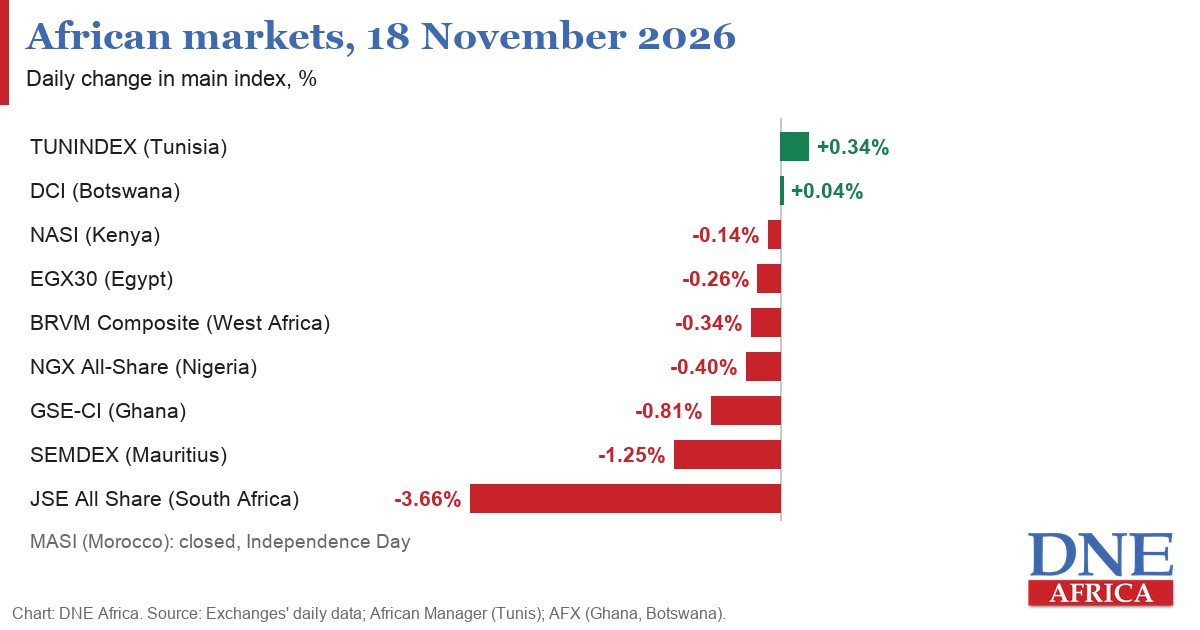
African stock markets fell on Wednesday 18 November as Johannesburg’s All Share index dropped 3.66 per cent, its steepest fall among the continent’s ten largest exchanges, led by gold and platinum miners.
Seven of the nine African stock markets that traded closed lower, with Mauritius down 1.25 per cent and Ghana down 0.81 per cent. Only Tunis and Botswana rose. Casablanca was closed for Morocco’s Independence Day, a public holiday.
Why did Johannesburg shares fall so sharply?
The JSE All Share closed at 106,572, down about 4,044 points from Tuesday’s 110,616, and the Top 40 index of the largest companies lost 3.91 per cent. JSE data showed decliners outnumbering gainers by about 1,000 to 289. Precious-metal producers led the losses: Sibanye Stillwater fell 7.22 per cent, Harmony Gold 7.18 per cent, AngloGold Ashanti 6.83 per cent and Northam Platinum 6.47 per cent. Sappi, the paper maker, lost 10.19 per cent.
The fall came as gold dropped below $3,800 an ounce for the first time since September 2025, Asharq Business reported. Spot gold was down 2.3 per cent at $3,762.11 in London trading after Alberto Musalem, president of the Federal Reserve Bank of St Louis, said the US economy would probably need “several interest rate increases” before the spring. Platinum fell 4.91 per cent and silver more than 5 per cent, according to the outlet’s market data.
The selling spread beyond mining. Absa fell 6.1 per cent, Capitec 6.03 per cent and Naspers 5.8 per cent, while Anglo American and Glencore each lost about 6 per cent. Bid Corporation, up 2.58 per cent, and Richemont, up 1.94 per cent, were among the few large gainers.
How did Egypt, Nigeria and West Africa trade?
The Egyptian Exchange said the EGX30 closed at 51,544.82, down 136.80 points or 0.26 per cent, leaving it up 23.23 per cent so far this year. Decliners outnumbered gainers by 119 to 78. Shares worth about LE6.67bn ($124mn) traded. Mena Touristic and Real Estate Investment rose 14.37 per cent, while Alexandria New Medical Center fell 10.21 per cent.
In Lagos, the Nigerian Exchange All-Share index fell 989 points, or 0.40 per cent, to 248,329.65. About 451mn shares worth N26.61bn ($19.7mn) changed hands. Aradel Holdings, the oil and gas producer, fell by the daily limit of 10 per cent to N1,166.40, according to market data compiled by AFX.
On the BRVM, the regional exchange of eight West African states, the Composite index slipped 0.34 per cent to 500.95, extending Tuesday’s 1.98 per cent fall. Unilever Côte d’Ivoire fell 7.49 per cent, while Sodeci gained 6.61 per cent. Turnover was CFA1.38bn ($2.3mn).
Which African stock markets rose?
Tunis’s TUNINDEX, the best performer among African stock markets on the day, rose 0.34 per cent to 19,170.85 on volume of 28.4mn dinars, most of it in brewer SFBT, which gained 1.4 per cent, African Manager reported, citing broker Tunisie Valeurs. State-owned lender STB rose 5.9 per cent. Botswana’s Domestic Company Index added 0.04 per cent to 11,354.94, AFX data showed. The Botswana Stock Exchange reported total turnover of BWP40.6mn, most of it in a government bond.
Losses on other African stock markets were smaller than in Johannesburg. The Stock Exchange of Mauritius SEMDEX fell to 2,290.50 from 2,319.42, as MCB Group, the island’s largest bank, lost 3.49 per cent. Ghana’s composite index fell 111.90 points to 13,775.20, AFX data showed, with GCB Bank down 2.44 per cent and GOIL up 10 per cent; the Ghana Stock Exchange had not published its daily summary by the time of writing. The Nairobi Securities Exchange All Share index lost 0.33 points to 240.57 on turnover of KSh712.9mn ($5.5mn).
African stock markets at the close
| Exchange | Index | Close | Change % | Turnover |
|---|---|---|---|---|
| Johannesburg | JSE All Share | 106,572 | -3.66 | n/a |
| Casablanca | MASI | closed | closed | closed |
| Egypt | EGX30 | 51,544.82 | -0.26 | LE6.67bn ($124mn) |
| Nigeria | NGX All-Share | 248,329.65 | -0.40 | N26.61bn ($19.7mn) |
| BRVM | BRVM Composite | 500.95 | -0.34 | CFA1.38bn ($2.3mn) |
| Nairobi | NASI | 240.57 | -0.14 | KSh712.9mn ($5.5mn) |
| Mauritius | SEMDEX | 2,290.50 | -1.25 | Rs17.8mn ($0.4mn) |
| Ghana | GSE-CI | 13,775.20 | -0.81 | n/a |
| Botswana | DCI | 11,354.94 | +0.04 | BWP40.6mn incl. bonds ($2.8mn) |
| Tunis | TUNINDEX | 19,170.85 | +0.34 | TND28.4mn ($9.4mn) |
Turnover is in local currency as published by each exchange or the source named above, with dollar figures at approximate exchange rates for 18 November; “n/a” means no figure was available. For the previous session, see Tuesday’s African stock markets report, and for the push to link the continent’s exchanges, our interview with the AFRINEX chief executive.
FAQ
How did African stock markets perform on 18 November 2026?
Seven of the nine markets that traded fell. Johannesburg’s All Share lost 3.66 per cent and the SEMDEX in Mauritius 1.25 per cent, while Tunis rose 0.34 per cent and Botswana 0.04 per cent.
Why did the JSE fall on Wednesday?
Gold and platinum miners led the decline as gold fell below $3,800 an ounce for the first time since September 2025, Asharq Business reported. Banks and Naspers also fell sharply.
Was the Casablanca Stock Exchange open?
No. The Casablanca exchange was closed on 18 November for Morocco’s Independence Day, a public holiday. Its MASI index last closed at 17,234.80 on Tuesday.
Which African stock markets rose?
Only Tunis and Botswana. The TUNINDEX rose 0.34 per cent to 19,170.85 and Botswana’s Domestic Company Index 0.04 per cent to 11,354.94.


