
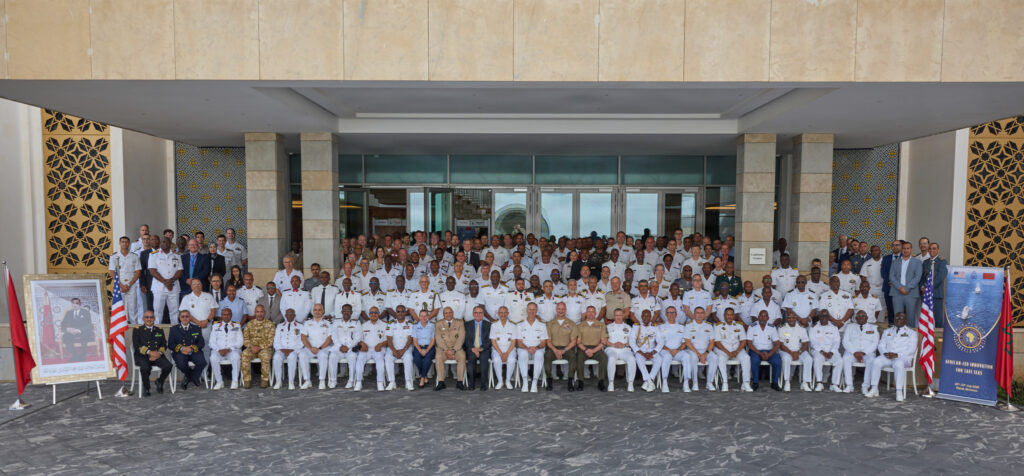

African naval leaders have called for deeper regional cooperation, greater intelligence sharing and wider use of emerging technologies to strengthen maritime security and unlock the economic potential of Africa’s seas, as the fourth African Maritime Forces Summit concluded in Morocco.
The five-day summit, held in Rabat, brought together representatives from more than 40 African countries and nearly 20 partner nations to discuss common maritime security challenges, including illegal fishing, piracy, terrorism, smuggling and transnational organized crime.
Hosted by the Royal Moroccan Armed Forces in partnership with the U.S. Naval Forces Europe and Africa and the U.S. Marine Corps Forces Europe, the summit focused on strengthening collaboration to safeguard Africa’s maritime domain.
“Maritime security represents a shared responsibility and a strategic priority that can only be achieved through sustained dialogue, mutual trust, coordinated action and effective partnerships among all stakeholders,” Rear Adm. Mohamed Tahin, Inspector of the Royal Moroccan Navy, said during the opening session.
He said Morocco remains committed to promoting African cooperation, enhancing regional stability and supporting collective efforts to improve maritime peace and security across the continent.
Beyond addressing security threats, participants emphasized the vast economic opportunities offered by Africa’s maritime sector, noting that stronger governance and regional coordination would be key to unlocking sustainable growth through the blue economy.
The summit featured simulation exercises focused on illegal, unreported and unregulated (IUU) fishing, alongside policy discussions on maritime governance and regional security cooperation.
Speaking during the summit, Commander of the Somali Navy and Coastal Defense, Brig. Gen. Abdulwahab Abdullahi Omar, said Somalia had made significant progress in combating piracy, illegal fishing and maritime terrorism through cooperation with international partners, according to the Somali National News Agency.
The discussions also highlighted growing security concerns in the Red Sea and the Bab el-Mandeb Strait, where attacks on commercial shipping and illicit arms trafficking continue to threaten one of the world’s busiest maritime trade routes.
Tahin also announced plans to establish the Africa Multidomain Training and Experimentation Center (AMTEC), a joint initiative between Morocco and the U.S. Africa Command (AFRICOM).
The proposed center will include a military training facility, a drone academy and a hub for developing and testing emerging technologies, including artificial intelligence, satellite systems and advanced data-sharing platforms to strengthen African maritime operations.
The summit also hosted the Africa Senior Enlisted Leaders Conference, where senior non-commissioned officers discussed professional military education, regional cooperation and modernization of naval forces across the continent.
In turn, Ghana’s Flag Officer Commanding of the Western Naval Command, Commodore Samuel Ayelazono, said the summit underscored the importance of intelligence sharing, inter-agency coordination, regional partnerships and technological innovation in addressing evolving maritime security challenges.
Africa’s maritime domain spans more than 30,000 kilometres of coastline and supports critical shipping lanes, fisheries and offshore energy resources that are central to the continent’s economic development. However, illegal fishing, piracy, trafficking and maritime terrorism continue to cost African economies billions of dollars annually, prompting growing efforts by governments and regional organizations to strengthen naval cooperation and maritime governance.


