

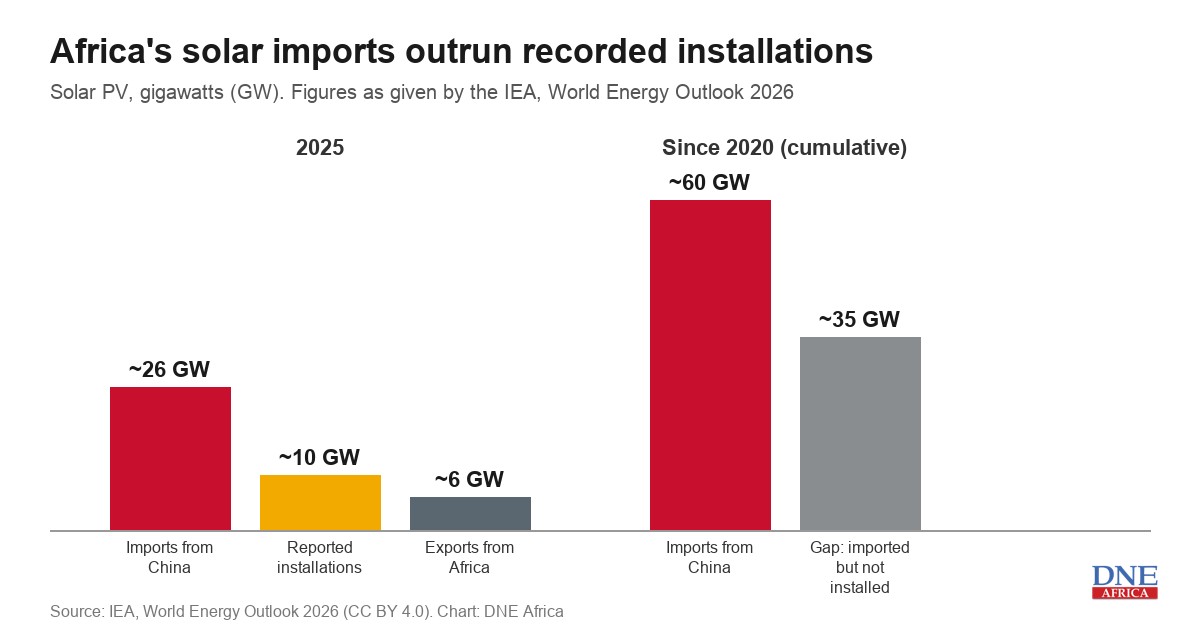
Africa solar imports from China have reached about 60 gigawatts (GW) since 2020, but less than half of that capacity appears in official installation records, the International Energy Agency (IEA) said on 19 November.
The gap of about 35GW matters because governments, utilities and lenders plan grids, tariffs and access programmes on recorded capacity. In 2025 alone, Africa solar imports reached around 26GW while reported installations totalled about 10GW, according to the IEA’s World Energy Outlook 2026.
How large is the gap in Africa solar imports?
Africa solar imports from China have grown 28-fold since 2017, the IEA said, citing Chinese customs data. South Africa, Nigeria, Algeria, Kenya and Senegal are the destinations its import figures show separately. The agency set out several possible explanations for the mismatch: equipment held in inventories for long periods, installations that official statistics fail to capture, and re-exports to other markets.
About 15% of Africa solar imports are cells rather than finished modules, the report said, and some of these may supply the continent’s emerging manufacturing industry. PV module production capacity was minimal in 2025, but Egypt and Ethiopia have since emerged as the leading producers, while Nigeria has ambitious expansion plans, according to the IEA.
What did satellite data show?
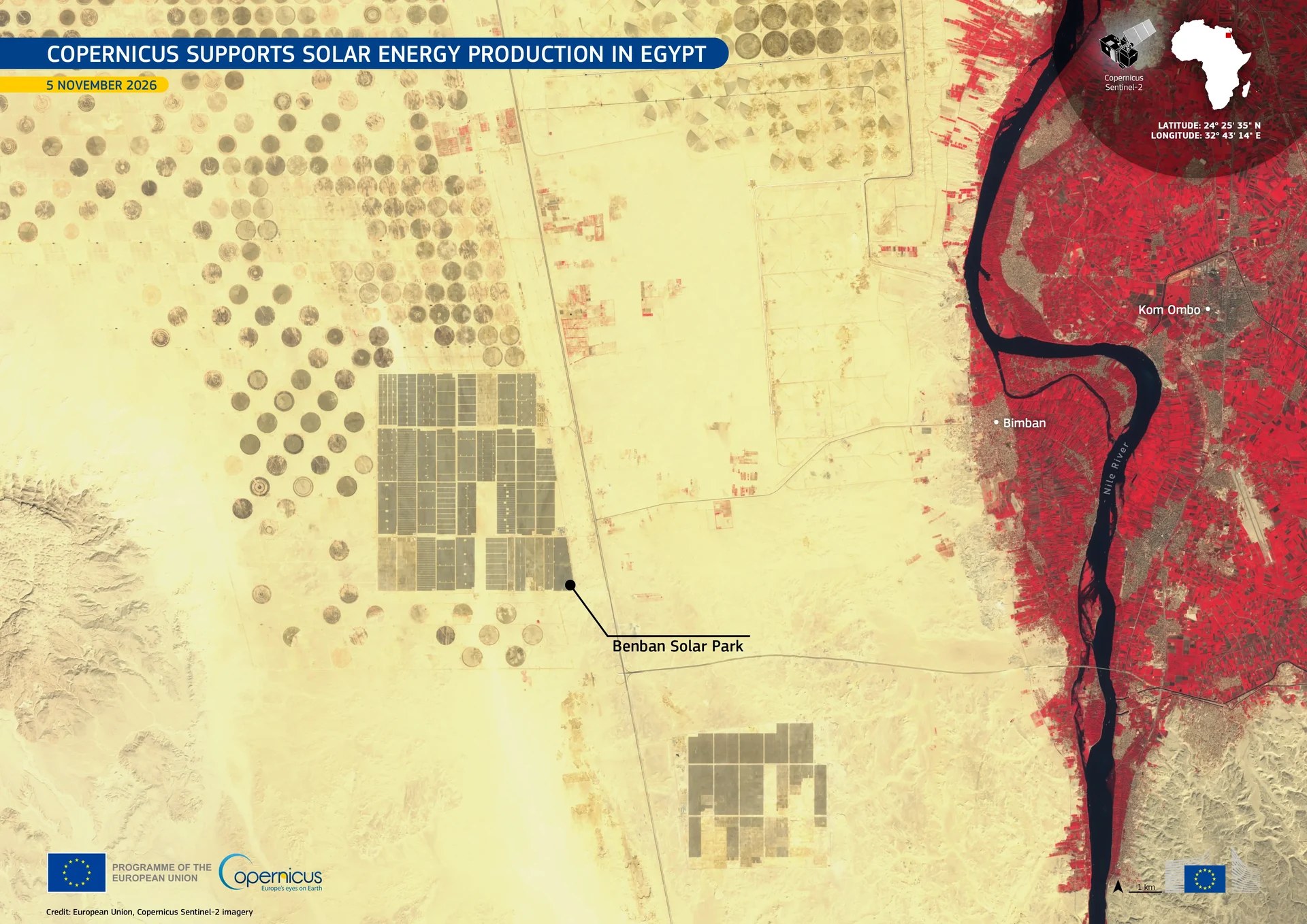
The IEA said new tools combining satellite imagery and remote sensing found over 50% more utility-scale solar capacity across Africa than is officially recorded. Even after correcting for that undercount, the capacity detected from space still leaves a gap of almost 30GW against Africa solar imports.
The agency also carried out a city-level study of rooftop solar in Johannesburg. It found a fivefold increase between 2020 and 2025, taking estimated rooftop capacity to more than 400 megawatts, roughly 60% higher than the small-scale embedded generation capacity in official records. Scaled up to other major African cities, the IEA said, that installed base is still too small to explain the volume of imports into South Africa and other countries.
Are African countries re-exporting solar panels?
Africa’s exports of solar panels were negligible until 2024 but reached almost 6GW in 2025, equivalent to around 22% of imported volumes, the IEA said. The United States accounted for about 70% of the value of these exports, with India taking most of the rest. Preliminary 2026 data suggest export volumes are still rising sharply, and these re-exports of Africa solar imports “may well explain a further part of the gap”, the report said.
The report does not name the exporting countries or say whether the trade involves panels assembled in Africa or goods passing through.
Why does the solar boom matter for energy access?
Africa is home to 60% of the world’s best solar resources but only 1% of global installed solar PV capacity, according to the IEA. Installed capacity rose from 2GW in 2015 to 39GW in 2025, and small systems drove most of last year’s growth: Algeria, Kenya, Nigeria and Senegal each added over 1GW in 2025.
The war in the Middle East has strengthened that trend. Diesel prices hit record levels this year after disruption to shipping through the Strait of Hormuz, raising the cost of running generators, and trade data show a rapid increase in imports of panels and batteries to African countries hit by the crisis, the IEA said. DNE Africa has reported on how the Hormuz disruption is affecting African economies. Solar home systems now cost 50% less than small diesel and petrol generators on a levelised cost basis, the agency said.
The IEA cautioned that much of the growth serves people who already have power, as backup or supplementary supply, rather than the roughly 720 million people worldwide who still lack electricity, 90% of them in sub-Saharan Africa. Uptake of distributed solar “appears skewed towards wealthier communities”, it said. Regional programmes such as ECOWAS’s RAISE project aim at new connections instead.
What happens next?
In the IEA’s Stated Policies Scenario, Africa’s installed solar capacity rises sixfold over the next decade, making solar the largest source of new capacity, though still less than 20% of electricity generation by 2035. The agency said grids, storage and grid codes have not kept pace with deployment in some regions. Better tracking of Africa solar imports and installations will be needed to plan for that growth.
FAQ
How much solar capacity has Africa imported?
About 60GW of solar PV from China since 2020, including around 26GW in 2025, according to the IEA’s World Energy Outlook 2026.
Why don’t Africa solar imports match installations?
The IEA points to equipment held in inventories, installations missing from official statistics, re-exports and imports of cells for local manufacturing. Satellite data closed part of the gap, but almost 30GW remains unexplained.
Which countries make solar panels in Africa?
Egypt and Ethiopia have emerged as the leading module producers since 2025, and Nigeria has expansion plans, the IEA said.
Where do Africa’s solar panel exports go?
Mostly to the United States, which took about 70% of the value of exports in 2025, with India taking most of the remainder.


