

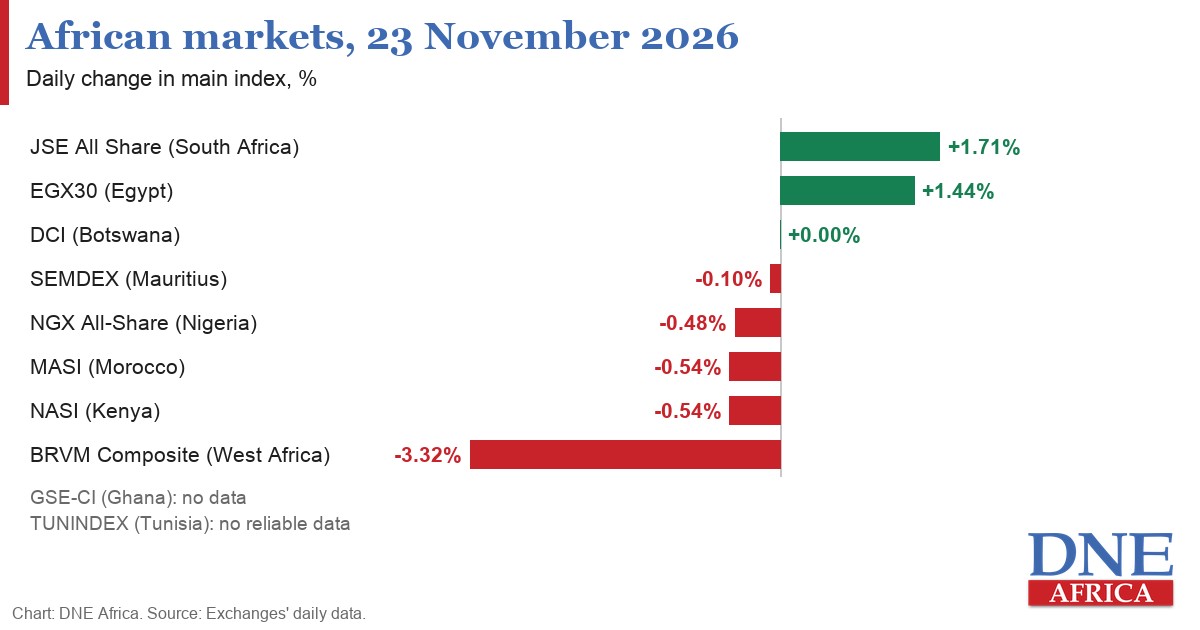
African stock markets split on Monday 23 November as the BRVM Composite index of eight West African states fell 3.32 per cent, while Johannesburg’s All Share rose 1.71 per cent and Egypt’s EGX30 gained 1.44 per cent.
The BRVM’s fall, its fifth consecutive decline, was the largest move among the eight African stock markets that published closing data. Johannesburg recovered about 30 per cent of the ground it lost in the three sessions to Friday, helped by banks, miners and Naspers. In currency markets, the Egyptian pound and the Nigerian naira weakened against the dollar, gold jumped 4.5 per cent and Brent crude fell 3.7 per cent.
Why did the BRVM lead African stock markets lower?
The Composite index of the BRVM, the regional exchange based in Abidjan, lost 16.35 points to 476.54, and the BRVM-30 fell 3.30 per cent to 230.86, according to the exchange’s data. Only one listed share rose: Société Ivoirienne de Banque gained 1.16 per cent. Coris Bank International Burkina fell 7.49 per cent, Bank of Africa Benin 7.48 per cent, NEI-CEDA Côte d’Ivoire 7.37 per cent, BIIC Benin 7.33 per cent and Nestlé Côte d’Ivoire 7.03 per cent.
Turnover was thin at CFA1.44bn ($2.4mn), less than a third of Friday’s CFA4.61bn. The exchange did not publish a reason for the decline.
How did Johannesburg and Cairo rebound?
The JSE, the largest of the African stock markets, saw its All Share index close at 106,428, up 1,789 points from Friday’s 104,639, and the Top 40 rose 1.9 per cent to 98,669, according to JSE data. The All Property index gained 1.12 per cent. Absa rose 4.09 per cent, African Rainbow Minerals 4.44 per cent, Valterra Platinum 3.89 per cent, Impala Platinum 3.58 per cent and Naspers 3.42 per cent. Momentum Group fell 8.01 per cent, Astral Foods 5.43 per cent and Tharisa 5.02 per cent.
The JSE also welcomed the listing of Coca-Cola HBC on Monday, the exchange said. US shares began recovering from Friday’s sell-off driven by concerns over trades linked to artificial intelligence, Asharq Business reported.
In Cairo, the Egyptian Exchange EGX30 rose 722.17 points, or 1.44 per cent, to 50,711.96, the second-best gain among African stock markets on the day, taking its rise since the start of the year to 21.24 per cent. Gainers far outnumbered decliners, 196 to 10, according to EGX data, and shares worth about LE7.06bn ($130mn) traded across rising, falling and unchanged stocks.
How did Lagos, Nairobi and Casablanca trade?
Other African stock markets eased. The Nigerian Exchange All-Share index fell 1,181.84 points, or 0.48 per cent, to 246,478.9. About 441.1mn shares worth N15.50bn ($11.1mn) changed hands in 38,902 deals, according to the exchange’s market snapshot.
Among East African stock markets, Nairobi’s All Share index lost 1.28 points, or 0.54 per cent, to 236.58, and the NSE 20 fell 11.80 points to 4,128.44, the Nairobi Securities Exchange said. Equity turnover rose to KSh765.7mn ($5.9mn) from KSh601.4mn on Friday.
The Casablanca Stock Exchange MASI fell 91.84 points, or 0.54 per cent, to 16,882.60, on turnover of 245.5mn dirhams ($24.4mn). Attijariwafa Bank was the most traded stock. Jet Energy rose 5.27 per cent, Minière Touissit 4.83 per cent and Managem 3.75 per cent, while Wafa Assurance fell 7.82 per cent.
The Stock Exchange of Mauritius SEMDEX slipped 0.10 per cent to 2,265.68 on trading worth Rs31.7mn ($0.7mn). In Gaborone, no domestic share changed price, leaving the Domestic Company Index unchanged at 11,358.82; turnover on the Botswana Stock Exchange was BWP864,291 ($60,000). The Ghana Stock Exchange had not published its 23 November summary by the time of writing, and no reliable close was available for Tunis’s TUNINDEX.
African stock markets at the close
| Exchange | Index | Close | Change % | Turnover |
|---|---|---|---|---|
| Johannesburg | JSE All Share | 106,428 | +1.71 | n/a |
| Casablanca | MASI | 16,882.60 | -0.54 | MAD245.5mn ($24.4mn) |
| Egypt | EGX30 | 50,711.96 | +1.44 | LE7.06bn ($130mn) |
| Nigeria | NGX All-Share | 246,478.9 | -0.48 | N15.50bn ($11.1mn) |
| BRVM | BRVM Composite | 476.54 | -3.32 | CFA1.44bn ($2.4mn) |
| Nairobi | NASI | 236.58 | -0.54 | KSh765.7mn ($5.9mn) |
| Mauritius | SEMDEX | 2,265.68 | -0.10 | Rs31.7mn ($0.7mn) |
| Ghana | GSE-CI | no data | no data | no data |
| Botswana | DCI | 11,358.82 | 0.00 | BWP0.86mn ($0.06mn) |
| Tunis | TUNINDEX | no data | no data | no data |
Turnover on African stock markets is as published by each exchange, with dollar figures at approximate rates for 23 November; “n/a” means no confirmed figure. For the previous session, see Friday’s African stock markets report, when Johannesburg fell 1.49 per cent, and Thursday’s report on the BRVM.
How did African currencies and commodities move?
Alongside African stock markets, currencies were mixed. The Central Bank of Egypt’s official rate was LE54.31 buying and LE54.44 selling per dollar, and the market rate rose 1.02 per cent to 54.36, according to Asharq Business. The naira weakened 0.31 per cent to N1,394.01 per dollar on the official market rate published by the Central Bank of Nigeria, from N1,355.80 on 17 November. The rand strengthened 0.79 per cent.
Brent crude fell 3.72 per cent to $89.13 a barrel as investors unwound hedges after signs that Washington was giving diplomacy with Iran more time, Asharq Business reported; Brent has fallen by about a fifth this month. The International Energy Agency expects a supply surplus of about 2mn barrels a day this quarter, the outlet added. Gold rose 4.54 per cent and copper 3.19 per cent, prices that matter to exporters such as Ghana, South Africa and Zambia.
| Currency or commodity | Rate or price | Change | Source |
|---|---|---|---|
| Egyptian pound | 54.31 buy / 54.44 sell per $ | market rate +1.02% (54.36) | CBE official; Asharq Business |
| Nigerian naira | 1,394.01 per $ | +0.31% (weaker) | CBN NFEM official rate |
| South African rand | 17.44 per $ | -0.79% (stronger) | Asharq Business, interbank |
| Kenyan shilling | 129.98 per $ | n/a | CBK daily rate |
| Ghanaian cedi | 11.83 per $ | +0.13% (weaker) | Asharq Business, interbank |
| Moroccan dirham | 10.04 per $ | +0.54% (weaker) | Asharq Business, interbank |
| Ethiopian birr | 161.35 per $ | n/a | NBE indicative rate |
| Tunisian dinar | 3.08 per $ | +0.24% (weaker) | Asharq Business, interbank |
| CFA franc | 655.957 per euro (fixed peg) | no data per $ | BCEAO peg |
| Brent crude | $89.13 a barrel | -3.72% | Asharq Business |
| Gold (Comex) | $3,704.90 an ounce | +4.54% | Asharq Business |
| Cocoa (ICE) | $5,313 a tonne | +0.82% | Asharq Business |
| Arabica coffee | 267.05 cents a lb | -0.54% | Asharq Business |
| Wheat (CBOT) | 589.50 cents a bushel | -0.42% | Asharq Business |
| Copper (Comex) | 575.05 cents a lb | +3.19% | Asharq Business |
Commodity prices are as quoted by Asharq Business during the afternoon of 23 November, before US markets closed. The Kenyan and Ethiopian rates are those published by the Central Bank of Kenya and the National Bank of Ethiopia.
FAQ
How did African stock markets perform on 23 November 2026?
Results were mixed. Johannesburg rose 1.71 per cent and Egypt’s EGX30 1.44 per cent, while the BRVM fell 3.32 per cent and Lagos, Nairobi, Casablanca and Mauritius ended slightly lower.
Why did Johannesburg shares rise?
Banks, platinum miners and Naspers led the gains, with Absa, African Rainbow Minerals and Valterra Platinum each up close to 4 per cent or more. The index had fallen about 5.4 per cent over the previous three sessions.
How did African currencies move against the dollar?
The Egyptian pound weakened about 1 per cent on the market rate and the naira 0.31 per cent on the Central Bank of Nigeria’s official rate, while the South African rand strengthened 0.79 per cent.
Why are there no figures for Ghana and Tunis in this African stock markets report?
The Ghana Stock Exchange had not published its daily summary at the time of writing, and no reliable closing value for the TUNINDEX was available. DNE Africa does not estimate figures.


