
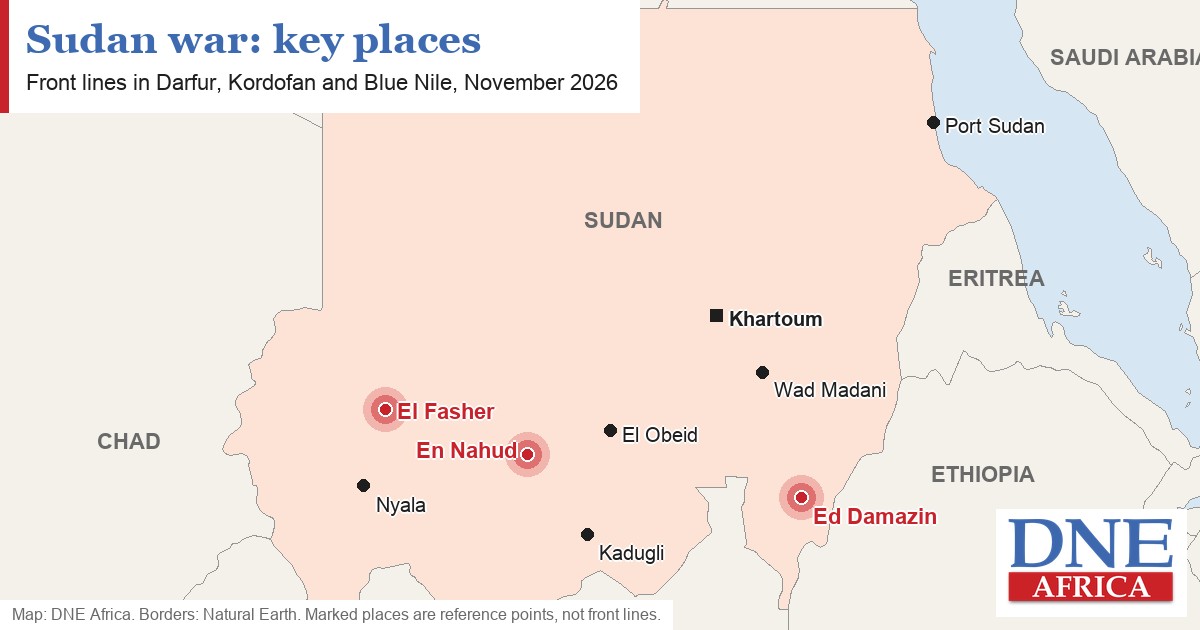

The Sudan war, fought since April 2023 between Sudan’s army and the Rapid Support Forces (RSF) militia, has displaced about 8.6mn people inside the country and is now centred on Kordofan, Darfur and Blue Nile.
Last updated: 23 November 2026
The Sudan war matters beyond the country’s borders. It has produced one of the world’s largest displacement and hunger emergencies, drawn in neighbours and Gulf states, and in November 2026 raised fears of a clash with Ethiopia after Sudan’s army accused it of allowing drone launches from its territory, which Ethiopia denies.
In brief
- Sudan’s army is advancing in West and North Kordofan and was within about 60km of En Nahud in mid-November, according to ACLED data cited by The National.
- The RSF militia holds most of Darfur, including El Fasher since October 2025, and runs a self-declared parallel administration from Nyala.
- The UN Human Rights Office counted at least 2,230 civilians killed from January to October 2026, more than 1,630 of them by drones.
- Sudan’s government rules out talks unless the RSF militia disarms; repeated truce plans from the US, Saudi Arabia, the UAE and Egypt have not been put into effect.
What is happening in the Sudan war now?
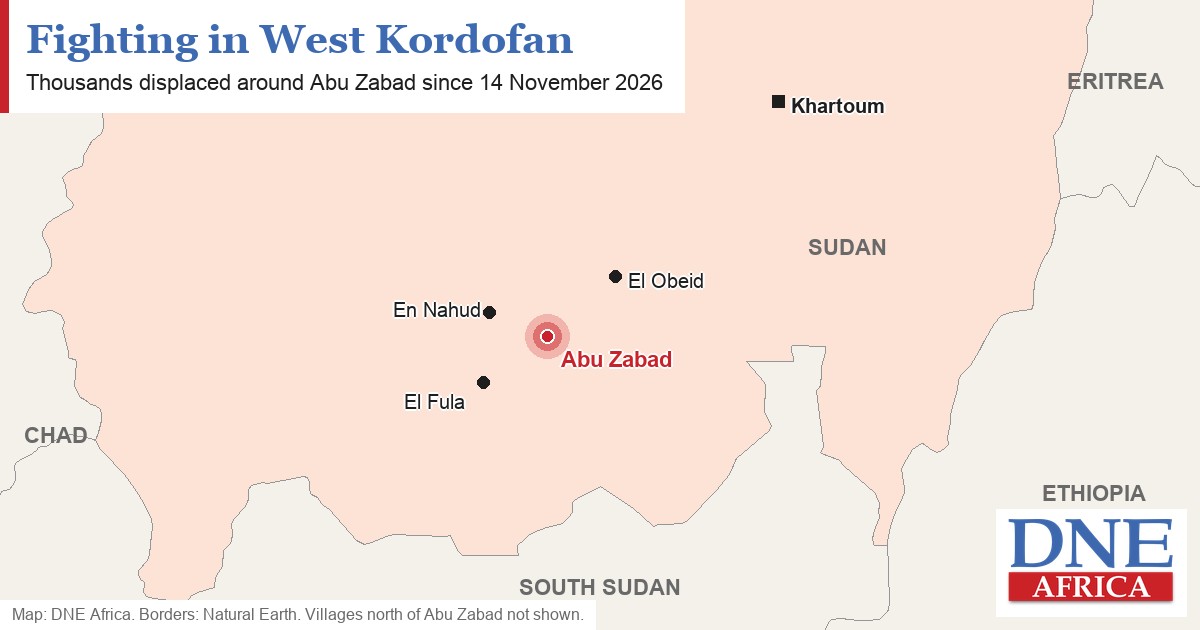
The main front of the Sudan war has moved west, to Kordofan. Since early November Sudan’s army and allied forces have retaken more than 30 villages and towns in North and West Kordofan, Ali Mahmoud Ali, a Sudan researcher at the conflict monitor ACLED, told The National. The army captured Al Khuway and by 17 November was about 60km from En Nahud, the RSF militia’s main base in West Kordofan.
The RSF militia still holds most of West Kordofan, between 85% and 90% of the state according to a territorial control analysis by Sudans Post. Army sources told the Egyptian daily Youm7, in Arabic, that the army was preparing to “open the Darfur fronts”. Fighting around Abu Zabad has displaced thousands in West Kordofan.
In the south-east, the RSF militia says it has taken several areas in Bau locality of Blue Nile state, claims the army has not confirmed, while the army has sent reinforcements toward Ed Damazin. Long-range drones are now a feature of the Sudan war on both sides. On 22 November drones damaged homes in Khartoum and UN premises while staff were inside, OCHA said. An army source blamed launches from Ethiopia, which denies the accusation, France 24 reported.
Who are the parties and what does each say it wants?
Sudan’s army and government. The Sudanese Armed Forces are led by General Abdel Fattah al-Burhan, who chairs the Transitional Sovereignty Council, Sudan’s ruling body. The government, based in Port Sudan, is headed by Prime Minister Kamil Idris, appointed in May 2025. It describes the RSF as a rebel militia. In October 2026 Burhan ruled out negotiations and said the army would fight until it defeated the RSF across Darfur, Kordofan and Blue Nile, according to reports of his remarks. He has said there can be no truce unless the RSF lays down its arms and leaves the areas it holds.
The RSF militia. The Rapid Support Forces grew out of militias the government used in Darfur in the 2000s and were made a formal force in 2013. They are commanded by Mohamed Hamdan Dagalo, known as Hemedti. In July 2025 the RSF and its allies, under a coalition called Tasis, announced a parallel “government of peace and unity” based in Nyala, with Hemedti chairing a 15-member presidential council, Al Jazeera reported. The coalition says its aim is a “transitional peace” and services and security for the areas it holds. On 18 November Hemedti appointed six governors for Darfur and West Kordofan, Sudans Post reported. The RSF has said it accepts the humanitarian truce part of the US-led plan.
Allies. In the Sudan war the army is backed by the Joint Forces, former Darfur armed movements fighting alongside it in North Darfur. The RSF militia’s main ally is the SPLM-N faction led by Abdelaziz al-Hilu, whose leader is deputy head of the parallel council.
On 18 November a counter-terrorism court in Port Sudan sentenced Hemedti and 13 other RSF leaders to death in absentia over the looting of medical supplies, Anadolu and Sudanese media reported.
How did the Sudan war begin?
The army and the RSF together removed the civilian-led transitional government in October 2021, two years after protests ended Omar al-Bashir’s rule. Talks on merging the RSF into the army broke down over the timetable and the chain of command, and the Sudan war began in Khartoum on 15 April 2023.
- April 2019: the army removes Omar al-Bashir after months of protests.
- October 2021: the army and the RSF dissolve the civilian-led cabinet; the African Union suspends Sudan.
- 15 April 2023: fighting breaks out in Khartoum between Sudan’s army and the RSF militia.
- May 2023: both sides sign the Jeddah declaration on protecting civilians, brokered by Saudi Arabia and the US; fighting continues.
- December 2023: the RSF militia takes Wad Madani in Gezira state.
- January 2025: the army retakes Wad Madani.
- March 2025: the army retakes central Khartoum and the presidential palace.
- July 2025: the RSF-led Tasis coalition announces a parallel administration in Nyala; the African Union rejects it.
- 26 October 2025: the RSF militia takes El Fasher, the army’s last major base in Darfur.
- Late 2026: the army advances in Kordofan; drone strikes reach Khartoum, El Obeid, Nyala and Blue Nile.
What is the human cost of the Sudan war?
There is no agreed death toll for the Sudan war. ACLED has recorded more than 58,000 reported deaths since April 2023, a count it calls a conservative minimum because it includes only deaths reported in specific violent incidents, according to the Center for Strategic and International Studies (CSIS). CSIS puts estimates that include deaths from hunger and disease at 150,000 to 400,000.
The UN Human Rights Office said on 17 November that it had verified at least 2,230 civilian deaths between January and October 2026, more than 1,630 of them caused by drones, and that the true toll was likely higher. More than two-thirds of the verified deaths were in Kordofan. The UN has criticised drone use by both sides. Satellite analysis by the Yale Humanitarian Research Lab found that army aircraft strafed vehicles and buildings in En Nahud despite a significant civilian presence, Dabanga reported. After El Fasher fell, the World Health Organization said more than 460 patients and companions had been reported killed at the city’s Saudi hospital.
About 8.59mn people were internally displaced in October 2026, the International Organization for Migration said. That is 26% below the January 2025 peak of 11.58mn, as people returned to Khartoum and Gezira. Some 19.5mn people, about 41% of the population, faced crisis levels of hunger or worse between February and May 2026, according to an IPC analysis released by WFP, FAO and UNICEF. Famine had been confirmed in El Fasher and Kadugli in 2025.
What are neighbours, the AU, the UN and outside powers doing about the Sudan war?
The main mediation group in the Sudan war, known as the Quad, brings together the US, Saudi Arabia, the UAE and Egypt. It has proposed a three-month humanitarian truce followed by a permanent ceasefire and a civilian-led transition. Burhan rejected the plan in November 2025, citing the UAE’s role, and the army has submitted counter-proposals. The RSF announced a unilateral truce that did not hold. In September 2026 the African Union and the US co-chaired the first joint meeting of the Quad and the Quintet, which groups the AU, IGAD, the UN, the EU and the Arab League. AU officials rejected any territorial division of Sudan.
African Narratives, an African think tank, has examined outside support for the RSF militia. A September 2026 assessment by its president, Mohamed Samir, concluded with high confidence that Ethiopian territory, including an army base at Asosa, had served as a rear base for RSF operations in Blue Nile, where the militia and its SPLM-N allies took Kurmuk and Geisan in August. It drew on satellite analysis by the Yale Humanitarian Research Lab and reporting by Reuters, Le Monde and Middle East Eye. The study said the evidence did not show at what level this was authorised, and that no UN body had found Ethiopian state support. Ethiopia says it is neutral in the Sudan war and rejects the allegations.
An earlier African Narratives study by researcher Sohaila Shamseldeen argued that gold and influence on the Red Sea explain the UAE’s alleged backing of the RSF, and proposed a gold certification system to cut the militia’s revenue. The UAE says it is not a party to the conflict and denies arming the RSF, calling the accusations a fabrication.
Egypt, which shares a long border with Sudan and hosts large numbers of Sudanese refugees, signed a training and capacity-building agreement with Sudan on 21 November. The UN envoy, Pekka Haavisto, has visited Addis Ababa to try to prevent an escalation between Sudan and Ethiopia. The European Union imposed sanctions on 18 November on foreign actors it says are fuelling atrocities.
What to watch next
- Whether the army reaches En Nahud and moves into Darfur, toward Kornoi and the border with Chad.
- RSF militia claims in Blue Nile and whether fighting reaches Ed Damazin and the Roseires dam.
- Relations between Sudan and Ethiopia after the drone accusations, which could widen the Sudan war.
- Any revival of the Quad truce plan, and aid funding: UNHCR and IOM warned on 6 November that millions could lose emergency shelter.
FAQ
When did the Sudan war start?
Fighting between Sudan’s army and the RSF militia began in Khartoum on 15 April 2023, after talks on merging the RSF into the army broke down.
Who controls what in the Sudan war?
The army holds Khartoum, the centre, the east and the north. The RSF militia holds most of Darfur and much of West Kordofan. Kordofan and Blue Nile are contested.
How many people have died in the Sudan war?
No agreed figure exists. ACLED has recorded more than 58,000 reported deaths, a minimum count. Estimates that include hunger and disease range from 150,000 to 400,000, according to CSIS.
Is there a ceasefire in the Sudan war?
No. The US, Saudi Arabia, the UAE and Egypt have proposed a humanitarian truce. Sudan’s government says it will not negotiate unless the RSF disarms, and no truce is in force.


