
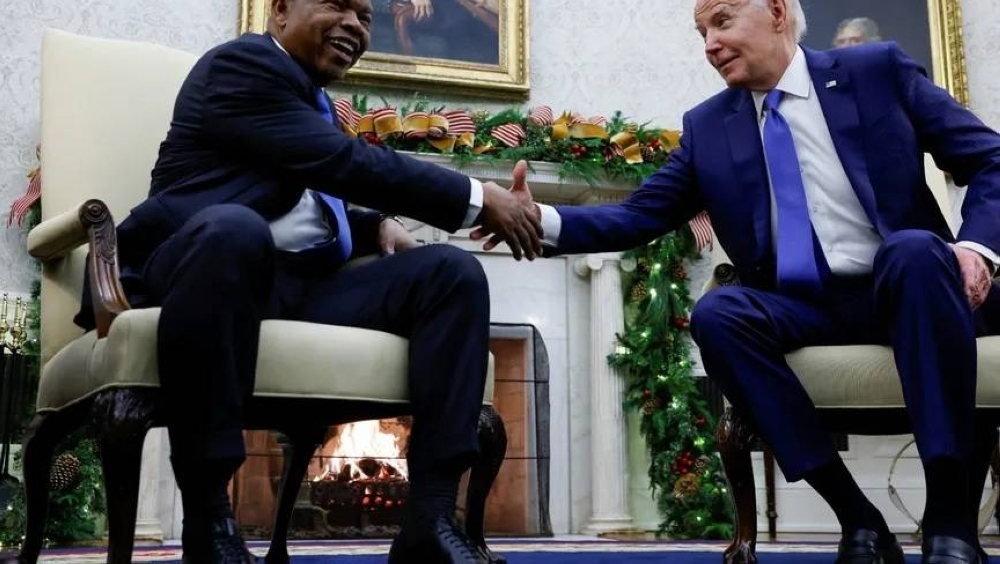

US President Joe Biden met with African leaders at Angola’s Lobito Port on Wednesday in a landmark move to reshape trade dynamics and counter China’s growing influence in Africa. The discussions centered around advancing the ambitious Lobito Corridor project, a multi-phase railway initiative designed to connect Zambia and the Democratic Republic of Congo (DRC) with Angola’s Atlantic Coast.
This corridor aims to revolutionize the export of critical minerals essential for renewable energy technologies, batteries, and other industrial components, providing an alternative to China’s dominant mining investments in the region.
The Lobito Corridor: A Vision for Africa’s Future
The United States has already pledged $550 million in loans to kickstart the Lobito Corridor project. The first phase involves the modernization and expansion of Angola’s existing rail network, stretching from Lobito Port into Congo’s mining regions. While no completion date for this phase has been announced, plans for a second phase are underway, targeting 2026. This next stage will connect Zambia to Lobito through a new railway line, further enhancing regional connectivity.
The ultimate vision includes extending the railway eastward to link with Tanzania’s Dar es Salaam Port on the Indian Ocean. However, this aspect has drawn criticism, as analysts warn that it may inadvertently strengthen China’s foothold in East Africa by creating competitive trade routes.
Biden’s First African Summit
President Biden’s visit to Lobito marked the culmination of his first—and potentially only—trip to Africa during his presidency. He was joined by the presidents of Angola, Congo, and Zambia, as well as Tanzania’s Vice President, for a summit to underscore the project’s significance.
At the meeting, Biden and Congolese President Félix Tshisekedi reiterated their commitment to fostering investment and peace in Central Africa to maximize the region’s immense mineral wealth. Zambian President Hakainde Hichilema emphasized the transformative potential of the corridor, stating, “This project is vital for unlocking our countries, our regions, our continent, and the global economy.”
Addressing Debt and Development
Debt relief was another key topic during Biden’s discussions. Zambia, a country heavily indebted to international creditors, recently completed a $13.4 billion debt restructuring deal under the G20-led Common Framework. The White House released a joint statement affirming that nations should not be hindered in their development efforts by excessive debt, emphasizing a shared commitment to long-term investments in Africa.
The US-China Rivalry in Africa
The Lobito Corridor symbolizes more than just infrastructure development; it represents a geopolitical contest between the US and China. In 2022, a consortium of Western firms secured the contract to develop the corridor, a victory hailed as a strategic countermeasure to China’s entrenched influence in Africa’s resource-rich regions.
China remains the dominant foreign player in the DRC’s mining industry, extracting cobalt, copper, and other critical minerals pivotal to global energy transitions. Washington’s heightened investment in the Lobito Corridor reflects a broader strategy to loosen Beijing’s grip on these resources, which are vital to US national security.
Financing Challenges Ahead
While the US Development Finance Corporation has provided significant funding, including an additional $600 million this week for related projects in solar energy, mineral processing, and telecommunications, uncertainties linger regarding the financing and execution of the project’s second phase.
The Lobito Corridor is also supported by major players like Trafigura, a global commodities trading giant, the Portuguese construction firm Mota-Engil, and rail operator Vecturis.
Strengthening US-Angola Relations
Angola, historically aligned with China and Russia, has recently pivoted toward the West. During Biden’s visit, Angolan President João Lourenço expressed a desire to deepen security and military collaboration with the US, signaling a shift in the nation’s strategic alliances.
Biden reaffirmed America’s long-term commitment to Africa, emphasizing a partnership built on the continent’s priorities rather than imposed conditions.
A Mixed Legacy
President Biden’s African tour fulfilled his campaign promise to engage with the continent but came late in his tenure, raising questions about its lasting impact. Despite his administration’s pledges, US influence in Africa has waned, particularly in the face of China’s robust investments and security partnerships.
The Lobito Corridor project is a promising step toward rekindling America’s ties with Africa, but its ultimate success will depend on sustained investment, local buy-in, and a clear strategy to balance regional and global interests.
As the clock ticks toward the end of Biden’s presidency, the Lobito Corridor stands as a symbol of US aspirations in Africa—a project that could reshape the continent’s economic landscape while redefining America’s role in global development.


