
By using this site, you agree to the Privacy Policy and Terms of Use.
Accept
DNE Africa
  • Home
  • Politics
    The House of the People in Mogadishu; Somalia's chief justice was dismissed before a ruling on parliament's term
    Politics

    Somalia chief justice row: UN experts demand reinstatement

    By DNE Africa 7 Min Read
    An artisanal gold miners' camp in eastern Senegal; a report says illicit gold from Africa reaches the UAE
    Business

    Illicit gold: UAE took 591 tonnes in 2024, most from Africa

    By DNE Africa November 13, 2026
    Ouagadougou city centre at night; Burkina Faso's prosecutor announced arrest warrants in the capital
    Politics

    Burkina Faso arrest warrants target exiled ex-ministers, journalists

    By DNE Africa November 13, 2026
  • Business
    Kilembe Mines waiver debate: MPs seated in the chamber of the Parliament of Uganda during a plenary sitting
    Business

    Kilembe Mines and K-Roma win Shs4.46bn waivers in Uganda

    Parliament wrote off Shs2.6bn in mineral rent owed by the dormant copper…

    By DNE Africa 7 Min Read
    Danpullo MTN dispute: Douala, Cameroon, with Mount Cameroon in the distance
    Business
    Danpullo MTN case: Cameroon court restores 140bn CFA freeze
    EAC Secretary General Stephen Mbundi speaking at the EAC development partners forum in Arusha
    Business
    EAC development partners back 48-project pipeline
    De Beers stake: file photo of the Jwaneng open-pit diamond mine in Botswana
    Business
    Botswana to double De Beers stake to 30% under Anglo American sale
    Energy Capital & Power logo for the South Sudan Oil & Power 2026 conference
    Business
    South Sudan Oil & Power 2026 to host women-led energy panel
  • Culture
  • Opinion
  • Technology
  • Sports
  • World
  • My Bookmarks
Reading: Why the Arab World Keeps Missing the Real Story About Somaliland 
Sign In
  • Join US
DNE AfricaDNE Africa
Font ResizerAa
  • Home
  • Politics
  • Business
  • Culture
  • Opinion
  • Technology
  • Sports
  • World
  • My Bookmarks
Search
  • Home
  • Politics
  • Business
  • Culture
  • Opinion
  • Technology
  • Sports
  • World
  • My Bookmarks
Have an existing account? Sign In
Follow US
© Foxiz News Network. Ruby Design Company. All Rights Reserved.
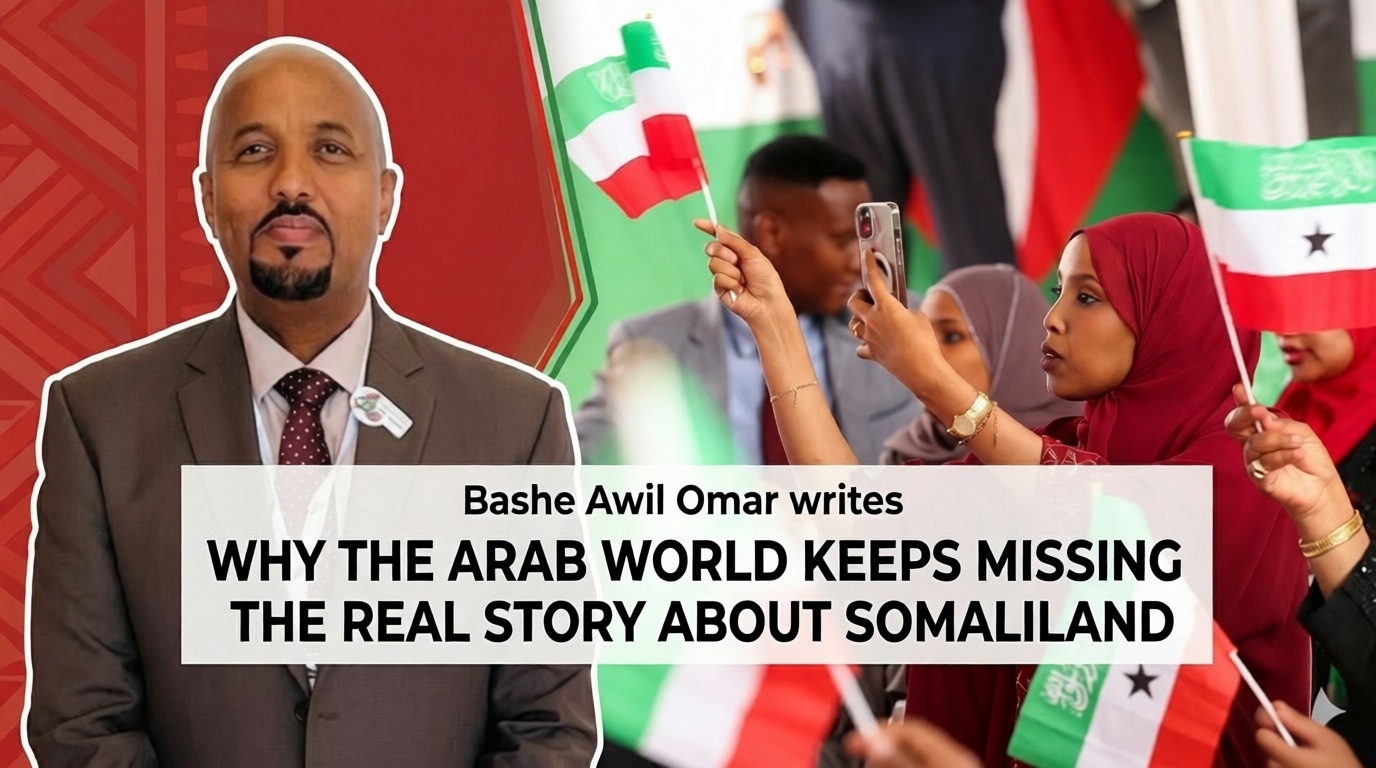
Why the Arab World Keeps Missing the Real Story About Somaliland By Bashe Awil Omar

Why the Arab World Keeps Missing the Real Story About Somaliland 

Bashe Awil Omar
Last updated: June 16, 2026 12:47 pm
By Bashe Awil Omar 5 Min Read
Share
Why the Arab World Keeps Missing the Real Story About Somaliland By Bashe Awil Omar
SHARE

Over the years, I have read countless articles and commentaries about Somaliland in the Arab world. One thing has always struck me. Too often, Somaliland itself is not the subject. Instead, discussions revolve around the interests of others. Israel. Ethiopia. The UAE. The United States. Somaliland becomes the backdrop rather than the story.

That is unfortunate, because the Somaliland question did not begin with any of these countries, and it will not end with them either. For many observers, Somaliland comes into focus only when it appears in a wider debate about the Red Sea or regional rivalries. Yet Somaliland is not a foreign project. It is a political reality shaped by its own history and by the choices of its own people. Perhaps that is why so much commentary misses what has actually happened over the past three decades.

Since restoring its sovereignty in 1991, Somaliland has had limited engagement with much of the Arab world. Many preferred to view it through Mogadishu rather than engage directly with Hargeisa. The expectation, whether stated openly or not, seemed to be that time would eventually resolve the issue. It did not. Thirty-four years later, Somaliland remains. More than that, it is more stable, more institutionalised and more deeply rooted in the consciousness of its people than at any point in its modern history. It rebuilt its institutions, maintained peace, held multiple elections and achieved democratic transfers of power, largely without the international attention and resources devoted elsewhere.

An entire generation has grown up knowing only Somaliland’s institutions and political reality. For many young Somalilanders, the debate is no longer about separation. It is simply about the country they have always known. Those who expected time and isolation to weaken Somaliland’s aspirations underestimated how deeply they had taken root. National aspirations rarely disappear simply because they are ignored.

Another misconception is that Somaliland’s aspirations somehow run contrary to Arab interests. The people of Somaliland have been connected to the Arabian Peninsula for centuries through trade, religion, culture and family ties. Somalilanders have lived, studied and worked across the Arab world for generations. Likewise, Arab traders and businesses have long been part of Somaliland’s economic life. A stable Horn of Africa and a secure Red Sea serve Arab interests no less than African ones.

Somaliland itself must also accept some responsibility. For too long, it did not do enough to explain its history and experience to Arab audiences. As a result, many people across the region know little about Somaliland or the circumstances that shaped its political journey. But the issue was not always a lack of information. More often, discussions were shaped by assumptions inherited from another era. Somaliland was viewed through the lens of preserving an established regional order rather than through its own history and experience. That gap was frequently filled by narratives driven more by regional competition than by fact. Which perhaps explains why discussions about Israel, Ethiopia and foreign powers so often come before discussions about Somaliland itself.

Thirty-four years ago, few would have predicted that Somaliland would emerge as one of the most stable political systems in the Horn of Africa. Yet that is precisely what happened. The more interesting question today is not why other countries engage with Somaliland. It is why, after more than three decades of peace and effective self-government, so many still prefer to understand it through the calculations of outside powers rather than through the aspirations of Somalilanders themselves.

If the Arab world wishes to understand Somaliland, it should begin not with Israel, Ethiopia or any other external actor. It should begin with Somaliland itself.


Bashe Awil Omar is a diplomat and politician. He served as the Somaliland Representative to the UAE (from 2015-2018) and Kenya (from 2018-2021).

Disclaimer: The views and opinions expressed in DNE Africa Opinion section are those of the writers and do not necessarily reflect the views or positions of DNE Africa.

You Might Also Like

Somalia chief justice row: UN experts demand reinstatement

Illicit gold: UAE took 591 tonnes in 2024, most from Africa

Burkina Faso arrest warrants target exiled ex-ministers, journalists

Al-Mirghani, Sudan’s Khatmiyya leader, dies in Cairo at 90

El Khuwei: Sudan army claims first West Kordofan gain

TAGGED:AfricaArabArab WorldSomaliaSomalilandUAE
Share This Article
Facebook Twitter Pinterest Whatsapp Whatsapp LinkedIn Reddit Telegram Email Copy Link

You Might Also Like

Saddam Haftar meets the head of Egypt's General Intelligence Service in Cairo on 13 November 2026
Politics

Saddam Haftar meets Egypt intelligence chief in Cairo

By DNE Africa 7 Min Read
Burundi election: President Evariste Ndayishimiye signing a document in Brussels in February 2022
Politics

Burundi election: 11 small parties back Ndayishimiye for 2027

By DNE Africa 6 Min Read
Migrants
PoliticsWorld

INTERPOL Exposes African Migrant Trafficking Networks as 262 Suspects Arrested in Cross-Border Crackdown

By Ahmed Emam 7 Min Read

More Popular from DNE AFRICA

Egypt v Malawi venue: Cairo International Stadium with supporters in the stands
Sports

Egypt v Malawi: Salah equals scoring record in 5-0 win

By DNE Africa 7 Min Read
Dakar 2026 Youth Olympic Games medal ceremony with three athletes on the podium

Dakar 2026 ends with record 74 medals for African teams

By DNE Africa
UN peacekeepers on patrol in Ituri province, where ADF attacks have killed civilians, in a 2025 file photo
World

ADF attacks kill at least 44 more civilians in Congo’s Ituri

By DNE Africa 7 Min Read
Ad imageAd image
Technology

Jensen Huang exit: what it means for Africa’s AI data centres

Nvidia is supplier and shareholder to Cassava Technologies, whose AI data centre plan could cost up…

By DNE Africa
TechnologyWorld

Ghana Seeks Int’l Support for Key ITU Telecommunications Seats

Ghana has stepped up its campaign for greater representation in global telecommunications governance, seeking international support…

By Ahmed Emam
Politics

Tagwirei powers limited to two laws as Ncube keeps 58

A gazetted order gives Zimbabwe's new economic development minister two laws to administer and leaves tax,…

By DNE Africa
Business

Morocco social aid to rise 20% to 600 dirhams in 2027

The government approved a draft decree raising the minimum direct aid payment to 600 dirhams a…

By DNE Africa
Politics

Gambia election: five candidates cleared as Barrow seeks third term

The electoral commission has accepted five nominations for the 5 December presidential vote, rejected two and…

By DNE Africa
DNE Africa

News by Africans, For Africans

Categories

  • Science
  • Health
  • Entertainment
  • Business
  • The Escapist

Quick Links

  • Advertise with us
  • Newsletters
  • Complaint
  • Deal

DNE Africa.All Rights Reserved.

Welcome Back!

Sign in to your account

Username or Email Address
Password

Lost your password?