

Commercial pickups arrive white and leave matte green with heavy machine guns bolted to the bed — assembled inside an active Ethiopian army installation, 100 kilometres from the front. A new assessment finds Ethiopian territory has functioned as the rear base for the Rapid Support Forces’ (RSF) entire eastern campaign. Days before it was published, Abiy Ahmed received the RSF militia’s commander with state honours.
They forgot the insides of the doors.
In footage filmed on the frontlines of Sudan’s Blue Nile state this spring, the pickup trucks of the RSF appear in the militia’s working colours: matte, non-reflective dark green, front bumpers painted over, corporate logos obscured. Open a door, and the panel behind it is bright factory white. So are the footrests. Somebody had gone to considerable trouble to disguise where these vehicles came from, and had done the job just badly enough to be caught.
They came from a fenced compound on the western edge of Asosa, capital of Ethiopia’s Benishangul-Gumuz region. Not a warehouse on the outskirts. Not a farm rented through intermediaries. They came from an active base of the Ethiopian National Defence Force.
That is the conclusion of Rear Base: Ethiopian Territory and the Rapid Support Forces’ Eastern Front, an evidentiary assessment published this week by African Narratives, which consolidates eight months of separate investigations by Reuters, the Yale School of Public Health, Le Monde and Middle East Eye, grades each of their principal claims by confidence level, and identifies what the record does and does not establish.
Its central judgement is unambiguous on the core question and careful on the harder one:
“The evidence establishes with high confidence that Ethiopian territory, including an active military installation, has functioned as the rear base for RSF operations on Sudan’s eastern front. It does not yet establish the level at which this was authorised … The principal obstacle to closing that gap is Ethiopia’s documented refusal to respond to international inquiry.”
African Narratives, Rear Base, September 2026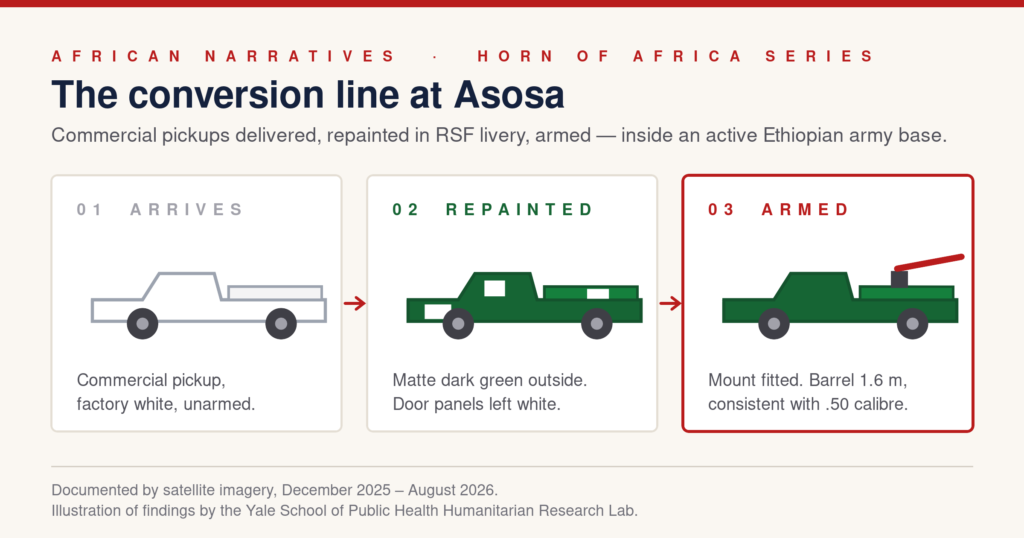
Two RSF sites in Ethiopia, thirty kilometres apart
The assessment separates two locations that most coverage has run together — a conflation it identifies as a source of error in both directions, because the objections that apply to one do not apply to the other.
Menge district is new construction, carved from forest 32 kilometres from the Sudanese border at the tri-point with South Sudan. Reuters revealed it on 10 February, working from 15 sources, commercial satellite imagery and independent analysis commissioned from the defence intelligence firm Janes. Clearing began in April 2025. Tents went up from late October. By 24 November, imagery showed more than 640 of them — accommodation, on Janes’s reading, for at least 2,500 people.
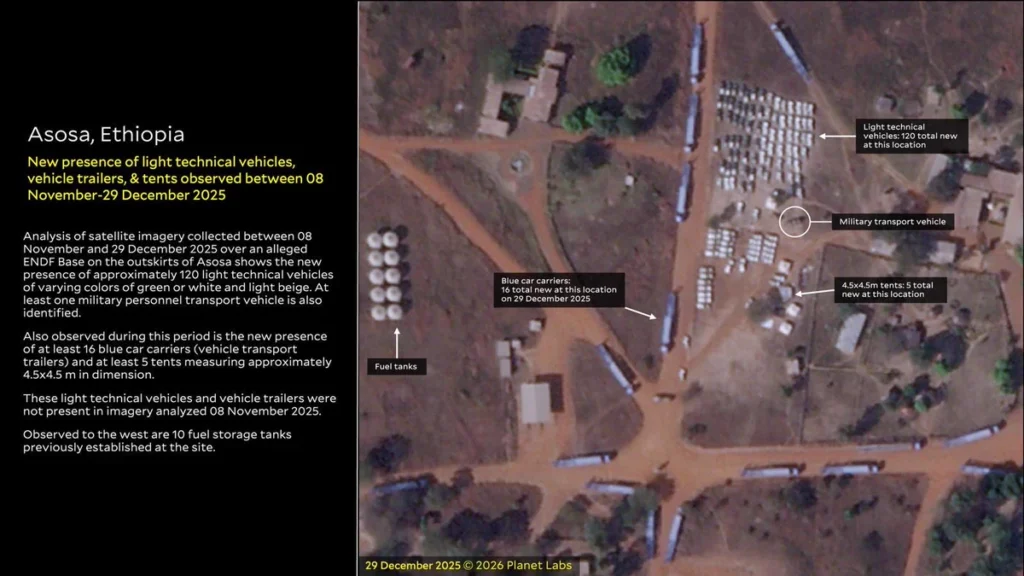
Asosa is different, and it is the more serious allegation. It is a functioning installation of the Ethiopian army, and what the Yale School of Public Health’s Humanitarian Research Lab documented there across three reports is not transit but manufacture.
The memo and the cable
What the camp at Menge is for was established not by pictures but by paper — and both documents come from inside the tent.
The first is an internal note written by Ethiopia’s own security services. Reviewed by Reuters, it records that as of early January, 4,300 RSF fighters were in training at the site, and that “their logistical and military supplies are being provided by the UAE.”
The second is a diplomatic cable dated November 2025, whose authoring country Reuters withheld to protect its source. It describes a facility built for up to 10,000 fighters and dates the start of activity to October, with the arrival of dozens of Land Cruisers, heavy trucks, RSF units and Emirati trainers.
The Ethiopian note went further. It named the officer it held responsible for establishing the camp: General Getachew Gudina, Chief of the Defence Intelligence Department of the Ethiopian National Defence Force. A senior Ethiopian government official and four separate diplomatic and security sources confirmed his role.
A camp on Ethiopian soil, training thousands of fighters for a foreign militia, established — according to Ethiopia’s own intelligence apparatus — by the head of Ethiopian defence intelligence.
Fourteen controls, one outlier
The African Narratives assessment rates the Asosa finding at its highest confidence level, and the reason is methodological rather than rhetorical.
Yale did not simply look at one base and draw conclusions. It ran the same analysis across fourteen other Ethiopian army bases in the same region over the same period, including installations where the army’s own heavy equipment transporters were plainly visible. Nothing resembling the Asosa pattern appeared at any of them. When the lab repeated the exercise across more than ten further military facilities in its second report, it again found nothing.
Asosa is not how the Ethiopian army behaves. Asosa is singular.
What the imagery shows, across five months: commercial car-carriers inconsistent with military transporters arriving repeatedly from late December, offloading unarmed pickups in livery matching no Ethiopian army vehicle of equivalent make. Five to fifteen tents with capacity for 150 personnel. Shipping containers and supply dispersal. White armoured personnel carriers in non-army colours. Multiple fuel tanks — which Menge lacks — permitting mass refuelling of an outbound fleet. By February, uniform gun mounts fitted to vehicles that had arrived unarmed, with 1.6-metre objects consistent with .50-calibre barrels laid out in rows on the ground beside them. Two hundred pickups present at one count.
At the airport: defensive fighting positions, a new hangar, a concrete pad. A helicopter consistent with an Mi-17 from 18 February. A cargo aircraft, most likely a C-130 — a type the UAE operates — from 9 March. And construction, in imagery from 28 January, consistent with a drone ground control station.
“This report is the first visual evidence that those allegations are true. In fact, it is even worse than first feared. Not only are the Ethiopians assisting the RSF, they are doing it from an actual Ethiopian army base.”
Nathaniel Raymond, Executive Director, Yale Humanitarian Research LabMoving it indoors
Yale’s second report, covering 29 March to 21 May, records something more incriminating than the operation itself: the attempt to conceal it.
Through the spring the work was done in the open, in an exposed field. Then Yale published in April — and the RSF base changed its habits. Activity shifted to the north-east, concentrating around a large roofed warehouse, a relocation the lab assessed as consistent with defeating satellite detection. Production did not slow. It moved under cover and accelerated. By 21 May there were 36 transport containers and 82 light technical vehicles across the base, more than 70 of them clustered at the new position.
A government does not relocate a vehicle-maintenance yard into a warehouse because a university published a report about it.
The third report, dated 28 August, measures the scale the operation has reached. In five days, roughly 100 new light technical vehicles appeared in three groupings — six times the number present on 23 August — with fifteen vehicles consistent with armoured personnel carriers and at least five already carrying mounted weapons. Yale’s assessment: enough materiel to field a regiment-to-brigade-size force and move 750 to 1,000 fighters.
The air bridge feeding the RSF
Something had to bring the materiel to Ethiopia. On 27 February, Le Monde traced how.
The carrier is Batot Air, registered in Ouagadougou in August 2024, flying since November 2025, and — in the detail that gives the game away — its Ilyushin and Antonov freighters have never once landed in Burkina Faso. The fleet instead runs a near-daily rotation between the Gulf and the Horn of Africa: at least 36 flights between the UAE and Ethiopia, routinely switching off their transponders over the Red Sea before setting down at Addis Ababa’s Bole International Airport or the Bishoftu airbase.
The balance sheet is equally eloquent. Batot Air bought three Il-76 freighters in late 2025, aircraft worth several million euros, while declaring share capital of 15,000 euros. Its owner is a Sudanese businessman, Mohamed Omer Suleiman Idriss. Security sources told the paper the airline also moves RSF commander Mohamed Hamdan Dagalo and his brother Abdelrahim discreetly.
Middle East Eye separately tracked UAE-linked Il-76s flying Abu Dhabi to Bahir Dar, in Amhara, some 300 kilometres from Asosa. The sea leg points to Berbera, in Somaliland, where the UAE keeps a base.
The timing of the pivot to Ethiopia was not incidental. On 26 December 2025 Israel became the first state to recognise Somaliland’s sovereignty. On 12 January 2026 Somalia cancelled every agreement it held with the UAE, including at Berbera and Bosaso. With its Somali positions suddenly contested, Abu Dhabi needed a corridor. Ethiopia had one.
What it bought: Kurmuk, twice
The point of a rear base is what happens at the front, and the front moved.
The RSF launched a Blue Nile offensive on 25 January; a Sudanese intelligence source said the attacking force came from South Sudan and Ethiopia. At the end of March the RSF and its SPLM-N allies took Kurmuk. The army recovered the town in July and found a mass grave holding the remains of 25 people, among them women, children and hospital staff. In August the RSF took it back — seizing Geisan on 11 August and Kurmuk on 13 August.
The Critical Threats Project at the American Enterprise Institute assessed that the RSF “almost certainly launched its operations from Ethiopian territory.” The Egyptian outlet MadaMasr reported that RSF struck Kurmuk on two axes — from Sudanese ground to the south and from Benishangul-Gumuz to the east — and that Geisan was assaulted from rear bases inside the Ethiopian region.
The geography closes the argument. The nearest significant RSF-held pocket in Blue Nile lies some 70 miles south-west of Geisan, on the far side of army-controlled territory. RSF had no route to these towns from within Sudan. The force that took them came through Ethiopia.
Four days in August
The African Narratives study contributes one observation that no previous account had assembled: a convergence of four events inside seventy-two hours.
- 27 August. The Sudanese Armed Forces state they downed a drone launched from Ethiopian territory.
- 28 August. Yale records the assembly at Asosa of vehicles sufficient to move a brigade — a sixfold increase in five days.
- 28 August. Mohamed Hamdan Dagalo arrives in Addis Ababa, and is received with official protocol and met by Prime Minister Abiy Ahmed.
- 29 August. Ethiopia answers Sudanese accusations with formal counter-accusations for the first time, rather than denial or silence.
The study is careful not to claim causation. What it argues is that the sequence places a materiel surge, a head-of-government reception of the recipient force’s commander, and a shift in Ethiopian declaratory posture inside the same week — “a pattern more consistent with a deliberate change of policy footing than with the incidental accumulation the Ethiopian account implies.”
It was the second time Abiy has hosted Hemedti. He received him in December 2023 in what the Washington Institute described as the trappings of a head of state. What has changed since is the guest’s standing in international law: in July 2026 the UN’s Fact-Finding Mission for Sudan concluded that the mass killings, abductions and gang rape carried out by the RSF at El Fasher constitute distinct markers of genocide.
Satellite imagery can be argued about. Leaked memos can be disputed. A state reception cannot.
What Geneva did not say
The study’s second original finding concerns a silence.
On 3 September the UN Independent International Fact-Finding Mission for the Sudan published A/HRC/63/23, the first mandated international investigation devoted to the external networks arming the RSF. It interviewed 125 witnesses, authenticated 58 videos and photographs, and sent its draft to every state it names before publishing.
On Ethiopia it established three things. Ethiopian nationals are fighting in RSF ranks, identified at El-Fasher and elsewhere by language, accent and in some cases uniform. The Mission’s evidence points at Ethiopian soil: it urges four governments to engage “particularly in light of evidence of illicit activities stemming from their territory as documented in this report.” And Ethiopia refused to engage — the report carries a subsection headed “Non-responsive states,” and the finding on Addis Ababa is four words: “Ethiopia and Somalia did not respond.”
But the report names Colombia, the UAE, Chad, Libya and Somalia in the RSF supply chain — and contains no reference to Asosa, to Menge, or to Benishangul-Gumuz at all.
The African Narratives assessment weighs the two available readings and concludes the likelier is that Ethiopia fell outside this particular report’s operational reach: the Mission’s field missions went to South Sudan, Kenya and the United Kingdom, and its evidentiary spine is the Colombian-contractor pipeline arming the RSF through Bosaso, Libya and Chad. Ethiopia sits in the report as an open line of inquiry the investigators could not advance — for the reason the report states plainly. They asked, and Ethiopia would not answer.
The study calls that unresolved distinction “consequential,” and makes putting the question directly to the Mission the first item on its research agenda.
The international community may still be struggling to formally pin down Addis Ababa’s involvement with the RSF. Yet Ethiopia’s own strategic calculus for backing the RSF has never been a secret.
Why Abiy did it
Ethiopia’s interest in this war is not obscure, and its own officials have described it.
General Abdel Fattah al-Burhan has built security ties with Egypt and Eritrea — both Ethiopian adversaries — and backed Cairo against Addis Ababa over the Grand Ethiopian Renaissance Dam. Ethiopian officials believe Sudan has sheltered and armed Ethiopian opposition forces, including Tigrayan fighters, a grievance running back to 2020. In 2025 Abiy sent a delegation to Port Sudan to press Burhan to abandon the TPLF. Burhan refused.
Present in that delegation was Getachew Reda, an adviser to Abiy, who afterwards wrote publicly that Ethiopia could not “behave as a passive bystander” in Sudan’s war, and should not be criticised for “seeking to protect its strategic interests in the context of the Sudanese conflict.”
Above the bilateral grievance sits the Gulf. Saudi Arabia backs the Sudanese army and Eritrea; the UAE backs Ethiopia and the RSF. And there is a final figure worth holding alongside the rest: while armed pickups rolled west out of Asosa toward Kurmuk, the Ethiopian army was moving troops, tanks and drones 1,500 kilometres north to Tigray. Two fronts, one army — and a proxy militia holding the third.
Even Abu Dhabi has stopped pretending. Abdulkhaleq Abdulla, an Emirati academic and former adviser to President Mohammed bin Zayed, complained publicly about the “singling out” of the UAE, noting that the RSF “has support from Uganda, from Ethiopia, from Chad.”
The reckoning
The institutional response has been slow, and it has been obstructed.
The Security Council’s 1591 Panel of Experts delivered its final report on 13 July. Seven weeks on it remains unpublished, held inside the Sanctions Committee. After Reuters disclosed elements of it on 29 July, the UAE wrote to the Council protesting the leak. Bahrain, backed by Liberia, moved repeatedly to postpone the committee meeting; Greece favoured delay. The meeting finally sat on 20 August and settled nothing.
The sanctions regime expires on 12 September. The arms embargo still covers only Darfur — which is to say it does not cover Blue Nile, or the Ethiopian border, or Asosa. Every finding in the African Narratives study falls outside its geographic scope. On 24 August the United States proposed extending it across all of Sudan; the African members, China and Russia oppose. The Fact-Finding Mission has urged the same extension.
Three tests lie ahead. Whether the Panel of Experts’ report, when released, names Ethiopia where the Fact-Finding Mission could not. Whether the embargo is widened beyond Darfur, bringing the Ethiopian frontier inside it. And whether Ethiopia answers the next letter from Geneva.
The imagery, meanwhile, keeps arriving. On the most recent count, at the end of August, an Ethiopian army base held enough armed vehicles to move an RSF brigade — and, 30 kilometres west, a border to move it across.
Responses and disputed points
Ethiopia maintains that it is neutral in Sudan’s civil war and rejects accusations that it facilitates arms RSF transfers or training. Its government spokesperson, army and foreign ministry did not respond to Reuters; the office of the prime minister and the foreign ministry did not respond to Middle East Eye; General Getachew Gudina did not respond to Reuters; Ethiopia did not respond to the UN Fact-Finding Mission. On 14 February, four days after the Reuters investigation appeared, the Ethiopian Media Authority declined to renew the accreditation of three Reuters correspondents and revoked the agency’s African Union summit accreditation. Reuters said the Authority had “informally indicated” the action was prompted by the story. The Committee to Protect Journalists called it “the latest in a troubling pattern of repressive regulatory action against international and independent press in Ethiopia.”
On 29 August an adviser to Abiy Ahmed called Sudan’s accusations “false claims lacking any facts,” and alleged Sudanese drone strikes on the Ethiopian side of Kurmuk, Sudanese support for Ethiopian armed opposition including the transfer of more than 7,000 fighters, and the presence of armed groups among 50,000 Tigrayan refugees in Gedaref.
The United Arab Emirates told Reuters it is not a party to the conflict or “in any way” involved in hostilities, and has dismissed the allegations as unfounded. The RSF and the Gorica Group did not respond to Reuters. A senior SPLM-N figure denied his forces have any presence in Ethiopia.
Points in dispute. Janes, which analysed the Menge imagery for Reuters, said it could not confirm from the pictures alone that the site was military. Reuters stated it could not independently verify Emirati financing. Witness estimates of the November convoys — 126 trucks carrying 50 to 60 fighters each — imply more than 6,900 arrivals inside 48 hours against an imagery-derived capacity of roughly 2,500; the African Narratives study identifies this as the strongest single objection in the file and notes it remains unreconciled. Horn Review, an Addis Ababa think tank, has argued the imagery is consistent with government gold-mining camps and that the Menge site lacks visible training infrastructure; its central argument — that RSF forces could never reach an Ethiopian base across intervening hostile territory — was overtaken by the RSF’s capture of Kurmuk and Geisan on the Ethiopian border. No court or UN body has adjudicated these allegations.
About the study
Rear Base: Ethiopian Territory and the Rapid Support Forces’ Eastern Front is published by African Narratives in its Horn of Africa Series, with an evidence cut-off of 3 September 2026. It assesses published investigations and UN documents rather than presenting original field reporting, grades eight principal findings by confidence level, and sets out eight outstanding questions for further reporting. Read the full study: Rear Base: Ethiopian Territory and the Rapid Support Forces’ Eastern Front.


