
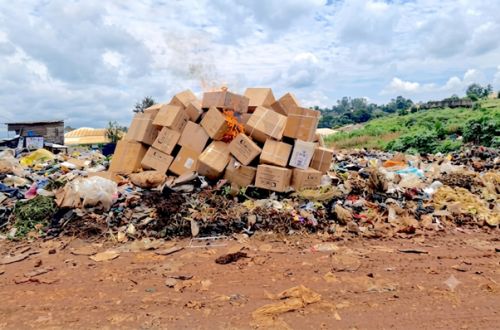

Cameroon has stepped up its fight against counterfeit medicines by destroying a fresh shipment of fake pharmaceutical products, highlighting the government’s continued efforts to curb an illegal market that remains deeply entrenched.
According to local reports, on July 31, Cameroon authorities incinerated counterfeit and illicit pharmaceutical products worth CFA28.15 million (about $48,000) in Bamenda, the capital of the Northwest Region, in the presence of administrative, judicial, health and security officials.
The medicines had been seized during enforcement operations led by the Central Police Commissioner of Bamenda before being reviewed by the Regional Committee for the Fight Against Illicit Medicines and Other Pharmaceutical Products. Officials said the products were destroyed in accordance with public health and environmental protection standards to prevent them from re-entering the market.
Authorities warned that counterfeit, expired and illegally distributed medicines expose patients to treatment failure, poisoning, antimicrobial resistance and, in severe cases, death.
The Bamenda operation is the latest in a series of destruction campaigns carried out across Cameroon over the past several years. Similar operations have taken place in Douala, Yaoundé, Garoua, Maroua, Bertoua and several border regions where counterfeit medicines are frequently smuggled into the country through informal trade routes.
Despite these repeated crackdowns, the volume of counterfeit pharmaceuticals entering the market has remained substantial.
In November 2025, the Minister of Public Health announced that authorities had seized counterfeit medicines worth more than CFA369 million during the first six months of that year alone, suggesting that trafficking networks continue to operate on a significant scale.
Earlier, Cameroon destroyed nearly CFA3 billion worth of counterfeit medicines following major seizures made during 2021, while prosecutors launched legal proceedings against dozens of suspected traffickers. Yet each successive destruction campaign has been followed by new seizures, pointing to the resilience of criminal supply chains rather than their dismantling.
The challenge facing Cameroon reflects a much wider global problem.
According to the World Health Organization (WHO), about 10.5% of medical products sold in low- and middle-income countries are either substandard or falsified, representing a criminal market worth more than $30 billion annually. Counterfeit medicines circulate primarily through informal markets, clandestine supply chains and increasingly through online platforms, disproportionately affecting countries with weaker regulatory systems.
In Cameroon, several structural factors continue to fuel the illegal trade. Long and porous borders, insufficient monitoring along commercial corridors, high profits for traffickers and limited access to affordable medicines all create conditions in which counterfeit products can thrive. For many consumers, medicines sold by informal street vendors remain considerably cheaper than those available through licensed pharmacies, despite the significant health risks.
Health experts raised the alarm that falsified medicines may contain little or none of the required active ingredient, incorrect dosages or even toxic substances. Besides causing treatment failure and poisoning, such products contribute to the growing global threat of antimicrobial resistance by exposing patients to ineffective therapies.
The public health consequences extend far beyond Cameroon.
The United Nations Office on Drugs and Crime (UNODC) estimates that trafficking in falsified and substandard medical products across the Sahel contributes to around 270,000 deaths each year, particularly among patients suffering from malaria and other infectious diseases.
Cameroon has also experienced several high-profile counterfeit medicine incidents in recent years. In July 2023, the WHO issued a global medical product alert after toxic batches of Naturcold syrup contaminated with diethylene glycol were detected in the country, a case linked to the deaths of several children.
More recently, at the end of 2025, Cameroonian customs authorities tightened border inspections following alerts from Interpol and the WHO concerning suspected falsified pharmaceutical products marketed under brands including Coldrif, Respifresh TR and Relife.


