
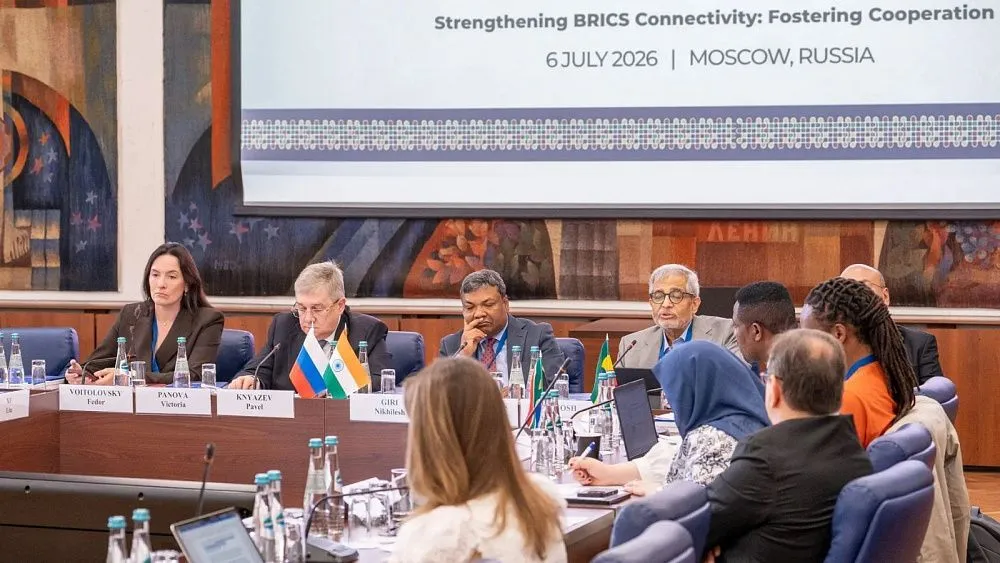

BRICS is not merely an important platform for the Global Majority; it is perhaps the only platform capable of transforming the current situation and proposing a new model of global governance,” Victoria Panova, Head of the BRICS Expert Council–Russia, told an international conference in Moscow.
Speaking at the “Strengthening BRICS Connectivity: Fostering Cooperation” event, Panova added: “Today, resilience and sovereignty are fundamental prerequisites for development. Transport connectivity, supply chains and independent technological ecosystems form the backbone of the economic security of the BRICS countries.”
The conference, held during India’s BRICS Chairship, brought together experts from Russia, India, Egypt, the United Arab Emirates (UAE), South Africa, China, Iran, Brazil, and Ethiopia to draft recommendations for the upcoming BRICS Summit in September. The event was organised by the BRICS Expert Council–Russia and India’s independent think tank, the Observer Research Foundation (ORF), under the framework of the BRICS Think Tanks Council (BTTC).
Pavel Knyazev, Ambassador-at-Large of the Russian Ministry of Foreign Affairs and Russia’s BRICS Sous-Sherpa, said the group has reached the level of a strategic partnership and achieved substantial results. He noted that the core principles of BRICS cooperation serve both the group’s members and the majority of countries worldwide, TV BRICS reported.
Nikhilesh Giri, Deputy Chief of Mission at the Embassy of India in Russia, stated that technological partnership and stronger ties among BRICS nations create new opportunities for sustainable development, while also calling for the reform of the United Nations (UN), the International Monetary Fund (IMF) and the World Bank.
During a session on transport, experts from Russia, the UAE and Egypt examined the International North–South Transport Corridor (INSTC) and the Northern Sea Route as alternatives to traditional logistics chains.
“Resilient networks must be diversified, with backup routes, digital integration and the capacity to adapt to crises,” said Nilanjan Ghosh, Vice President of the ORF.
At a session dedicated to resources, participants from India, South Africa, China and Iran discussed expanding raw material processing directly in producing regions. Philani Mthembu, Executive Director of the Institute for Global Dialogue (IGD) in Pretoria, South Africa, stressed that BRICS cooperation is helping African countries develop their own value chains for processing raw materials and manufacturing higher value-added products.
Addressing technology and artificial intelligence (AI), Walter Desidera Neto, Researcher and Coordinator of Studies in Economic Relations at Brazil’s Institute for Applied Economic Research (IPEA) and the country’s BTTC coordinator, described a shortage of computing infrastructure as one of the main constraints on technological development. He proposed joint investment in supercomputers, networks and cloud computing.
“The BRICS group should develop common principles and values in the field of AI, making digital infrastructure a foundation not only for economic growth but also for innovation,” Desidera Neto said.
Shimellis Hailu Dessie, Director General for European and American Affairs at Ethiopia’s Institute of Foreign Affairs (IFA), also advocated for the development of independent BRICS technological standards.
Further conference discussions addressed the digitalisation of ports and customs procedures, risk management, infrastructure financing through the New Development Bank (NDB), the green transformation of extractive industries, educational initiatives, specialist exchanges, public diplomacy development, and the interconnection between technological and energy cooperation among the member countries.


