
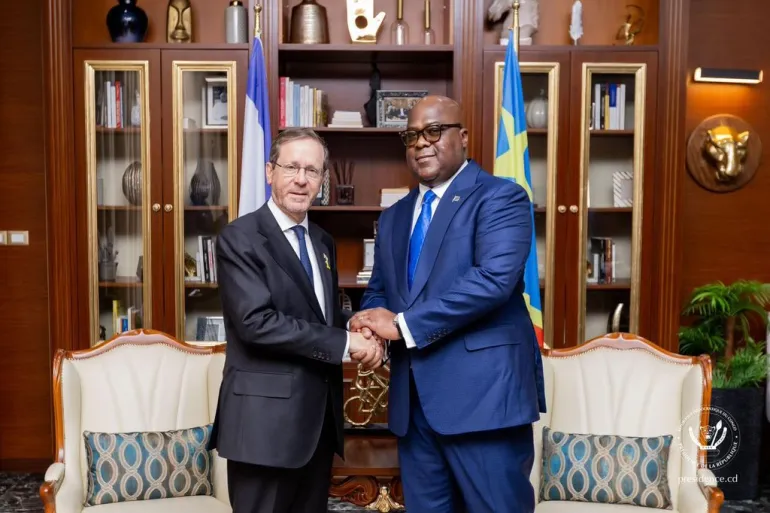

Israeli President Isaac Herzog arrived in Kinshasa this week on the first-ever visit by an Israeli head of state to Central Africa, where he met Congolese President Félix Tshisekedi to discuss expanding economic and political cooperation.
The visit, which followed a stop in Zambia, is part of Israel’s broader push to strengthen ties across Africa — a continent that has historically backed Palestinian statehood.
Strengthening Bilateral Ties
During a joint press conference, President Tshisekedi highlighted opportunities for Israeli companies in mining, energy, agriculture, infrastructure, and education, describing the talks as “very positive.”
Herzog said relations between the two countries were rooted in “deep friendship” and mutual interests spanning security, diplomacy, and digital innovation.
The Israeli president’s African tour signals renewed diplomatic outreach at a time when Israel seeks to counter growing criticism over its military campaign in Gaza and to diversify global alliances.
Palestinian Reaction
The visit triggered sharp condemnation from Palestinian groups, particularly Hamas, which described Herzog’s reception as an “attempt to whitewash Israel’s crimes” and a “betrayal of Africa’s anti-colonial legacy.”
In a statement, Hamas accused African leaders hosting Herzog of “normalizing genocide against the Palestinian people,” calling on African nations to “stand by their historical position against occupation and oppression.”
Regional Context
Israel has been working in recent years to rebuild diplomatic bridges in Africa through trade, technology, and agricultural partnerships. Several African governments have welcomed Israeli assistance in water management, cybersecurity, and renewable energy.
However, these moves remain controversial. Critics in African political and civil society circles argue that closer ties with Israel could undermine Africa’s traditional solidarity with Palestine — especially amid mounting civilian casualties in Gaza.
Analysts say Herzog’s trip places African governments in a difficult position: balancing development and investment needs with the continent’s long-standing support for Palestinian self-determination.
“Israel is offering technology and investment at a time when many African economies are under strain,” a regional analyst told DNE Africa. “But aligning too closely with Tel Aviv could carry diplomatic costs, particularly within the African Union.”
As Israel expands its diplomatic footprint south of the Sahara, the visit underscores how the Gaza conflict continues to reverberate across continents, shaping political choices far beyond the Middle East.


