
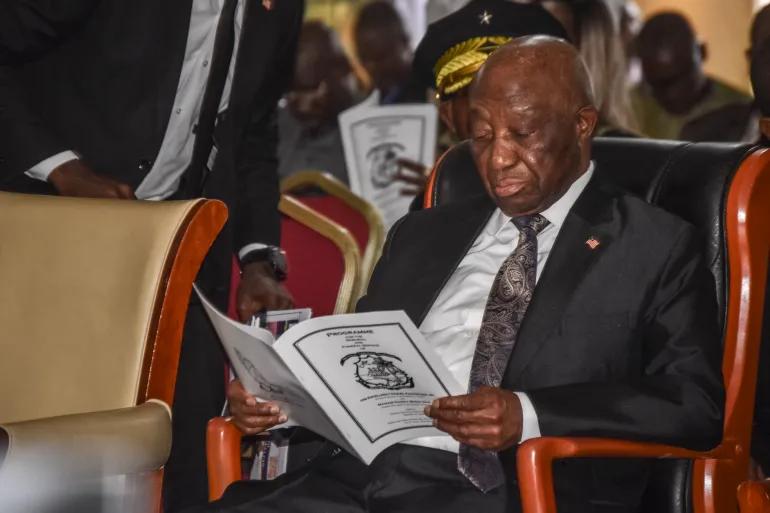

Liberian President Joseph Boakai has issued an unprecedented formal apology on behalf of the state for the violence, trauma, and devastation caused by the country’s two brutal civil wars, which left a deep scar on the nation and claimed the lives of an estimated 250,000 people.
Speaking at a national reconciliation ceremony in the capital Monrovia on Saturday, Boakai declared: “On this historic occasion, I offer a formal apology on behalf of the state. To every victim of our civil wars, to every broken family, to every shattered dream, we say: we are sorry.”
The apology marks the first time a Liberian head of state has publicly acknowledged state responsibility for the suffering and atrocities committed during the conflicts that ravaged the country between 1989 and 2003. The wars were marked by mass killings, mutilations, sexual violence, and the large-scale recruitment of child soldiers.
Boakai’s address comes just days after his symbolic participation in ceremonies honoring former presidents Samuel Doe and William Tolbert — Doe was tortured and killed in 1990 at the outset of the first war, while Tolbert was assassinated during Doe’s 1980 coup. The tributes were seen as a gesture of national healing.
“There is not a single Liberian family untouched by the pain, violence, or injustice that has haunted our nation,” Boakai said. “The state could have done more — and we must do all we can to ensure it never fails us again.”
Call to Implement War Crimes Court
Despite the gravity of the crimes committed during the civil wars, no war crimes tribunal has yet been established in Liberia. A Truth and Reconciliation Commission (TRC), established in 2005, submitted its final report in 2009 with strong recommendations — chief among them the creation of a special war crimes court. However, successive governments have failed to act, largely due to the political influence of individuals implicated in wartime abuses.
Boakai broke with that pattern on Saturday, calling for the implementation of the TRC’s main recommendations. “Justice and accountability must be part of reconciliation,” he said. “It is time to give voice to the victims and deliver the justice they deserve.”
While the president did not set a concrete timeline for establishing a war crimes court, his speech was widely interpreted as the most serious official commitment to transitional justice in over a decade.
Mixed Reactions and Political Challenges Ahead
Human rights organizations and survivors’ groups welcomed the president’s apology, describing it as a long-overdue moral reckoning. “It is a powerful moment,” said Amos Jallah, a war survivor and activist. “But apologies must be followed by action. We need a court. We need accountability.”
Still, the road ahead may be politically fraught. Several figures with alleged ties to war-era atrocities remain active in national politics, and past efforts to revive the TRC’s recommendations have met resistance in the legislature.
For now, Boakai’s speech has rekindled hopes among many Liberians that the nation may finally confront its painful past — and take steps toward a future grounded in truth, justice, and national unity.


