
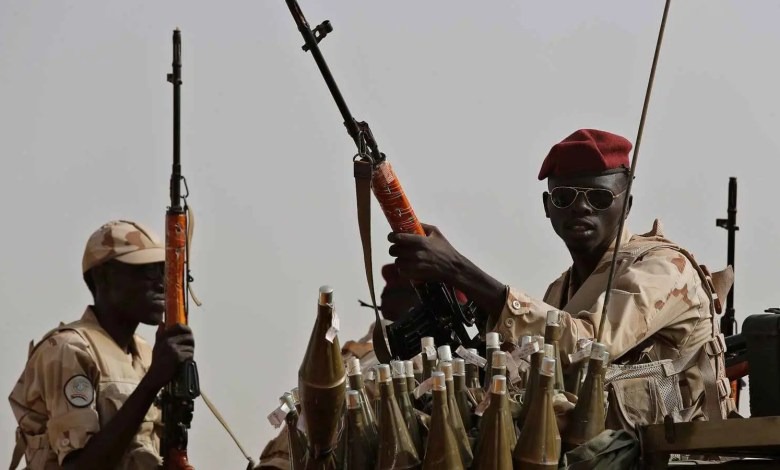

The focus of the Sudan conflict has abruptly shifted from battlefronts in Kordofan and Darfur to the country’s far northwestern tip after the Rapid Support Forces (RSF) militia announced it had seized control of the strategic tri-border region with Libya and Egypt.
The RSF claimed it inflicted heavy losses in personnel and materiel on the Sudanese Armed Forces (SAF) and captured dozens of vehicles, describing the expansion as a “strategic shift in securing the borders and protecting the country.” Conversely, the SAF stated it had evacuated the area and accused the RSF, which it termed a “terrorist militia,” and allied “Haftar’s forces” from Libya of attacking the region’s perimeter.
The seizure of the remote territory, which serves as a vital corridor between Sudan and Libya, opens a new and significant front in the year-long war. Military analysts say the move reshapes the conflict’s logistics, potentially securing new supply lines for the RSF while cutting off a key source of fuel for the army.
Sudan: A War Over Supply Lines
The development is the latest move in a conflict that has resembled a chessboard in recent months, with both sides maneuvering for position, using the element of surprise, and diversifying their weaponry.
After securing control over Sudan central states of Khartoum, Al Jazirah, and Sennar, the SAF had directed its forces toward Kordofan. Its objective was to expel the RSF, secure the strategic city of El Obeid, and advance westward to break the siege on El Fasher in North Darfur.
In response, the RSF launched a series of flanking and surprise operations, capturing key positions in Kordofan. The group has also been accused of targeting oil facilities in what analysts say is an effort to deprive the army of fuel for its forces in Kordofan and Darfur. Observers believe the operation in the border triangle is an extension of this strategy.
The ‘Gold Triangle’
The tri-border area is situated around Jebel Uweinat, a mountain rising nearly 2,000 meters above sea level in the Sahara Desert. The harsh, arid environment, covering over 1,500 square kilometers, has for decades been a known route for cross-border trade, human trafficking, and the smuggling of weapons and goods.
The area captured by the RSF is a desolate desert, largely uninhabited except for a population of 5,000 to 6,000 people, most of whom work in mining and trade. According to sources, “The area contains precious minerals and has two markets for the trade of gold extracted from the earth.”
The same sources added that “estimates indicate the RSF deployed about 5,000 fighters to this region, and it is believed these forces were supported by the Subul al-Salam (Paths of Peace) battalion, which is allied with Libyan National Army commander Khalifa Haftar.”
The control of this area has direct logistical implications. It was noted that “a significant amount of goods and fuel, which the army and its allied Joint Force had been utilizing, passes through the border triangle.” By capturing it, “the RSF will be able to secure its own flow of smuggled fuel and weapons.”
Regional Repercussions and Conflicting Accounts
The development has triggered security concerns in neighboring Egypt and exposed deep divisions within Libya. Analysts suggest that “Egypt may fear the spread of instability into its western desert, which could facilitate the flow of undocumented migrants, terrorist groups, and the smuggling of weapons and drugs. This situation keeps its security focus firmly on these developments along its southwestern border.”
Within Libya, factions offered contradictory accounts. The Libyan National Army (LNA), led by Haftar, rejected the SAF’s accusations of intervention. The LNA considered “Sudan claims about the seizure of Sudanese lands or siding with one of the conflicting parties” to be an attempt “to export Sudan’s internal crisis, and create a virtual external enemy.” An LNA statement emphasized that “protecting Libyan borders and territorial sovereignty is a sacred duty and a firm doctrine of the armed forces.”
In a contrasting statement, the Foreign Ministry of the Tripoli-based Government of National Unity (GNU), led by Abdul Hamid Dbeibeh, distanced itself from the events. It said the armed group suspected of involvement “does not fall under the authority of the Libyan Ministry of Defense” and expressed its “strong condemnation and complete rejection of involving our citizens in acts that would destabilize the security of brotherly nations.”
Adding to the confusion, a Libyan source claimed that “a patrol of the Libyan border guard was attacked a few days ago by Sudanese gunmen inside Libyan territory,” asserting that “the Sudanese army’s narrative of Libyan participation in the attack on the border is incorrect.”
However, Ahmed Hussein, the spokesman for Sudan Joint Force, countered these claims. He stated that “the Salafist battalion,” also known as the “Subul al-Salam battalion,” which is under the command of LNA leader Khalifa Haftar, “attacked our forces inside Sudanese territory at the Jebel Kussi gate in Uweinat.” Hussein also accused this battalion of “participating alongside the RSF in attacks on El Fasher in previous times.”
Strategic Implications for Sudan Conflict
Military analysts believe the RSF now effectively controls Sudan’s borders with Egypt and Chad in addition to Libya. One analyst considered the withdrawal of government-allied forces to mean that “the border posts that once provided early warning have become irrelevant.”
Another analyst, said, “The army and the Joint Force were using the border triangle area to bring fuel to the forces in the Debba area in the north of the country, and Al-Tina and Wadi Howar in North Darfur.” He noted, “This will now become extremely difficult, given the vast distances of supply lines from Port Sudan in the east to the forces in the west.”
The shift in control of the triangle alters Sudan military calculus on the ground. “RSF control will inevitably alter the dynamics of supply lines,” an analyst said, adding that the group will likely use the route through Libya, “especially after Chad changed its position and ceased its support for the RSF.”
One analyst concluded, “Controlling the triangle, in addition to depriving the army of smuggled fuel, will allow the RSF to secure its rear flank if it decides to advance on the Northern State. Meanwhile, after these military developments, breaking the siege on El Fasher in North Darfur has become almost impossible.” This is compounded by the RSF’s recent dispersal of the army’s “Al-Sayyad” (The Hunter) mobile unit in Kordofan, which had been tasked with lifting the siege on Darfur’s largest city.


