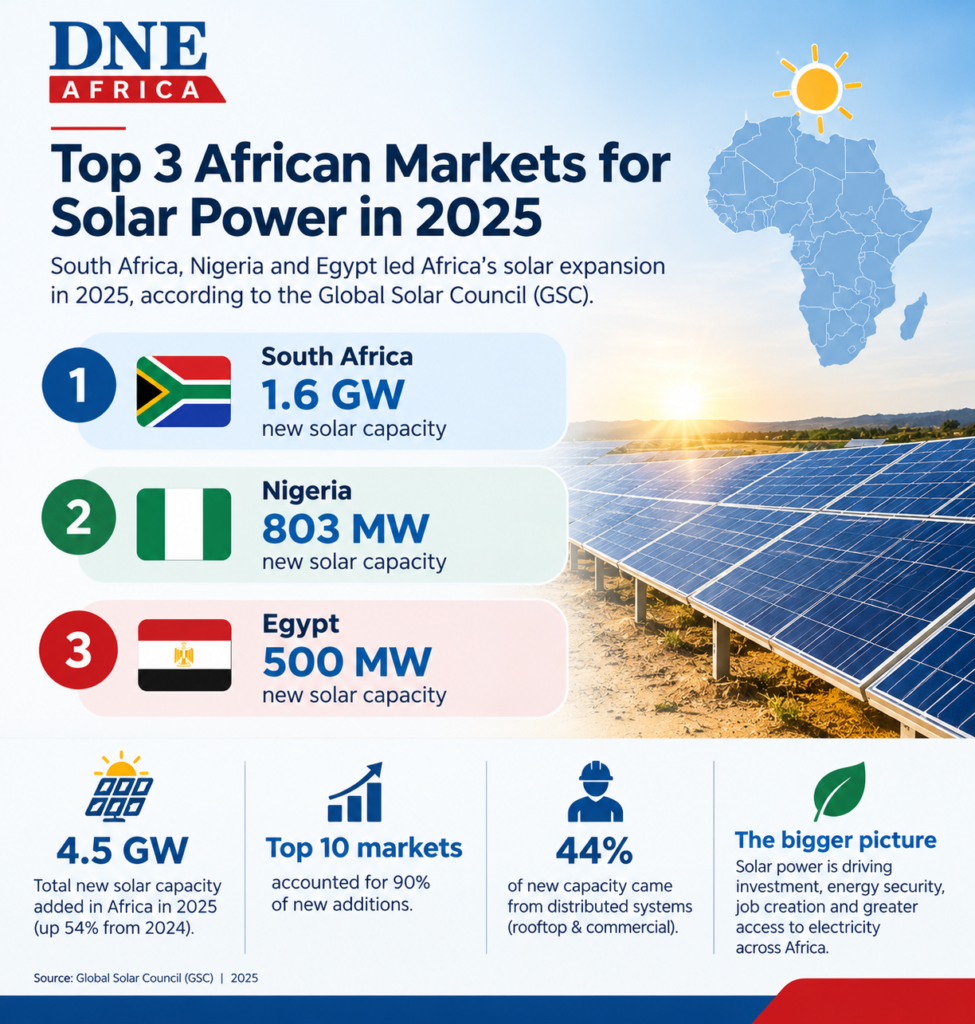
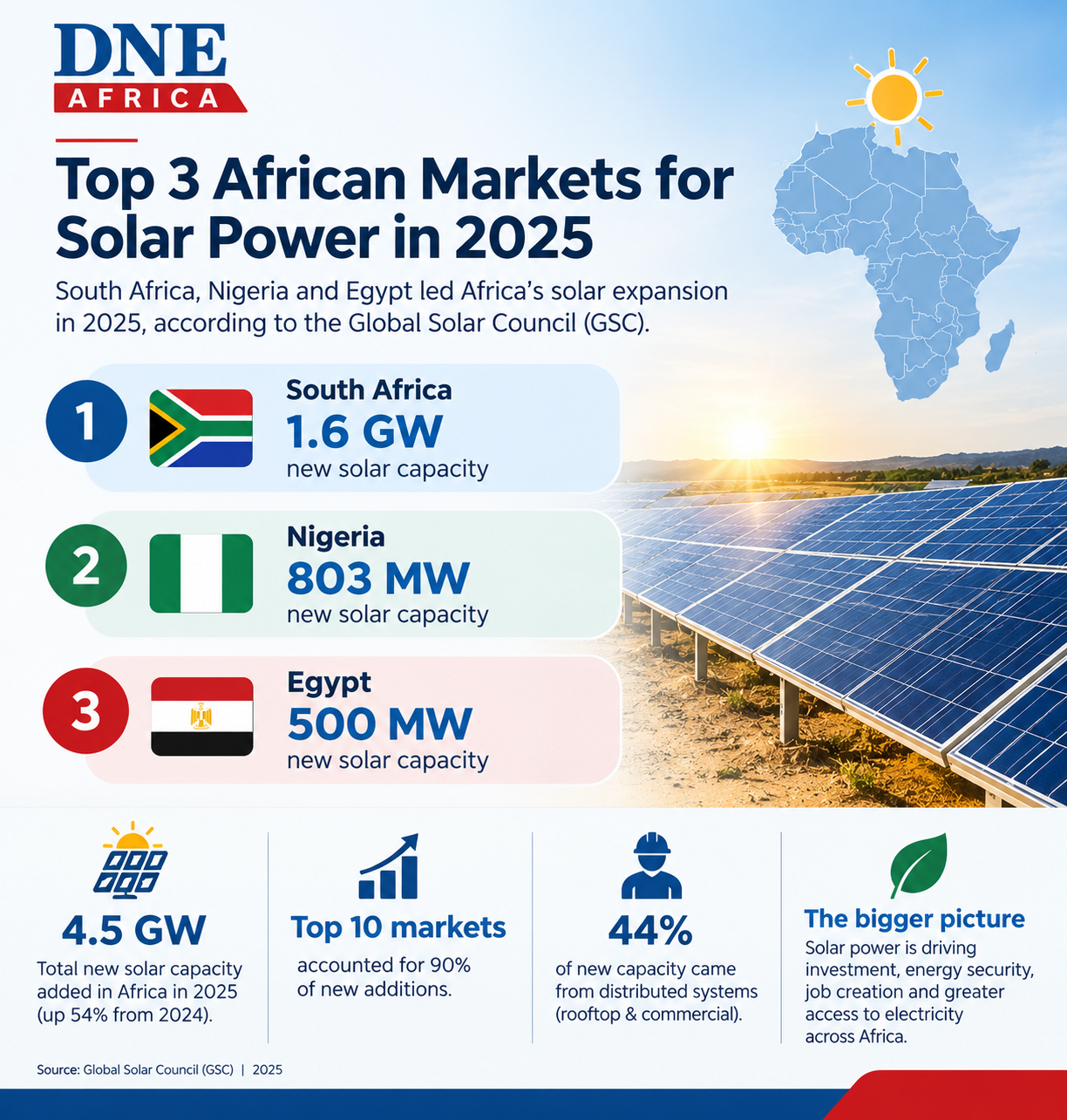

South Africa, Nigeria and Egypt ranked as Africa’s three largest markets for new solar power capacity in 2025, as the continent recorded its fastest annual growth in solar deployment, according to the Global Solar Council (GSC).
Africa added about 4.5 gigawatts (GW) of new solar photovoltaic capacity in 2025, up 54% from the previous year. The continent’s top 10 markets accounted for about 90% of new additions, highlighting the growing concentration of solar investment in major markets while deployment expands across a wider range of countries.
Africa’s Top Three Solar Markets in 2025
1– South Africa: 1.6 GW

South Africa led the continent with around 1.6 GW of new solar capacity added in 2025. The country remains Africa’s largest solar market, with growth driven by utility-scale projects as well as commercial, industrial and rooftop installations.
2- Nigeria: 803 MW

Nigeria ranked second, adding approximately 803 megawatts (MW) of solar capacity in 2025. The expansion reflects growing demand for alternative power sources as businesses and households increasingly turn to distributed solar systems.
3– Egypt: 500 MW

Egypt ranked third after adding around 500 MW of new solar capacity during 2025. The country is also seeking to expand domestic manufacturing of solar cells, modules and related equipment as part of efforts to develop the renewable energy industry.
Algeria followed the three leading markets with around 400 MW of new capacity. Other notable markets included Morocco, which added 204 MW, Zambia with 139 MW, Tunisia and Botswana with 120 MW each, and Ghana with 92 MW.
The expansion is being driven by falling solar technology costs, rising electricity demand and the need to improve energy access across the continent. Distributed systems, including rooftop and commercial solar, accounted for about 44% of reported new capacity in 2025, although the GSC cautioned that such installations are difficult to track and may be underestimated.
The GSC expects Africa’s solar market to continue expanding through the end of the decade, with solar increasingly linked to electricity access, energy security, investment and job creation.