

South Sudan’s government has strongly dismissed media reports suggesting that it had reached an understanding with Israel to host Palestinians displaced from Gaza, describing the claims as “entirely baseless.”
The denial followed publications by the Associated Press and Israel’s Ynet news outlet, which reported that Israel was in talks with five countries — including South Sudan — to receive Gazan Palestinians under what Tel Aviv calls “voluntary migration.”
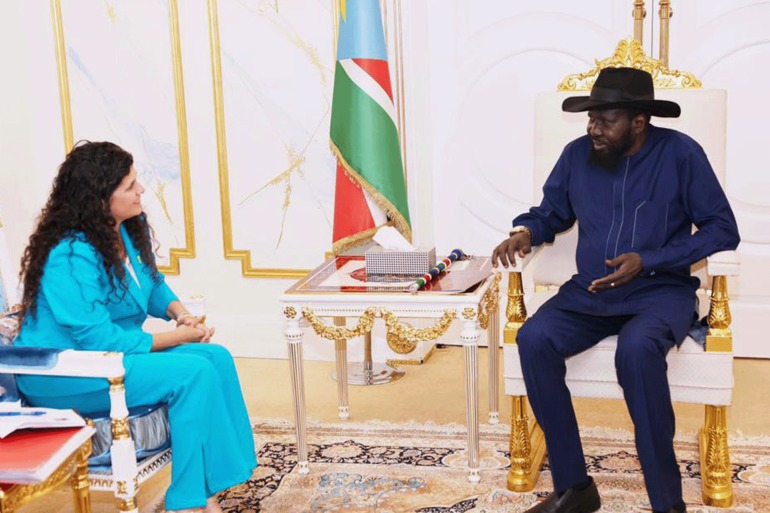
The speculation intensified after a series of high-level exchanges between Juba and Tel Aviv. In recent weeks, South Sudan’s Foreign Minister Mandi Simon Ayual reportedly paid a discreet visit to Israel, followed days later by Israeli Deputy Foreign Minister Sharren Haskel’s trip to Juba, where she met President Salva Kiir and signed a memorandum of understanding with her counterpart. The lack of transparency surrounding the visit and the signed agreement fueled speculation over its content, particularly against the backdrop of sensitive regional issues.
Domestic Outcry and Official Denials
The reports triggered a wave of criticism on South Sudanese social media platforms, with activists warning against any arrangement that could turn the country into a destination for forced resettlement. Seeking to quell the uproar, Haskel told reporters in Juba that the issue “was never on the agenda” of her visit and that no discussions took place on relocating Palestinians.
Yet, analysts remain skeptical. Political commentator Samuel Peter Oyay Shier argued that the sequence of events — beginning with Juba’s outreach to pro-Israel lobbying circles in Washington, followed by direct engagement in Tel Aviv, and culminating in the signing of what officials termed a “historic” agreement — suggests that the subject was, at minimum, informally explored.
Shier warned that the arrangement, if true, represents a “diplomatic bargain” through which Juba could seek financial aid and a softening of U.S. sanctions, but at the risk of inflaming domestic opposition and exposing the fragile state to new security pressures.
Strategic Interests at Play
For Israel, South Sudan represents a strategic partner in the Horn of Africa, offering both geopolitical leverage and an opportunity to strengthen its regional footprint. For Juba, closer ties with Tel Aviv could provide a critical channel to Washington at a time when the country remains politically isolated and economically fragile.
However, South Sudanese lawmakers and civil society leaders have voiced sharp opposition to any potential relocation deal. Aldo Ajou Deng, a member of the National Council of States, stressed that while the country might accept individual refugees on humanitarian grounds, it would firmly reject “any large-scale, externally designed resettlement plan.”
Civil society activist Charles Madeng similarly called for the government to disclose the contents of the memorandum signed with Haskel, warning that opacity in handling sensitive agreements “undermines both sovereignty and public trust.”
A Test of Transparency
The episode has revived memories of how Juba managed previous sensitive deals — including its initial denial, later admission, of the presence of Ugandan troops on South Sudanese soil. Observers caution that without greater transparency, the government risks further eroding its credibility domestically.
With both Juba and Tel Aviv issuing denials, the controversy underscores the growing geopolitical weight of South Sudan’s partnerships. Whether the relocation claims prove unfounded or not, the episode has highlighted how the young nation’s search for external legitimacy and economic relief continues to intersect with one of the region’s most sensitive conflicts.


