
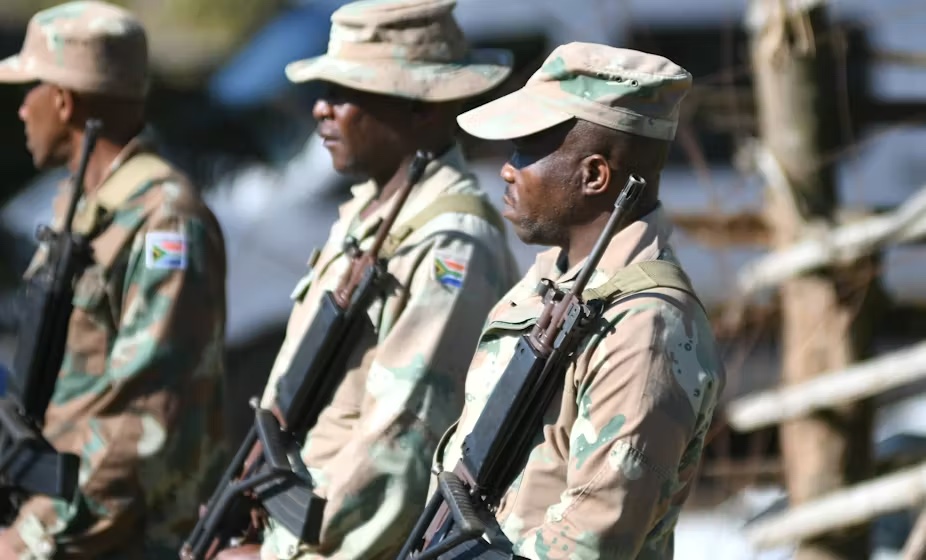

The death of South African soldiers on a Southern African Development Community (SADC) mission in the Democratic Republic of Congo (DRC) has sparked fierce debate about the deployment of South African National Defence Force (SANDF) soldiers there. Some, including political parties, have questioned whether the soldiers were adequately trained, equipped and supported. Lindy Heinecken has spent decades researching the South African military in peacekeeping operations and has interviewed hundreds of soldiers about their experiences and the challenges during deployment. We asked her for her insights.
What is South Africa doing in the DRC?
The country is part of the Southern African Development Community Mission in the Democratic Republic of Congo (SAMIDRC), which includes troops from Malawi and Tanzania. This deployment followed approval by the Southern African Development Community in May 2023, in response to the deteriorating security situation in eastern DRC. The South African National Defence Force is leading the mission.
Their mandate is to support the DRC government, a member of the 16-member SADC group, in restoring peace, security and stability. The fact that the mandate states that it is to support the DRC government in combating armed groups that threaten peace and security in the eastern DRC implies that this is not a peacekeeping mission.
The legal basis for the deployment lies in the SADC Mutual Defence Pact, (2003), which states that
Any armed attack perpetrated against one of the States Parties shall be considered a threat to regional peace and security and shall be met with immediate collective action.
The mandate gives them the responsibility to protect civilians, disarm armed groups, and help implement the August 2024 ceasefire agreement between the DRC and Rwanda, brokered by Angola as part of the Luanda Process. This agreement aimed to provide a more secure environment, and protect critical infrastructure to ensure the safe delivery of humanitarian aid. This is in line with the United Nations’ responsibility to protect victims of genocide, war crimes, ethnic cleansing and crimes against humanity.
The M23 rebel group, which is supported by Rwanda, has committed a wide range of atrocities in the eastern DRC which can be traced back to the 1994 genocide.
The impact on civilians has been devastating. While pinning down an exact number is difficult, it’s clear that the rebel forces operating in the eastern DRC, particularly the M23, pose a significant challenge to the stability of the region, and the safety and security of civilians.
The rebels are implicated in mass killings of civilians, rape and other forms of sexual violence and attacks on camps for internally displaced persons. The M23’s atrocities have been condemned by the international community. The United Nations and human rights bodies have called for an end to the violence. They also demand accountability for the perpetrators.
In sum, South African soldiers – alongside Malawians and Tanzanians – are in the DRC to assist the Congolese army in combating the armed groups and to protect civilians from violence and human rights abuses. https://datawrapper.dwcdn.net/k4Py9/2/
Are the soldiers adequately prepared and equipped?
Many questions have been asked about whether South African troops on the mission forces are adequately trained and equipped. Critics claim this deployment is suicidal.
South African soldiers are well-trained and have served in numerous peace operations. Their extensive deployment means that they have accumulated valuable experience. They have been part of the UN Stabilisation Mission in the DR Congo, Monusco, almost since inception in 1999.
Monusco forces are still present in the DRC, but in the process of withdrawing. Congolese president Félix Tshisekedi requested they leave because of their perceived ineffectiveness.
Nonetheless, there are some valid concerns about the South Africans’ current level of preparedness for the DRC mission. Not least given the complex political situation. There are over 100 diverse armed groups involved. And the terrain is difficult.
The combination of budget cuts, resource limitations, and the complex nature of the conflict raises questions about the South African National Defence Force’s ability to effectively achieve its objectives, and ensure the safety of its personnel.
The force takes its own equipment on missions to ensure it is self-sufficient and can meet its specialised needs. The problem is that this equipment is old, leading to shortages due to maintenance problems. This affects the force’s ability to carry out its duties.
Budget cuts for defence over the years, to less than 1% of GDP compared to the global average of 2%, have severely affected the military’s ability to maintain equipment, conduct training exercises and modernise its force. This has led to a decline in overall readiness.
South African troops in the DRC lack essential resources, including adequate air support, attack helicopters and modern equipment. This limits their ability to respond quickly to threats and provide close air support for ground troops.
Despite having one of the most capable air forces in Africa, it is unable to deploy its Gripen and Rooivalk helicopters because they have not been serviced and lack spare parts.
The use of older equipment has also been less effective against the well-equipped M23.
Besides being outgunned, the regional mission is also out-manned.
The SADC mission in the DRC was authorised to have 5,000 troops from Malawi, South Africa and Tanzania. The actual deployment has fallen far short of this number. As of late January 2025, only about 1,300 troops had been deployed.
Where to from here?
There are concerns in the DRC about the presence of multiple foreign forces, given the relative ineffectiveness of these interventions.
There are also questions about the legitimacy of the mission. Rwanda has opposed the deployment, saying that the SAMIDRC, and specifically South Africa’s involvement, undermines regional unity and cooperation.
The best approach to peace and stability in the DRC requires a concerted effort by regional actors – the DRC, Rwanda, Uganda, Burundi, Kenya and the Southern African Development Community – to address the underlying causes of the conflict. This requires political dialogue with the regional actors, the UN, the international community and, most importantly, the Congolese people.
As for South Africa, it is time for some critical reflection on the future roles of its military. The equipment shortages and challenges it faces raise serious concerns about the defence force’s ability to carry out its core mandate of protecting South Africa, its territorial integrity and its people in accordance with the constitution.
The tragedy in the DRC highlights the dire need for the South African National Defence Force to be redesigned, modernised and funded to become more effective and capable, ready to meet the immediate challenges it faces (like ageing equipment) and ensure the security of South Africa.
Lindy Heinecken, Professor of Sociology in the Department of Sociology and Social Anthropology., Stellenbosch University
This article is republished from The Conversation under a Creative Commons license. Read the original article.


