
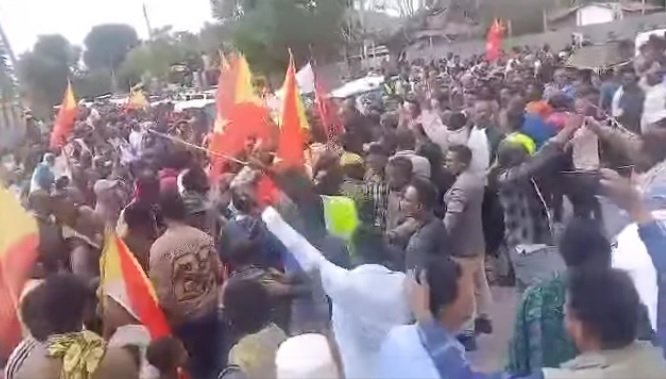

Tensions are escalating in Ethiopia’s northern Tigray region as protests erupted in the town of Maichew following sweeping administrative changes announced by the Tigray Interim Administration (TIA). Residents took to the streets in opposition to what they describe as forceful political control imposed by the TPLF-backed leadership.
The unrest was triggered by recent decisions from the interim leadership under Lt. Gen. Tadesse Werede, which included the removal of local administrators and the appointment of new officials across towns in the Southern Zone—most notably Raya, Maichew, Mohoni, and Chercher.
Local demonstrators accuse the TIA of bypassing community consensus and reigniting old wounds tied to territorial disputes. Protesters argue that the appointments are part of broader efforts by the Tigray People’s Liberation Front (TPLF) to reassert dominance over disputed border regions.
The move comes amid rising friction between the Amhara and Tigray regional governments, especially over the contested Raya Alamata area—an epicenter of post-conflict instability. Although this area was administered by Amhara authorities following the two-year civil war, Tigrayan forces have reportedly re-entered the region and taken control, prompting speculation that federal forces may have been ordered—or requested—to vacate.
It remains unclear whether the federal government sanctioned the redeployment. The Amhara regional leadership has yet to comment publicly on the latest developments, though concerns are mounting over potential escalation.
Historically part of the Wollo province, Raya was absorbed into Tigray under Ethiopia’s ethnic federalism model introduced in the early 1990s. Its administrative status has been a persistent flashpoint, with local residents divided over ethnic identity and regional affiliation.
The House of Federation, Ethiopia’s constitutional arbitrator on interregional disputes, has confirmed it is working to resolve border and identity issues in Raya and similar contested areas. However, tangible progress has yet to materialize.
The current wave of protests adds to an already volatile post-war landscape. Although the Pretoria Agreement brought an end to open conflict in 2022, intermittent clashes and population displacements have continued. In July 2024, over 14,000 displaced individuals returned to their homes in Alamata, Waja, Timuga, Merewa, and Cheqera after months of uncertainty.
That brief calm was shattered in March when Tigrayan and Amhara militias clashed in Raya Alamata. Local officials reported four Amhara casualties and multiple injuries. The Ethiopian National Defense Force (ENDF), accused of failing to intervene, was said to have been informed of the attack in advance. Regional authorities pointed fingers at the TPLF for orchestrating the violence.
The broader dispute extends beyond Raya. Other contested areas like Wolqayt, Tsegede, and Telemt—currently under Amhara administration—are also sources of interregional contention, rooted in Ethiopia’s divisive federal structure.
According to conflict analysts, the federal government faces growing pressure to contain the fallout. One expert, speaking to DNE Africa, warned that the current trajectory could spiral into another major conflict. “Without federal arbitration and a transparent peace mechanism, we’re staring down the barrel of renewed civil war,” the expert said.
These internal tensions unfold as Ethiopia also faces diplomatic challenges on multiple fronts. Disagreements with Eritrea over port access and mounting pressure over the Grand Ethiopian Renaissance Dam (GERD) are stretching the country’s capacity to navigate both domestic and international disputes.
With mistrust deepening between Amhara and Tigrayan authorities and the status of border areas unresolved, Raya Maichew is once again becoming a flashpoint in Ethiopia’s fragile post-conflict transition. Whether the federal government will intervene decisively—or continue its cautious silence—remains to be seen.


