
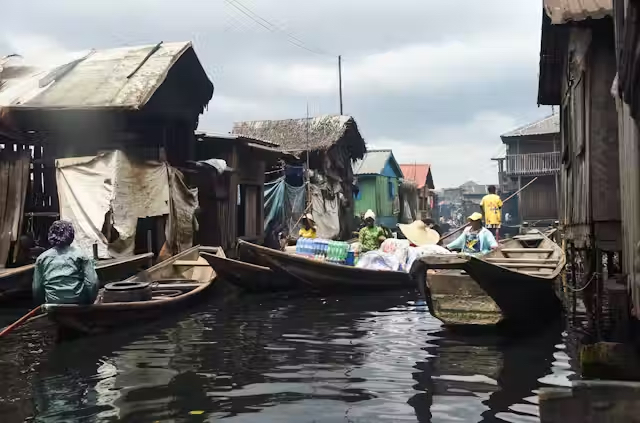

Lagos is Nigeria’s economic powerhouse, but it has some of the worst slums in the country.
Lagos slums are characterised by high levels of poverty – the state of not having enough resources to meet basic needs for living, such as food, water, shelter, healthcare and education.
Poverty is multidimensional. It is not only about money. Yet poverty in Lagos slums has often been studied using traditional methods that focus mostly on income thresholds. A person is considered poor if their income falls below a certain level. This approach captures financial hardship. But it misses other aspects of poverty, such as lack of access to education, healthcare, clean water and decent living conditions.
Measuring poverty requires a multidimensional approach, not simply an income approach. Multidimensional poverty means looking at all the aspects of deprivation to get a fuller picture of what it means to live in poverty. It helps policymakers and researchers understand that even with some income, a person may still be struggling because they don’t have other essential services.
In a study of poverty in the Lagos State slums, two other development economists and I used a mathematical framework to model multidimensional poverty. We used what is known as the fuzzy set approach. This was developed in the 1990s as an alternative to purely monetary measures of poverty.
The traditional monetary approach often classifies people as either “poor” or “not poor” based on specific cut-off points. In reality, poverty exists on a spectrum, and people can experience different levels of deprivation across various aspects of their lives. The fuzzy set approach accounts for this by assigning degrees of membership to different poverty indicators.
We found considerable disparities in poverty, based on a multidimensional index, across slums in Lagos State. Our insights will enable economists and policymakers to see the different ways people in slums are deprived. In turn this should help them understand how to make their lives better in a more targeted and effective way.
Background and methodological approach
Our study focused on five big slums that lie close to the coastal line in Lagos state. These are among the slums the World Bank has identified for upgrading as part of a US$200 million loan project to improve drainage and solid waste management.
We chose 400 respondents from the five slums: Makoko, Iwaya, Ilaje, Ijora Badia and Amukoko.
According to Avijit Hazra and Nithya J Gogtay, researchers in bio-statistics and research methodology, a minimum of 384 samples is appropriate for a large population size. Nevertheless, the selected sample for this study limits the ability to generalise the findings to other slums, especially those with different characteristics.
Findings
The multidimensional poverty index was highest in Makoko and Iwaya. These scores indicate severe poverty, as they are above the threshold of 0.50.
In contrast, Amukoko had the lowest multidimensional poverty index, showing relatively less severe deprivation across indicators.
Makoko and Iwaya are particularly deprived in areas like schooling, sanitation and nutrition. This explains their higher poverty levels compared to other communities.
Makoko’s location along the coast, with its makeshift housing and poor infrastructure, adds to its vulnerability. Iwaya shares similar challenges in education and health services. These factors make both areas more deprived than other slums.
Of the three broad poverty dimensions measured, education emerged with the highest deprivation across all communities. This highlighted the limited formal education among residents.
Specifically, Makoko and Iwaya showed the highest deprivation in schooling. Despite some improvements, particularly in child enrolment, these communities are still marked by severe deprivation.
The second dimension exhibiting severe deprivation was living standards. There were variations across different slums. Makoko and Iwaya had higher sanitation challenges.
The third dimension in the severe deprivation category was health. Indicators included mortality and nutrition. They were high across many slums, contributing significantly to their multidimensional poverty indexes.
Other communities, such as Amukoko (0.0312), showed better sanitation outcomes. On the other hand, electricity, flooring and cooking fuel indicators generally showed lower levels of deprivation, with most slums scoring around or below 0.03 in these categories.
The prevalence of both serious and minor illnesses, coupled with insufficient medical care, contributed to high mortality rates.
Poor sanitation could also be a factor in health issues. In Makoko and Iwaya, toilet facilities and waste management were poor, with waste often disposed of in waterways.
Despite this, personal hygiene practices such as using clean water, soap and regular brushing were prevalent. This helped keep the sanitation index relatively low compared with other factors affecting health.
Other slums had relatively better-organised waste collection systems and generally improved sanitation practices.
Lagos: What needs to be done
Policymakers should prioritise education-focused initiatives. This should include improving access to quality schools, providing scholarships and setting up adult literacy programmes.
The study also highlights challenges related to sanitation, especially in Makoko and Iwaya. There is a need for improved infrastructure in these areas, such as better sanitation facilities, waste management systems and access to clean water.
Policies should focus on upgrading sanitation services to reduce health risks and improve living conditions.
But the differences in poverty index across slums indicate varying levels of deprivation, suggesting that a one-size-fits-all approach will not be effective.
Coastal slums like Makoko and Iwaya require more intensive interventions compared to slums not directly on coastal lines such as Amukoko.
Policymakers should focus resources where they are most needed to have the greatest impact.
Slums like Ilaje and Ijora Badia are close to the threshold of severe poverty. Policymakers need to take proactive measures to prevent these communities from falling into severe deprivation.
Lastly, it is important to use data to identify priority areas and develop targeted interventions aimed at improving the quality of life for slum dwellers.
Instead of relying on generalised approaches, the insights from this study can facilitate the design of specific policies that address the distinct needs of each community.
Oluwaseyi Omowunmi Popogbe, Lecturer II, Crawford University
This article is republished from The Conversation under a Creative Commons license. Read the original article.


