
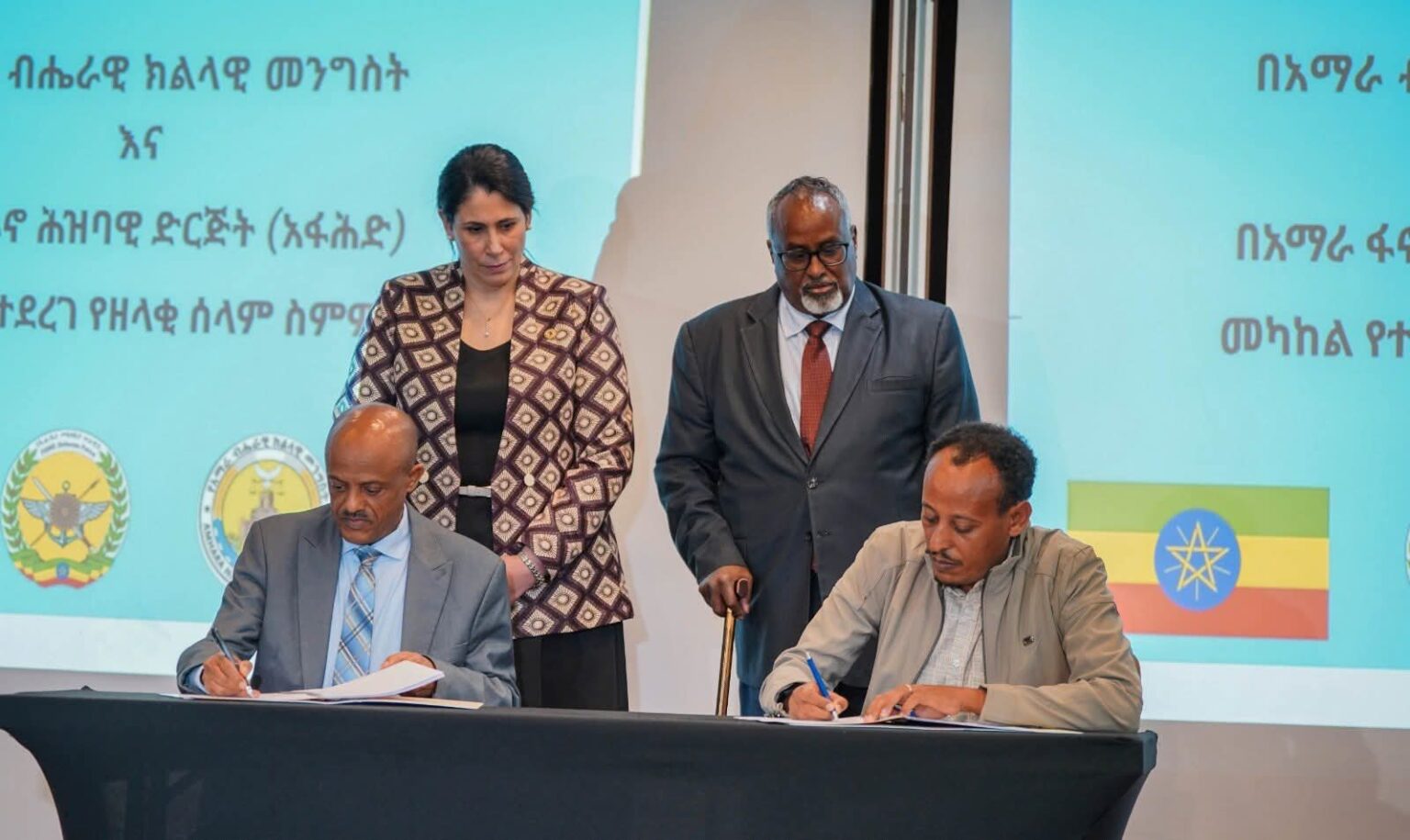

Recently, Ethiopian state-owned media outlets and social networks were flooded with headlines announcing a “peace agreement” between the Amhara Regional Government and Captain Masresha Setie. Introduced as a representative of the Amhara Fano People’s Organization (AFPO), Captain Masresha signed the accord in a ceremony celebrated by the Ethiopian government, the African Union (AU), and the Intergovernmental Authority on Development (IGAD). Officials hailed the event as a major breakthrough for achieving lasting stability in the region.
However, for those closely observing the grinding conflict in the Amhara region, the agreement appears to be less a genuine step toward peace and more a staged event. The deal underscores a concerning trend in Ethiopia’s conflict dynamics: the prioritization of procedural appearances over meaningful, substantive peacebuilding.
Notably, prior to the signing ceremony, the AFPO had formally expelled Captain Masresha on November 29, 2025, citing his unauthorized attempts to negotiate on behalf of the organization. Despite defecting with only thirteen individuals, Masresha was center stage at the Radisson Hotel in Addis Ababa on December 4, engaging in the pageantry of handshake photo-ops and press statements. The quick endorsement by the AU and IGAD of such a deal as a “breakthrough” raises serious questions about the depth of their due diligence.
A Deal with No Constituency
Armed conflicts are, by nature, political. The Amhara Fano movement is no exception. Since its inception as a civic movement in late 2015, Fano has been driven by deep-seated grievances, including widespread ethnic-based violence, a lack of self-administration, exclusion from central power, and structural injustices. Meaningful conflict resolution requires dialogue with actors who command real constituencies and uphold the people’s political quest. Captain Masresha does not meet this criterion.
In a strongly worded statement, the AFPO dismissed the deal, asserting that Masresha had “no mandate to negotiate on behalf of the organization” and that the agreement “does not reflect the reality on the ground.” Furthermore, the largest Fano group, the Amhara Fano National Force (AFNF), has not engaged with the process, and sources indicate that combat operations remain unchanged.
In the conflict zones, thousands of fighters and civilians continue to experience the daily, brutal realities of war. Negotiating with an individual who no longer represents his organization does not weaken an armed movement, nor does it bring sustainable peace.
A Skeptical Public and Complicit Mediators
News of the agreement was met with widespread mockery across Ethiopian social media platforms. Many users dismissed the deal as “a staged performance,” questioning the logic of signing a peace agreement with an individual representing a movement he ostensibly no longer belongs to.
The federal government’s enthusiasm, however, is telling. For years, Addis Ababa has struggled to control the narrative surrounding the conflict in Amhara. The fighting has grown more intense, the number of active Fano units has not diminished, and the grievances that ignited the resistance remain unaddressed. Consequently, when a defector is willing to sign a document, the government rushes to frame it as national progress.
For officials in the capital, this is a low-cost propaganda victory. On the ground, however, nothing has shifted. Federal and regional security forces continue operations, civilians continue to bear the cost, and no political roadmap has been offered. At best, this deal delays honest engagement; at worst, it further entrenches mistrust.
The involvement of international bodies adds a layer of complexity. In April 2025, leaked audio exposed the initiation of peace talks between the AFPO and the Ethiopian government, facilitated by the AU and IGAD. AFPO leader Mr. Eskinder Nega subsequently admitted to ongoing talks. Yet, the process has lost credibility as mediators appear to have pivoted to negotiating with a single, expelled individual.
IGAD’s involvement is complicated by its leadership’s close relationship with Prime Minister Abiy Ahmed, suggesting an alignment with the federal government’s strategy. However, the AU’s rationale is more obscure. The AU has defended its participation by invoking a new “Individual-Centered Peace-Signing Model,” which theoretically leverages defections to catalyze wider demobilization. But applying this model without verifying representational authority risks legitimizing individuals without constituencies. It threatens to erode the AU’s already fragile credibility in the Horn of Africa, reducing peacebuilding to incentivized opportunism.
Reframing the Conflict to Avoid Responsibility
A distinct political strategy lies behind the choice of signatories. Although the Fano insurgency is fighting the federal government, this deal was signed with the Amhara regional government. This is a calculated move by the Abiy administration to frame the conflict as a local uprising—a law-and-order issue for regional leaders to manage—rather than a national political crisis requiring federal accountability.
If the federal government were to engage in direct negotiations with Fano, it would imply recognition of Fano as a legitimate political actor—a concession authorities are unwilling to make. By channeling the deal through the regional government, the federal administration creates a strategic workaround. It maintains the appearance of diplomatic progress while sidestepping the core issue of legitimacy.
Moreover, this maneuver allows the federal government to deflect political responsibility for the crisis. By placing the onus on regional authorities, the federal administration distances itself from direct accountability regarding accusations of federal-level grievances and allegations of genocide. This fits a broader pattern in Ethiopia’s recent trajectory: shifting responsibility for conflict downward while keeping centralized power intact. A similar playbook was used a year ago when the Oromia regional state signed a peace deal with defectors from the Oromo Liberation Army; despite the fanfare, the conflict in that region remains unresolved.
Conclusion: A Manufactured Peace Is No Peace at All
The deal between Masresha Setie and the Amhara Regional Government is not a step toward peace; it is an artifact of a political system increasingly reliant on optics, deflection, and procedural theater. It does not reduce violence, address the grievances of the Amhara people, or engage legitimate actors.
Instead, it creates the illusion of progress while the population continues to suffer displacement, militarization, arbitrary detention, and extrajudicial killings. Ultimately, this deal serves to mislead diplomats, confuse donors, and delay the meaningful intervention of international peace actors. It reinforces a dangerous trend where mediated spectacles are normalized as a substitute for genuine conflict resolution.


