
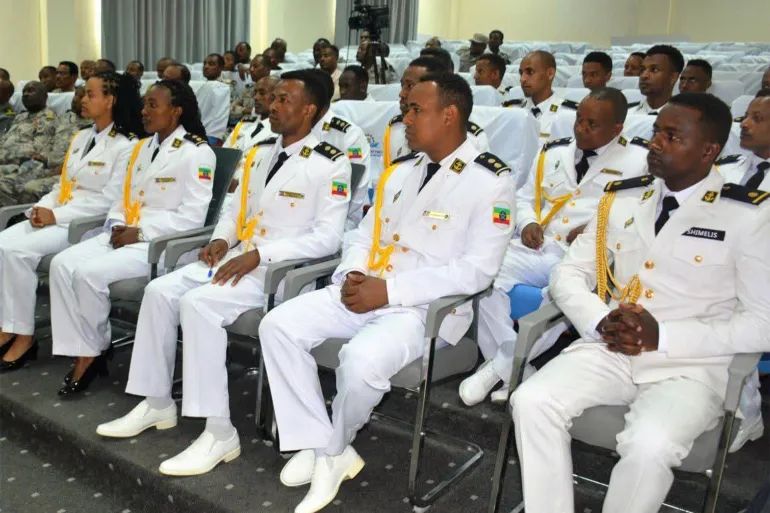

Ethiopia has officially welcomed home its first cohort of naval officers trained abroad, in a landmark step towards rebuilding its maritime capabilities more than three decades after the country lost its coastline. The Ministry of Defense held a formal ceremony to celebrate the return of the graduates—who completed six years of study and training in various naval engineering and technical disciplines—describing the occasion as a significant milestone for Ethiopia’s defense strategy.
These are the first Ethiopian naval officers to be trained internationally since the secession of Eritrea in 1993, which left Ethiopia landlocked and without a naval force. The graduation underscores Ethiopia’s ambitions to re-establish a naval presence that can protect national interests, particularly in the Horn of Africa and surrounding maritime routes critical to the country’s economic and security outlook.
Speaking at the ceremony, Ethiopian Navy Commander General Kindu Gezu said the return of the naval officers marks “a new chapter in Ethiopia’s defense doctrine” and reflects a “strategic commitment to building a competent maritime force that can safeguard the country’s interests, even from inland.” He added that the newly trained officers would play a vital role in shaping the future of Ethiopia’s naval institutions and maritime security operations.
The Ministry of Defense has not revealed the countries where the officers received their training. However, Ethiopia had previously signed naval cooperation and training agreements with several states, including Russia, France, and Italy. These agreements aimed to support Ethiopia’s long-term plan to revive its naval capacity despite lacking direct access to the sea.
In May 2025, Ethiopia announced the formation of a new maritime police unit tasked with securing the area surrounding the Grand Ethiopian Renaissance Dam (GERD), one of the country’s most strategic infrastructure projects. The artificial reservoir created by the dam has been described as a “critical national asset” and has attracted growing concerns over regional water security, particularly from Egypt and Sudan.
The government’s decision to re-establish a naval force and develop maritime policing units has also been interpreted as part of Ethiopia’s broader regional security agenda. Analysts have noted that, despite being landlocked, Ethiopia’s access to ports via neighboring Djibouti—and its increasing military and economic engagements in the Red Sea and Horn of Africa—make the revival of a naval command both symbolic and strategic.
With the return of its first naval graduates, Ethiopia signals a new era in its post-1993 defense posture, aligning military modernization with regional ambitions. The Ministry of Defense is expected to announce additional steps in the coming months to expand Ethiopia’s maritime defense strategy, including training, infrastructure, and cooperation with foreign allies.


