
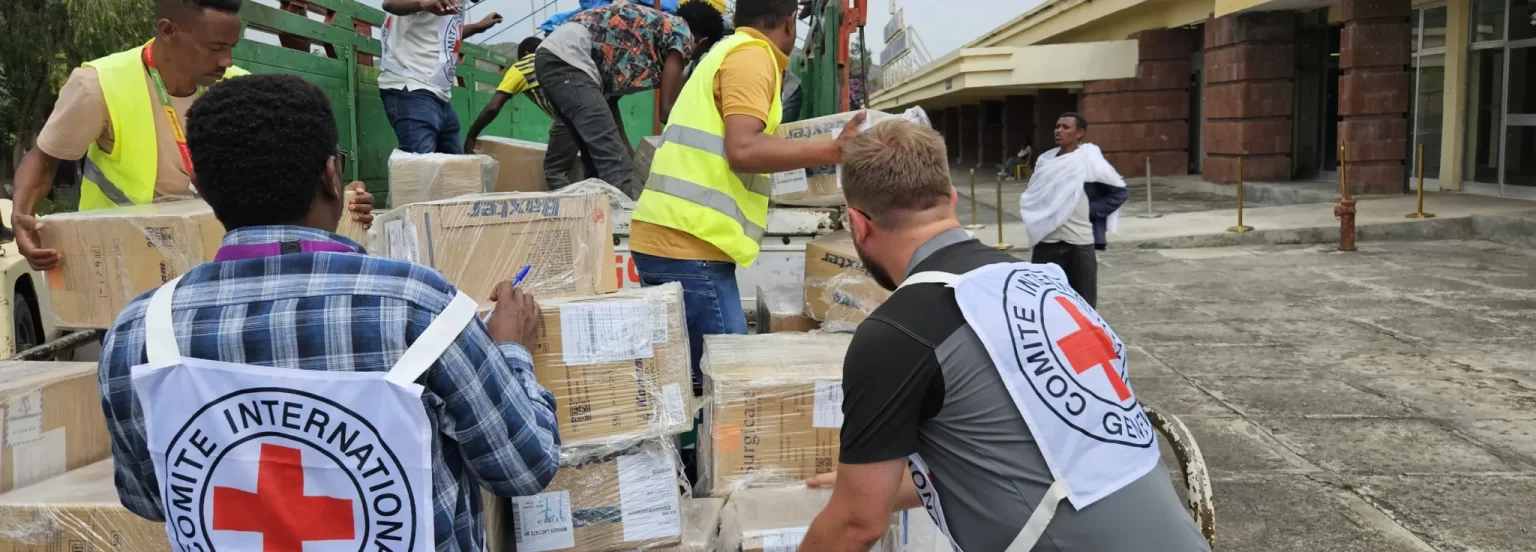

The International Committee of the Red Cross (ICRC) has stepped up its humanitarian response in Ethiopia’s Amhara region, delivering critical medical supplies, evacuating wounded Ethiopian National Defense Forces (ENDF) soldiers, and visiting detainees after a recent escalation in fighting caused large numbers of casualties.
The Amhara region has been experiencing a conflict between government forces and the Amhara Fano armed group since August 2023. The ICRC said the situation in the eastern part of the region deteriorated further at the end of September after a sudden escalation of hostilities in the North Wollo zone.
In response, the ICRC said it had deployed two teams in and around the towns of Lalibela and Woldiya over the past six days, delivering enough surgical material to treat 250 severely wounded people to six health facilities.
On Oct. 8, the organisation evacuated 16 critically injured soldiers who were handed over by the Amhara Fano across the front line and transferred to government forces in Woldiya town. A day later, ICRC staff visited detainees held by the Amhara Fano in North Wollo.
“Many people have been killed or wounded in North Wollo in recent days,” said Martin Thalmann, the ICRC’s team leader in Lalibela. “Staff at local health centres cared for wounded soldiers and civilians with limited resources. Sixteen critically injured detainees needed urgent evacuation for surgical treatment, and for five of them it was a matter of hours to save their lives.”
The ICRC provided initial medical assistance to health centres in Kulmesk and Muja and plans to bring more supplies to address acute shortages. It has also donated surgical supplies and medicines to hospitals in Woldiya, Kobo, and Tekulashe, with a similar donation planned for Lalibela’s hospital.
The purpose of the detainee visits was to assess their conditions, the treatment they receive, and to re-establish contact with their families, the organisation said.
The ICRC warned of the wider humanitarian impact on civilians in the area.
“Communities in the most affected areas shouldn’t be forgotten,” said Thalmann. “Due to the lack of safety, there is little access to health care, education or transport for people in more remote areas. In the areas most affected by the recent clashes, people are unable to go to markets and harvest their fields. Some have fled to other villages.”
The ICRC called on the parties to the armed conflict in Amhara to comply with international humanitarian law, which protects civilians and those no longer participating in hostilities, including captured or wounded fighters.
The organisation said it will continue its emergency response and plans to increase its support at the Woldiya hospital by providing physical rehabilitation for severely wounded patients. It also underlined its readiness to serve as a neutral intermediary in future detainee releases.
.
AMHARA FANO OFFENSIVE
The recent escalation in fighting appears to be linked to a new offensive claimed by the Amhara Fano. The group said the operation, now in its third day, is named “Operation Adem Ali (Aba Nadew)” after a Fano commander killed months ago.
Fano sources have claimed to have taken control of Mekaneselam, a significant city in South Wollo, and captured Colonel Habtamu Assefa during the operation.
Intense clashes have been reported in several strategic towns across the Wollo region, including Gashena, Woldiya, and Lalibela in the north, and Kutaber and Boru Selassie in the south.
Fano sources have claimed substantial casualties among the Ethiopian National Defense Forces (ENDF), with DNE Africa reporting claims of 716 ENDF troops killed and 188 captured on Thursday alone. The rebels also claimed to have wounded the commander of the ENDF’s 12th Division and captured his deputy. These claims have not been independently verified.


