
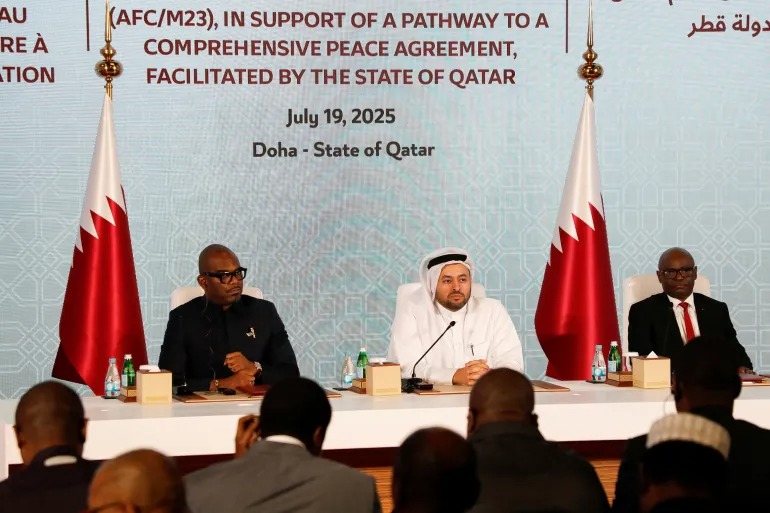

In a significant step toward ending years of violence in eastern Democratic Republic of the Congo (DRC), the Congolese government and the M23 rebel group signed a Declaration of Principles on Saturday in Doha, committing to a permanent ceasefire and opening the door to direct peace negotiations.
The signing follows months of complex negotiations hosted by Qatar since March, with direct participation from both parties and strong international backing—including from the United States.
Speaking at the signing ceremony, Qatar’s Minister of State for Foreign Affairs, Mohammed bin Abdulaziz Al-Khulaifi, emphasized that the agreement lays the groundwork for a new phase of national reconciliation in the DRC. He added that the declaration not only commits both sides to ending hostilities, but also sets a path toward inclusive peace talks that address the root causes of the conflict.
“Qatar’s engagement in this file began with the high-level meeting in Doha last March between the Presidents of Rwanda and the DRC, which was a true turning point,” Al-Khulaifi said. He noted that Qatar played a central role in bridging the divide between the conflicting sides.
Backed by International Consensus
The declaration builds on earlier diplomatic efforts, including the Washington Agreement signed on June 27 between Rwanda and the DRC. That accord laid the groundwork for coordination that culminated in today’s Doha breakthrough.
Al-Khulaifi stressed that the new agreement represents a clear commitment to ending violence and opens the way for stronger international engagement to support peacebuilding and sustainable development in affected regions of eastern Congo.
Also present at the signing was the U.S. Presidential Envoy for African and Middle Eastern Affairs, who praised Qatar’s “vital and consistent” role in global conflict mediation. “Qatar has proven once again to be a trusted partner in facilitating peace. We thank Doha for its crucial leadership,” he said.
A Turning Point After Years of Conflict
The war in eastern Congo has displaced more than 8 million people and fueled one of the world’s longest-running humanitarian crises. Most previous peace efforts have failed to secure lasting results.
By contrast, the Doha Declaration is being hailed as a rare and potentially transformative opportunity to address long-standing grievances, demobilize armed groups, and create conditions for lasting stability in the Great Lakes region.
Over the past two decades, Qatar has emerged as a key diplomatic actor in global conflict resolution, having mediated agreements in Darfur, Lebanon, and Afghanistan. Its role in the DRC crisis is the latest in a series of high-profile efforts aimed at supporting peace and international cooperation.


