
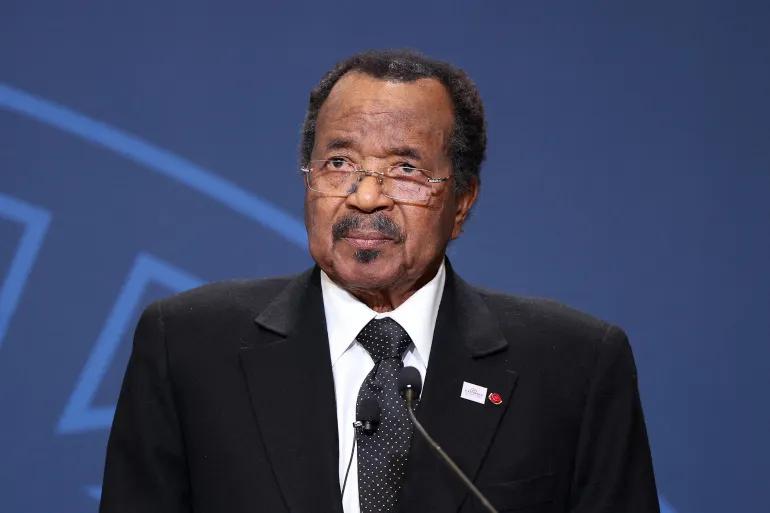

Cameroon’s president, Paul Biya, who is now over 90 years old, has officially announced his candidacy for the presidential election scheduled for October. The move, while not surprising to political observers, underscores his continued reliance on a tightly knit network of political and security figures that has helped him remain in power for more than four decades.
In keeping with his political tradition, Biya appeared surrounded by key members of his long-standing inner circle — including First Lady Chantal Biya, presidential chief of staff Samuel Mvondo, presidential secretary-general Ferdinand Ngoh Ngoh, and senior military and police officers.
While the ruling Cameroon People’s Democratic Movement (CPDM) provides much of Biya’s political base, his grip on power has been equally anchored in a sophisticated, loyal security apparatus. Many civil servants and politicians remain in the dark about the exact structure and interplay of these forces.
Biya’s deep dependence on security forces dates back to April 6, 1984, when he survived an attempted coup. In its aftermath, he restructured the armed forces, replaced the Republican Guard with the Presidential Guard, and ensured that key security positions were filled by trusted loyalists heading the presidential security service, the national police, and the armed forces general staff.
Key Figures in Biya’s Security Machine
• Brig. Gen. Emmanuel Amoungou – Chief of the president’s personal military staff and a close aide, overseeing military and security aspects of presidential travel and coordinating directly with the armed forces.
• Col. Raymond Jean Charles Beko’o Abondo – Commander of the Presidential Guard, who in February 2024 trained a 700-strong elite unit to reinforce the force.
• Adm. Joseph Fouda – Special defense and security adviser, responsible for secure presidential communications. Once sidelined over corruption allegations, he has returned to prominence.
• Ivo Desancio Yenwo – Head of presidential security since 2004, tasked with protecting the president, first lady, and presidential premises. A veteran of the 1984 coup suppression.
Field Commanders with Direct Access to the Presidency
• Gen. René Claude Meka – Chief of Defense Staff since 2001, coordinating the army, navy, and air force, including special forces.
• Col. François Blain – Commander of the Rapid Intervention Battalion (BIR), an elite unit reporting directly to the presidency, independent of army command.
• Charles Alain Mvondo Matieng – Head of the capital’s security brigade, formerly led counterinsurgency operations in the Anglophone regions.
Veteran Loyalists
• Martin Mbarga Nguele – Director-General of National Security since 2010 and one of the oldest active officers in the world at 92. Oversees national intelligence and daily security reports to Biya.
• Col. Pacific Melengue Nkoulou – Head of military security, a position with wide-ranging intelligence powers beyond traditional military policing.
This intricate web of loyal military and security leaders — spanning the presidency, armed forces, and police — has been central to Biya’s political survival. Beyond these prominent figures, the president also works closely with the minister delegate for defense, the minister of territorial administration, and the commander of the national gendarmerie.
Biya’s carefully maintained balance of political and security forces ensures that, as he seeks yet another term, his control over Cameroon’s state machinery remains as firm as ever.


