
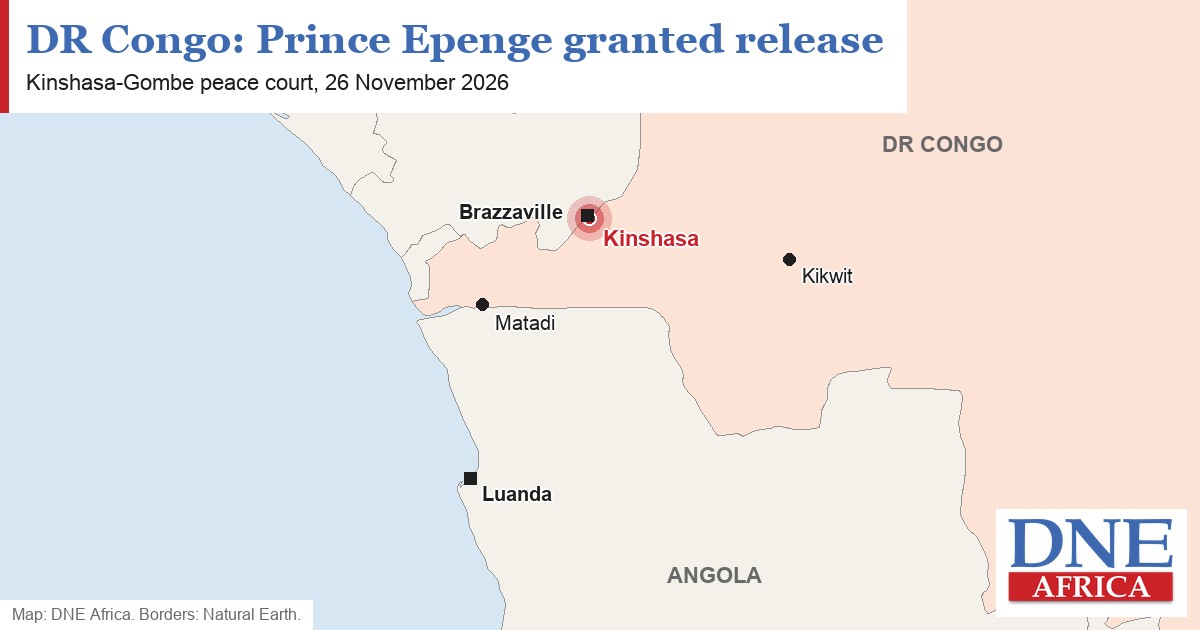

A court in Kinshasa on Thursday granted provisional release to Prince Epenge, spokesman of DR Congo’s opposition Lamuka coalition, who has been held for a month on a charge of spreading false rumours, one of his lawyers said.
The decision on Prince Epenge eases one of the most visible cases in a dispute between President Félix Tshisekedi’s government and an opposition that accuses it of silencing critics, though his trial continues.
What did the court decide in the Prince Epenge case?
The Kinshasa-Gombe peace court, sitting in chambers, granted Epenge provisional release on Thursday, 26 November, defence lawyer Clément Muza Kayembe said, according to Actualite.cd and Reporter.cd. “The defence welcomes this decision with satisfaction and relief,” he said, calling it an important step for democracy and fundamental rights. The conditions of the release were not disclosed.
The next hearing in his trial is set for 11 December, Reporter.cd said. Provisional release does not end the prosecution.
Why was Prince Epenge arrested?
Prince Epenge, who leads the ADD Congo party, was detained on 25 October at N’Djili international airport as he was about to fly to Rome for a meeting of the opposition Coalition Article 64. He was held at first by the National Cyber Defence Council, then moved to Makala central prison on 31 October, where he spent 26 days.
Lamuka is the opposition alliance formed in 2018 to back Martin Fayulu, who came second to Tshisekedi in that year’s presidential election and disputed the result. Prince Epenge has been one of its most outspoken figures in Kinshasa and a frequent critic of the security services’ handling of opposition protests.
He is charged with spreading false rumours after saying that Manassé Lomboto, his party’s head of security, was killed after an opposition protest in Kinshasa on 15 September. Prosecutors say Lomboto died of illness, citing medical evidence.
Tshisekedi defended the arrest on 30 October, telling the Congolese diaspora in Moscow that the death had been used in a case “fomented against us” and that Lomboto had died of “other illnesses”, Actualite.cd reported. Being in opposition does not exempt anyone from accounting for what they say, he said.
What happened at the last hearing?
At a hearing on 25 November, prosecutors opposed the release of Prince Epenge, citing a risk of flight, and said messages on Epenge’s phone showed he had asked a doctor at Kinshasa’s Olympique hospital for a medical certificate, which the doctor refused, Mediacongo reported. The defence cited Article 17 of the constitution, which guarantees individual liberty, and said his health had deteriorated in detention. Earlier requests for release had been rejected.
The case comes amid wider strains between the government and its critics. Police this month blocked a Catholic Church march in Lubumbashi and a Mass led by Cardinal Fridolin Ambongo in Kinshasa, while fighting continues in the east, where the government also faces the M23 and the FRN armed groups.
What happens next?
Epenge’s trial resumes on 11 December before the same court. His lawyers said they would keep defending him “in respect of the laws of the Republic” until the case is concluded.
FAQ
Who is Prince Epenge?
He is the president of the ADD Congo party and spokesman of the Lamuka opposition coalition in the Democratic Republic of Congo.
Why was Prince Epenge released?
On 26 November 2026 the Kinshasa-Gombe peace court granted him provisional release after a month in detention, his lawyer said. His trial continues.
What is he charged with?
Spreading false rumours, over his claim that his party’s security chief, Manassé Lomboto, was killed after a 15 September protest. Prosecutors and President Tshisekedi say Lomboto died of illness.
When is the next hearing?
The trial is due to resume on 11 December 2026.


