
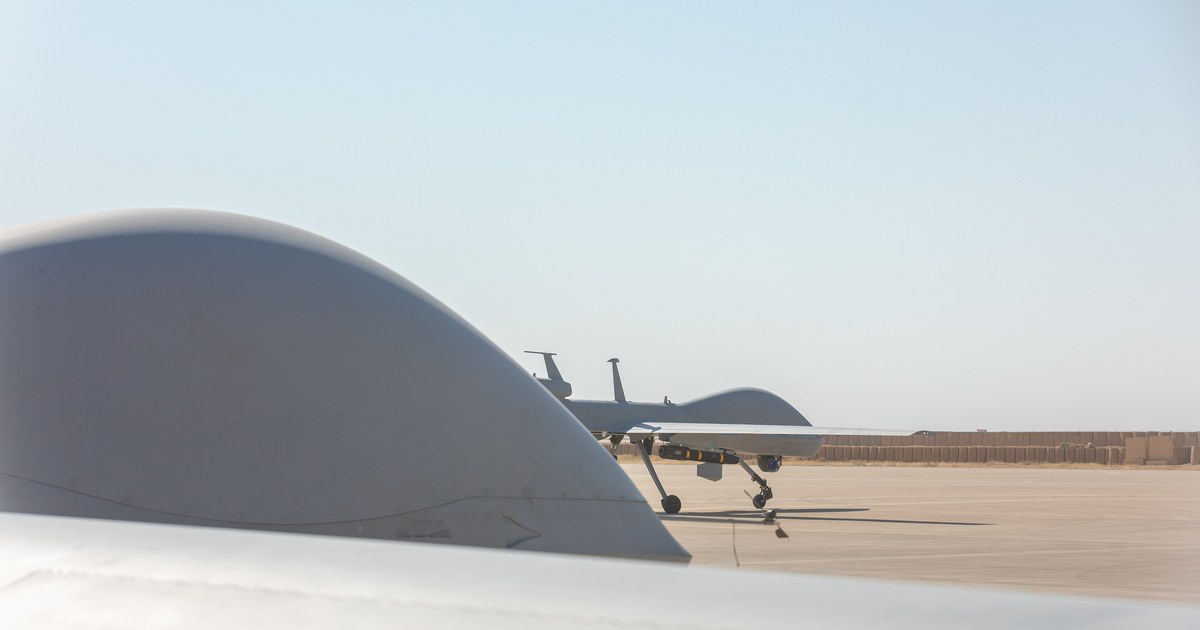

Iran’s Revolutionary Guards said on Sunday that their air defences had shot down a US MQ-1 drone east of the Strait of Hormuz, the fourth American drone they say they have downed in 24 hours.
The claim, which the US military had not addressed by midday, adds to a run of disputed accounts from the waterway as Washington weighs new strikes on Iran. Shipping through Hormuz remains far below pre-war levels, which keeps fuel costs high for importers in Africa and elsewhere.
What did Iran say about the MQ-1 drone?
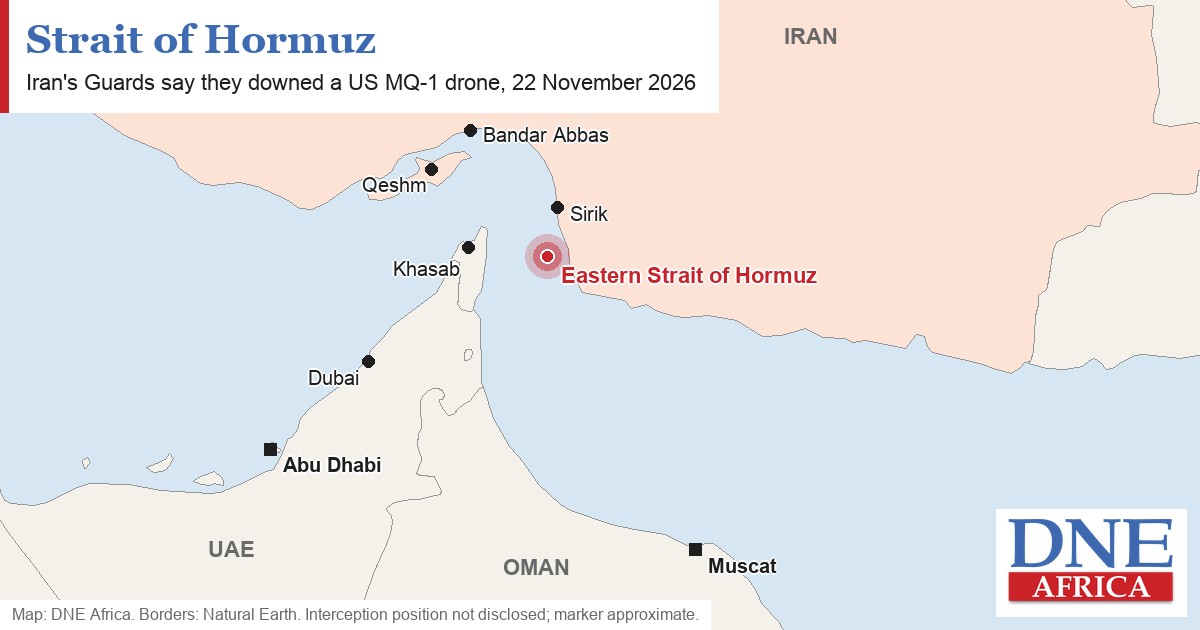
The Guards’ public relations office said its air defence systems had intercepted and destroyed an “advanced reconnaissance and combat” MQ-1 drone over the eastern part of the strait on Sunday morning. It said the aircraft was an extended-range (ER) version and the 20th of the type it had brought down, according to the statement carried by the state broadcaster’s IRIB News (in Persian, translated by DNE Africa).
“The airspace of the Islamic Republic of Iran is a red line,” the Guards said, warning that any aggression or violation of it would meet a “harsh, decisive and capable” response. The statement was also relayed at about 08:30 GMT by Al-Masirah, the channel run by Yemen’s Houthis, Iran’s allies.
The Guards did not give the exact position of the interception or release images of wreckage. The claim could not be independently verified.
Has the US responded to the MQ-1 drone claim?
Not yet. US Central Command had not commented on the MQ-1 drone claim by midday on Sunday. On Saturday it flatly rejected a separate account from Iran’s army that a missile had damaged a US F-16 over the Gulf, saying all its fighter jets in the region were safe, as DNE Africa reported.
The Guards said on Saturday that they had downed the 19th MQ-1 drone over Qeshm Island, near the port of Bandar Abbas, according to the semi-official Mehr news agency. Hours earlier they said they had destroyed an unidentified reconnaissance drone off Bushehr. Tallies published by Iranian outlets differ, and Washington has not confirmed most of the losses Tehran has announced since the war began.
The MQ-1C, known as the Gray Eagle, is a US Army drone built by General Atomics and derived from the Predator. It is used for surveillance and can carry Hellfire missiles.
Why does the Strait of Hormuz matter to Africa?
The fighting around the strait has kept energy prices high far beyond the Gulf. The International Energy Agency said last week that the Hormuz crisis was the largest energy supply shock in history, and warned that higher fuel prices risk slowing gains in electricity access in developing economies, most of whose people without power live in sub-Saharan Africa.
African importers are paying for it. Kenya’s government said it committed KSh28.19bn in fuel price support over two pricing cycles this year, through a stabilisation fund and a cut in value added tax on fuel from 16 to 8 per cent, according to State House in Nairobi. Egypt expects its liquefied petroleum gas import bill to nearly double this winter.
What happens next?
The war began with US and Israeli strikes on Iran on February 28th, and talks have stalled despite a memorandum signed in June. US and Israeli officials are discussing a new round of strikes, CBS News reported this week, though President Donald Trump has not announced a decision. Inside Iran, fuel shortages at power plants mean electricity rationing starts on Sunday.
Each new MQ-1 drone claim and denial raises the risk of a miscalculation in a strait that, before the war, carried about a fifth of the world’s oil.
FAQ
Where did Iran say it shot down the MQ-1 drone?
Over the eastern part of the Strait of Hormuz on Sunday November 22nd 2026, according to the Revolutionary Guards. They did not give an exact position.
Has the US confirmed losing an MQ-1 drone?
No. US Central Command had not commented by midday on Sunday, and the claim could not be independently verified.
How many drones does Iran say it has downed?
The Guards called it the 20th MQ-1 drone they have brought down and the fourth US drone in 24 hours. These are their own figures.
Why does Hormuz matter to African economies?
Disruption to shipping through the strait has raised global oil and gas prices, increasing fuel and import bills for African countries such as Kenya and Egypt.


