

Sierra Leone IMF talks have produced a staff-level agreement that would release about $78.2mn, the International Monetary Fund said on 17 November, as high oil prices push inflation towards 19 per cent.
The agreement covers the fourth review of Sierra Leone’s Extended Credit Facility (ECF) and the first review of its Resilience and Sustainability Facility (RSF), according to an IMF press release. Subject to approval by the IMF Executive Board and completion of agreed prior actions, it would make SDR57.9mn available: SDR23.333mn (about $31.5mn) under the ECF and SDR34.567mn (about $46.7mn) under the RSF. The board is expected to consider both reviews in the coming weeks.
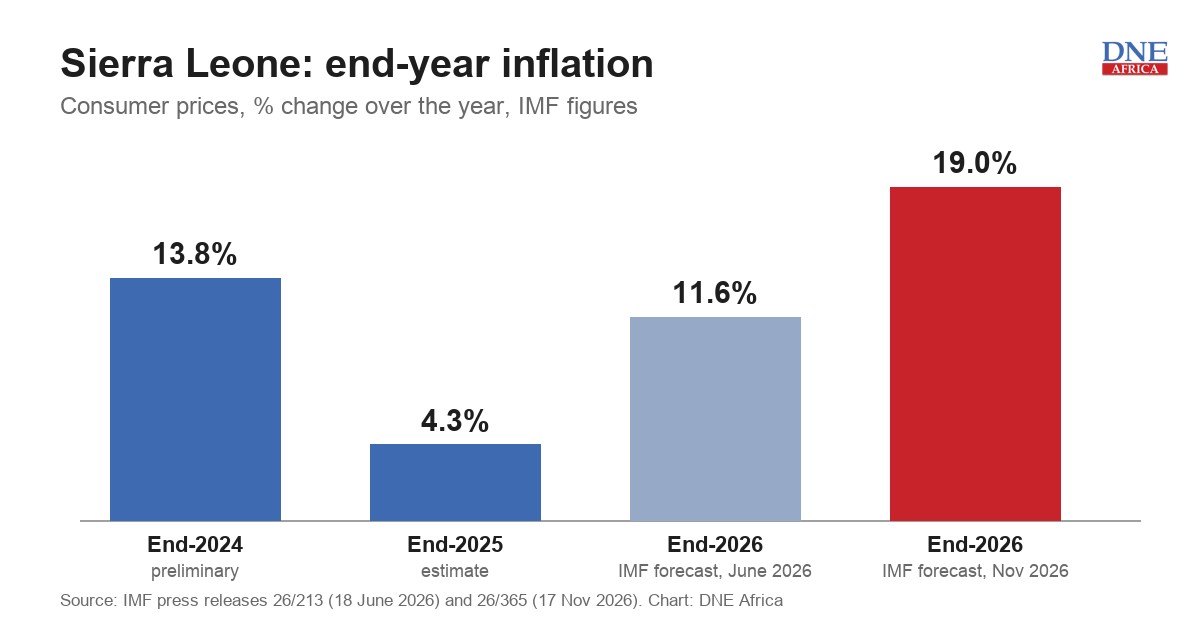
The money matters because the outlook has worsened since the last review. The 19 per cent inflation the IMF now expects by the end of 2026 compares with the 11.6 per cent it forecast in June, and the Fund said fiscal and foreign-exchange pressures threaten recent stabilisation gains.
What did the Sierra Leone IMF mission find?
The Sierra Leone IMF mission, led by Jeta Menkulasi, held talks in Freetown from 28 October to 10 November. “Sierra Leone’s economy has made important gains, but they are now under strain,” Menkulasi said in the statement. High global oil prices have fuelled inflation and demand for foreign exchange, and fiscal pressures have returned, she said.
The IMF projects growth of 4 per cent in 2026, rising to 4.4 per cent in 2027. Inflation reached 17.1 per cent in September and is forecast to fall to single digits by the end of 2027.
Fiscal performance was strong in the first half of 2026, but spending overruns eroded it in the third quarter, according to the IMF. The authorities have since cut spending and improved revenue compliance while protecting priority social spending, including school feeding, it said. Phasing out the temporary fuel subsidies introduced earlier this year has eased pressure on the budget.
Interest payments absorb about one-third of tax revenue, the Fund said, so sustained fiscal consolidation will be needed to cut financing needs and borrowing costs.
What does the Sierra Leone IMF deal require?
The government is preparing a 2027 budget that delivers fiscal adjustment, protects the school-feeding programme, begins clearing audited domestic arrears and keeps a limited buffer against renewed oil-price pressures, the IMF said. An independent audit of arrears pointed to weaknesses in cash, commitment and public investment management. The authorities have committed to publish its findings, report arrears regularly, prepare a clearance strategy and tighten controls on domestically financed capital spending.
On monetary policy, the Fund said the Bank of Sierra Leone (BSL) should stay focused on returning inflation to its single-digit objective. The BSL has raised its policy rate to 17.25 per cent and is ready to tighten further if inflation proves persistent, according to the statement. Rebuilding international reserves remains a priority, through tighter control of government foreign-exchange spending and better repatriation of export proceeds.
The banking system remains well capitalised, the IMF said, though bad loans and banks’ exposure to the state need close watching. Climate reforms under the RSF are broadly on track, it added.
How has the Sierra Leone IMF programme performed so far?
The IMF board approved the 38-month ECF arrangement on 31 October 2024. When it completed the third review on 18 June 2026, it released SDR23.333mn (about $31.7mn), bringing disbursements to SDR116.664mn (about $158.6mn), and approved the RSF arrangement of SDR155.55mn (about $211.5mn), according to the IMF’s June statement. The board granted waivers on two missed performance criteria, on concessional external debt and on net domestic assets.
At that time the Fund said reserve coverage was low and debt was at high risk of distress. It put public debt at 49.3 per cent of non-iron ore GDP in 2025 and gross reserves at 2 months of imports. Inflation had fallen to 4.3 per cent by the end of 2025, from 13.8 per cent a year earlier.
Beyond the Sierra Leone IMF programme, Freetown is courting investment, from a China-West Africa dialogue to an offshore licensing push. Senegal reached its own IMF staff-level agreement in September.
What happens next?
The IMF Executive Board must approve the Sierra Leone IMF reviews before any money is paid. The Fund said risks remain substantial: another rise in global oil or food prices, political uncertainty ahead of the 2028 elections, or climate shocks could renew pressure on the economy. The government has not yet published the 2027 budget.
FAQ
How much money is in the Sierra Leone IMF agreement?
SDR57.9mn, about $78.2mn: about $31.5mn under the ECF and $46.7mn under the RSF, subject to board approval and prior actions.
When will the Sierra Leone IMF reviews be approved?
The IMF said its Executive Board is expected to consider both reviews in the coming weeks.
What does the Sierra Leone IMF review say about inflation?
The IMF expects inflation of 19 per cent by end-2026, up from 17.1 per cent in September, and single digits by end-2027.
What is the Resilience and Sustainability Facility?
An IMF facility that supports climate resilience reforms. Sierra Leone’s SDR155.55mn RSF arrangement was approved in June 2026, with payments starting after the first review.


