
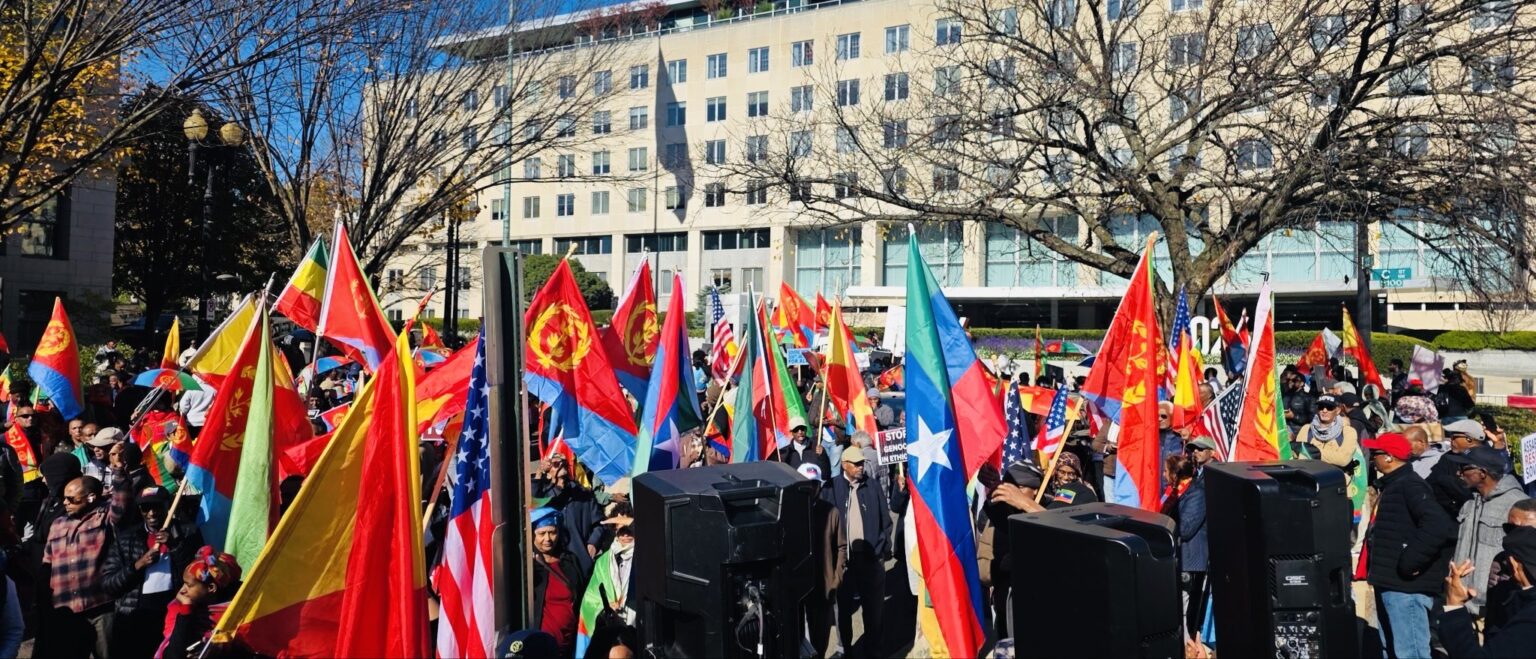

Ethiopian and Horn of Africa diaspora groups held a Washington protest outside the US State Department on Monday, chanting for Prime Minister Abiy Ahmed to face the International Criminal Court.
The march on 16 November brought together Afar, Amhara, Benishangul-Gumuz, Oromo, Tigrayan and Somali communities from Ethiopia, joined by Eritrean, Somali and Sudanese diaspora groups. The protesters asked Washington to press for an end to fighting in several Ethiopian regions and for independent investigations into alleged abuses, at a time of rising tension between Ethiopia and its neighbours.
What did the Washington protest demand?
Marchers at the Washington protest gathered outside the State Department on C Street and called for an immediate cessation of hostilities, independent investigations into alleged atrocities and accountability for those responsible. Video posted by DNE Africa shows the crowd chanting “Abiy Ahmed to the ICC!” and “Stop the genocide in Ethiopia!”, and, in Amharic, “Abiy Ahmed will be defeated!”. Some marchers also chanted in support of Sudan.
Protesters at the Washington protest carried the flags of Ethiopia, Eritrea, Oromia, Tigray, Amhara and the Ogaden. Organisers said the march was also directed at the United Arab Emirates, which they accuse of military involvement in the conflicts in Ethiopia and Sudan. The UAE has repeatedly denied arming parties in Sudan’s war.
The Ogaden National Liberation Front (ONLF) said in a statement that it joined the Washington protest alongside six other Ethiopian opposition alliance groups. Addis Standard said letters presented by participants referred to groups including the Tigray People’s Liberation Front leadership, the Fano militias in Amhara and the Oromo Liberation Army.
Could Abiy Ahmed be brought before the ICC?
Ethiopia is not a party to the Rome Statute, the treaty that created the International Criminal Court. The court could act only if Ethiopia accepted its jurisdiction or the UN Security Council referred the situation to it. No such step has been taken, and the chant reflects the protesters’ demand rather than any legal process under way.
Speakers cited estimates of about 600,000 deaths and about 120,000 victims of conflict-related sexual violence in the 2020-22 war in Tigray, Addis Standard reported. Death toll estimates for that war vary widely, and the Ethiopian government has disputed the higher figures. The war ended with the Pretoria peace agreement of November 2022, but fighting has since continued in Amhara with the Fano militias and in parts of Oromia with the Oromo Liberation Army.
How has the Ethiopian government responded?
DNE Africa could not find a response from the Ethiopian government or its embassy in Washington to the Washington protest by Tuesday evening. Addis Ababa has in the past described armed groups such as Fano and the OLA as “extremists” and says its security operations aim to restore law and order.
The march comes amid friction in the region over Ethiopia’s push for access to the Red Sea, which Eritrea regards as a threat, and over Sudan’s war. DNE Africa has reported on the dispute over the Eritrean port of Assab. DNE Africa has previously reported on the conflicts Ethiopia faces on several fronts.
Watch the video on DNE Africa’s Facebook page.
FAQ
Where did the Washington protest take place?
Outside the US Department of State in Washington DC on Monday 16 November 2026, according to Addis Standard.
Who took part in the Washington protest?
Diaspora members from several Ethiopian communities, including Amhara, Oromo, Tigrayan, Afar and Somali groups, joined by Eritrean, Somali and Sudanese organisations. The ONLF said it took part with six other opposition groups.
Is Ethiopia a member of the ICC?
No. Ethiopia has not joined the Rome Statute, so the court could act only with Ethiopia’s consent or a UN Security Council referral.
Has Ethiopia responded to the protest?
No response from the Ethiopian government had been published by Tuesday evening.


