
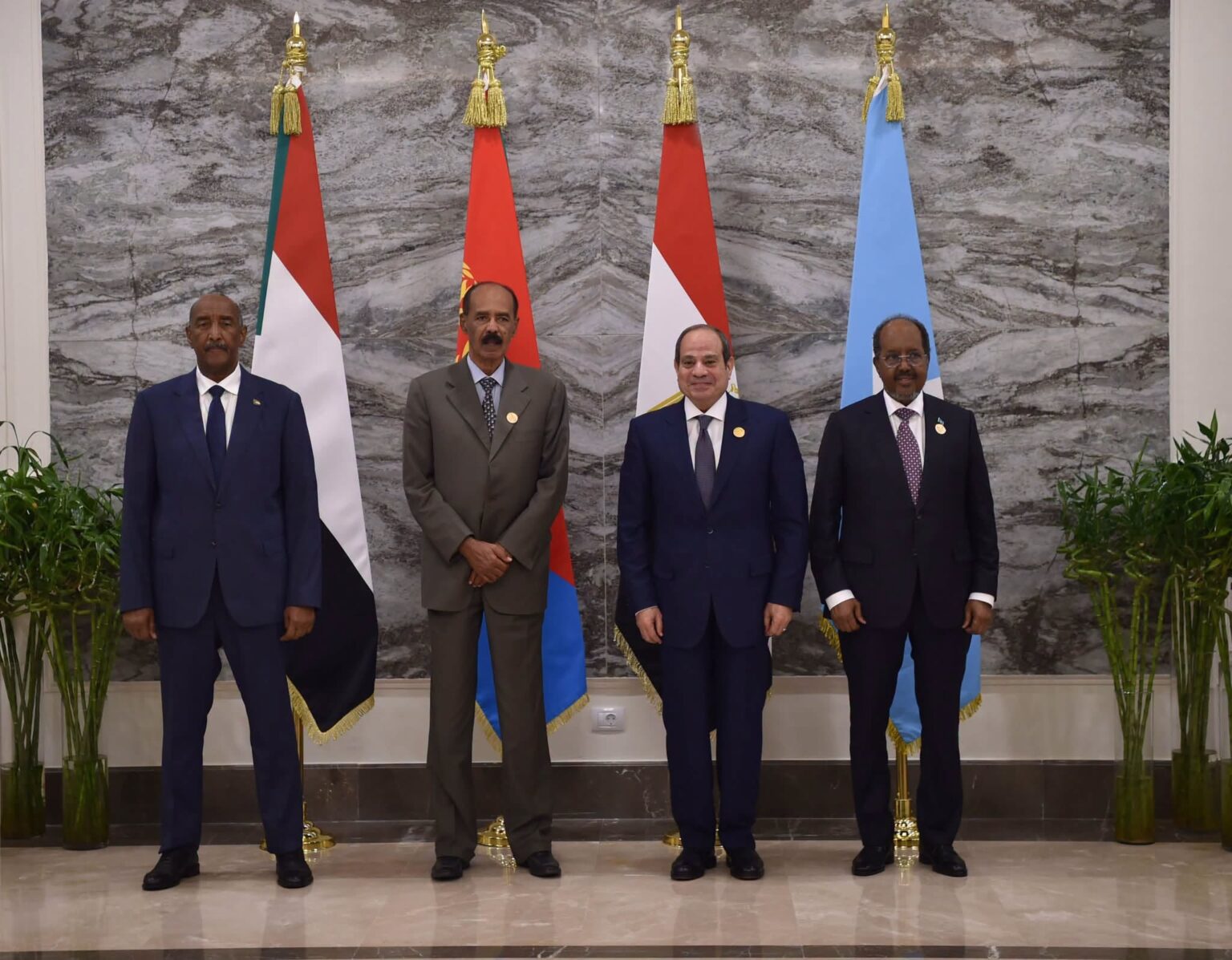

The leaders of Egypt, Somalia, Sudan, and Eritrea have drawn stark regional red lines in a newly forged geopolitical alliance, issuing a joint declaration that asserts exclusive control over the Red Sea, vehemently rejects breakaway Somaliland, and issues a stern warning against unilateral maneuvers on the Nile River.
Meeting in the coastal city of New Alamein on October 4, Egyptian President Abdel Fattah al-Sisi, Eritrean President Isaias Afwerki, Somali President Hassan Sheikh Mohamud, and Sudanese Transitional Sovereignty Council Chairman General Abdel Fattah al-Burhan solidified a unified quadripartite front. The resulting “Alamein Joint Declaration” pulls no punches in addressing the region’s most volatile flashpoints, establishing a periodic mechanism to aggressively coordinate and enforce their collective security interests.
In a pointed message regarding transboundary waters, the leaders declared a “complete rejection” of any unilateral actions that threaten the water security of the Nile’s downstream nations. The summit mandated that any river projects must adhere to international law and the principle of no harm, demanding prior notification, consultation, and strict consensus.
Red Sea Governance Exclusive Responsibility of Littoral States
The bloc further staked a rigid claim over one of the world’s most critical maritime corridors. Pushing back against broader geopolitical interference, the leaders declared that Red Sea governance remains the “exclusive responsibility” of its littoral states, whilst underscoring the absolute necessity of ensuring safe, free navigation through the Gulf of Aden and the Bab-el-Mandeb strait.
Tackling explosive Horn of Africa dynamics, the coalition threw its full, uncompromising weight behind Mogadishu. The declaration forcefully condemned any encroachment on Somalia’s sovereignty, explicitly refusing to recognise or support the so-called Somaliland. Deeming such recognition a direct violation of territorial integrity, the leaders also demanded predictable, sustainable international funding for the African Union’s AUSSOM mission to crush terrorism and seamlessly transition security to Somali national forces.
The summit similarly served as a definitive bulwark for Sudan’s official leadership. The four states outright rejected the creation of “parallel entities” and voiced total refusal of any support for “mercenaries.” Throwing their collective support behind Sudan’s national institutions and unity, they urged a return to a Sudanese-owned, Sudanese-led political process.
Egypt Warns Against Foreign Interventions
Egyptian Presidency Spokesperson Ambassador Mohamed El-Shenawy highlighted al-Sisi’s stark warning against foreign interventions, which the Egyptian leader blamed for dragging out conflicts and deepening human suffering. Framing any attempts to fracture state unity as a blatant violation of international law and the African Union’s Constitutive Act, al-Sisi reaffirmed Cairo’s commitment to equipping national institutions against armed extremism.
Beyond the hard-security posture, the leaders charted a path for cooperative survival, pledging deeper regional integration across infrastructure, trade, and energy. The visiting heads of state lauded Egypt’s assertive diplomacy, backing a continent-wide strategy anchored in African solidarity and the uncompromising defense of state sovereignty.


