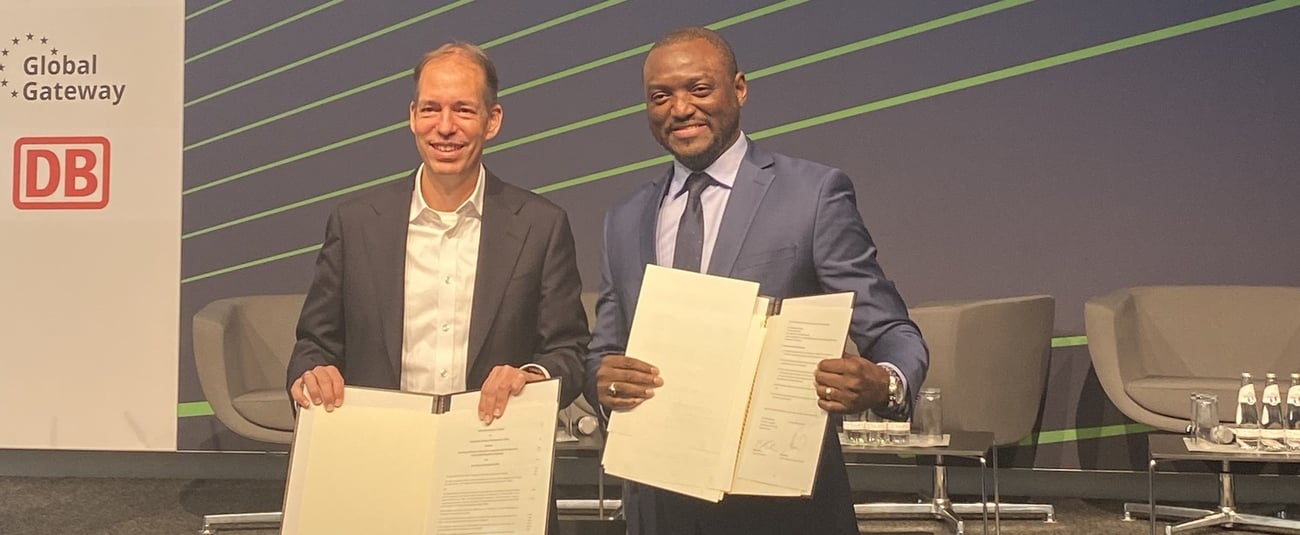

The African Development Bank Group (AfDB) has signed a letter of intent (LOI) with the German Federal Ministry for Economic Cooperation and Development (BMZ) to cooperate on developing Africa’s railway systems and deepening regional economic integration.
Mike Salawou, Bank Group Director for Infrastructure and Urban Development signed on behalf of the institution during the inaugural African European Industry Dialogue on Railways. Michael Krake, BMZ’s Deputy Director General for Economic Cooperation also signed.
The African European Industry Dialogue on Railways, part of the International Trade Fair for Transport Technology, InnoTrans, was jointly organised by Deutsche Gesellschaft für Internationale Zusammenarbeit (GIZ) GmbH, Deutsche Bahn, and the EU Global Gateway initiative.
The two entities will work together to reduce Africa’s transport costs, improve cross-border interoperability, promote low-carbon transport solutions, promote and embed sustainable transport policies and actively promote the establishment of a robust local labour market in the railway sector through skills transfer, vocational training, and the creation of sustainable employment opportunities.
Cooperation between the Bank Group and BMZ will start with a joint feasibility study for an African Rail Competence Center, implemented by GIZ and expected to launch by October 2026, bringing together innovation and training to modernise and expand Africa’s railways.
In a keynote address Director Salawou pointed to Bank-supported investments in the Lobito Corridor, the Standard Gauge Railway program in East Africa, the Nacala Corridor, Algeria’s North-South Rail Corridor, Morocco’s high-speed rail system, and urban rail projects in Senegal and Nigeria.
Africa’s rail network currently represents only 8–10% of the world’s total, but the African Continental Free Trade Area is driving growing demand for cross-border freight and passenger movement across a market of over 1.4 billion people.
The Bank Director also set out five priorities for the sector: a continental market driven by the African Continental Free Trade Area, modal-shift reforms, interoperable standards, financing that crowds in private capital, and the competencies needed to operate the networks once built. “Building a railway is half the job,” he said. “Running it is the harder half.”
Deputy Director General Michael Krake emphasised BMZ’s long-standing commitment to supporting Africa’s development. “BMZ is committed to working with our African partners to strengthen regional connectivity and support sustainable economic development. Together with the African Development Bank, we will advance practical cooperation on interoperability, skills development and other priorities that help build a stronger railway sector,” he said.
Salawou ended with calls to action to critical stakeholders: African governments and railway authorities should set a clear vision, commission credible feasibility studies, reform early and give investors regulatory certainty. European industry should offer long-term partnership, local content and skills transfer, not just equipment. Financiers should get involved at the preparation stage. He added that the Bank Group would support them with guarantees, blended finance and technical assistance.


