


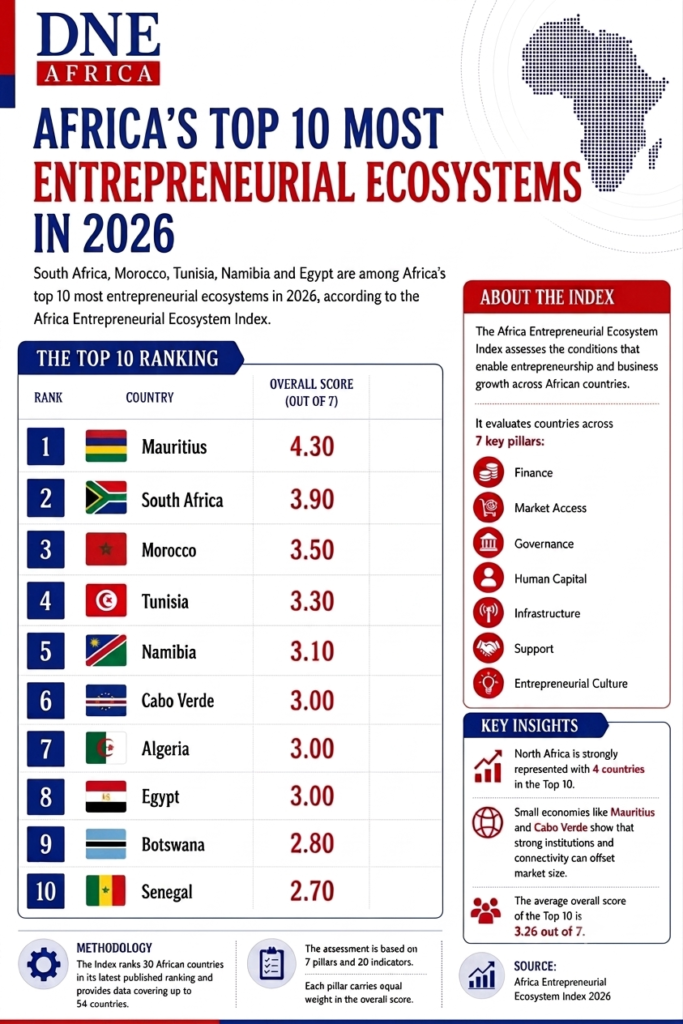
South Africa, Morocco, Tunisia, Namibia and Egypt are among Africa’s 10 most entrepreneurial ecosystems in 2026, according to the Africa Entrepreneurial Ecosystem Index (AEEI), which assesses the conditions supporting business creation and growth across the continent.
The ranking highlights the continent’s increasingly diverse startup and business landscape, with countries from North, Southern and West Africa making the top 10. Mauritius topped the overall index, followed by South Africa and Morocco.
The index ranks 30 African countries and assesses entrepreneurial ecosystems across seven pillars: finance, market access, governance, human capital, infrastructure, support and entrepreneurial culture. Rather than measuring the number of startups or entrepreneurs, the index evaluates the conditions that enable businesses to start, operate and grow.
1 – Mauritius
Mauritius took first place in the 2026 ranking with an overall score of 4.30 out of seven, giving the island nation the strongest entrepreneurial ecosystem among the African countries assessed.
Its performance was driven by particularly strong scores in governance and entrepreneurial support, reflecting a favorable regulatory environment and the presence of professional networks and innovation hubs.
Mauritius also performed strongly in human capital and infrastructure, with high levels of literacy, tertiary education, electricity access and internet penetration compared with continental averages.
However, the country’s relatively small domestic market remains a constraint, underlining the importance of international trade and cross-border opportunities for Mauritian businesses.
2 – South Africa
South Africa ranked second in Africa, maintaining its position as one of the continent’s most developed environments for entrepreneurship and business creation.
The country benefits from a relatively sophisticated financial system, a large and diversified economy, and an established network of businesses and institutions supporting entrepreneurs.
Its market size and access to financial services provide important advantages for companies seeking to expand beyond the startup stage and reach a broader customer base.
South Africa’s second-place position nevertheless highlights the gap between the continent’s leading entrepreneurial ecosystems and Mauritius, which topped the ranking with a score 0.4 points higher.
3 – Morocco
Morocco secured third place with an overall score of 3.50, making it the highest-ranked country in North Africa.
The ranking reflects Morocco’s growing position as a regional business and investment hub, supported by infrastructure development and expanding connections with African and international markets.
Its strategic location and integration into trade networks offer entrepreneurs opportunities to serve both domestic and external markets.
Morocco’s position in the top three also reinforces North Africa’s growing role in the continent’s entrepreneurial landscape, with four countries from the region appearing among the top 10.
4 – Tunisia
Tunisia ranked fourth, with an overall score of 3.30, placing it among Africa’s leading entrepreneurial ecosystems.
The country’s position reflects the importance of human capital, education and the broader support environment available to entrepreneurs and emerging businesses.
Tunisia has increasingly sought to position itself as a center for innovation and entrepreneurship, particularly through policies and institutions aimed at supporting startups and technology-driven businesses.
Its ranking immediately behind Morocco confirms North Africa’s strong representation in the upper tier of the continent’s entrepreneurial ecosystems.
5 – Namibia
Namibia ranked fifth in Africa with an overall score of 3.10, becoming the highest-ranked country from Southern Africa after South Africa.
The country’s position reflects a relatively balanced entrepreneurial environment, combining institutional conditions, infrastructure and market opportunities.
Namibia’s performance is notable given the size of its population and domestic market, which can limit the scale available to businesses operating solely within the country.
Its presence in the top five suggests that the quality of an entrepreneurial ecosystem is shaped not only by economic size, but also by governance, infrastructure and the wider conditions supporting business formation and growth.
6 – Cabo Verde
Cabo Verde ranked sixth with an overall score of 3.00, placing the island nation among Africa’s leading entrepreneurial ecosystems.
Its position is significant because it demonstrates how smaller economies can compete through institutional quality, connectivity and support systems, despite having limited domestic markets.
Like Mauritius, Cabo Verde faces structural challenges associated with its small population and geographic separation from major continental markets.
Nevertheless, its inclusion in the top 10 points to the role that governance, infrastructure and an enabling business environment can play in strengthening entrepreneurship.
7 – Algeria
Algeria ranked seventh, sharing an overall score of 3.00 with Cabo Verde and Egypt, although it was placed ahead of both countries in the final ranking.
As one of Africa’s largest economies, Algeria has the advantage of a substantial domestic market that can provide opportunities for entrepreneurs and emerging businesses.
The country’s challenge is to translate its economic scale into a more comprehensive entrepreneurial ecosystem, including stronger access to finance, business support and market opportunities.
Its position in the top 10 nevertheless places Algeria among the continent’s leading countries in terms of the broader conditions supporting productive entrepreneurship.
8 – Egypt
Egypt ranked eighth in Africa with an overall score of 3.00, placing it among the continent’s 10 strongest entrepreneurial ecosystems.
The country’s large population and economy provide entrepreneurs with access to one of Africa’s biggest domestic markets, while its geographic position links African, Arab and international markets.
Egypt’s entrepreneurial ecosystem has also been supported by the growth of innovation hubs, startup programs and business networks, although access to finance and other structural challenges remain important factors in the wider business environment.
Its ranking alongside Algeria and Cabo Verde underscores the mixed nature of entrepreneurial ecosystems, where market size alone does not determine a country’s overall performance across the seven pillars.
9 – Botswana
Botswana ranked ninth with an overall score of 2.80, securing its place among Africa’s 10 leading entrepreneurial ecosystems.
The country has long been associated with relatively strong institutions and governance compared with many other economies on the continent, factors that can contribute to a more predictable environment for businesses.
However, its relatively small population and domestic market can constrain opportunities for companies seeking to scale rapidly without expanding beyond national borders.
Botswana’s ranking illustrates the importance of combining institutional strength with broader access to finance, markets, talent and entrepreneurial support.
Senegal completed Africa’s top 10 with an overall score of 2.66 out of seven, according to its 2026 country profile.
The country performed particularly strongly in governance and entrepreneurial culture, with its business regulation, corruption perception and trust indicators scoring above the African average.
10 – Senegal
Senegal also ranked above the continental average on 11 of the 20 indicators used in the index, although weaknesses remained in areas including GDP, household income per capita and innovation hubs.
Its position in the top 10 makes Senegal the highest-ranked country from West Africa in the index and highlights the region’s growing importance in Africa’s wider entrepreneurship landscape.
The 2026 ranking shows a geographically diverse picture of entrepreneurship in Africa, with countries from North, Southern, Eastern and Western Africa represented among the continent’s leading ecosystems. Mauritius, South Africa and Morocco formed the top three, while North African countries accounted for four positions in the top 10.
The AEEI assigns equal weight to its seven pillars and uses 20 indicators to compare national ecosystems. Scores are standardized, with a theoretical maximum of seven, offering policymakers, investors and ecosystem builders a comparative measure of the conditions supporting productive entrepreneurship across the continent.


