
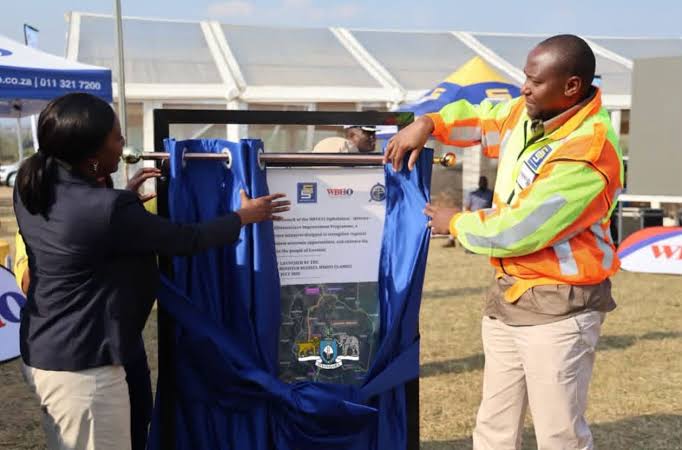

Eswatini has launched a $175.7 million road infrastructure programme aimed at improving connectivity, reducing transport costs and unlocking economic opportunities in some of the country’s most underserved rural communities.
The programme, financed jointly by the African Development Bank (AfDB) and the Government of Eswatini, marks one of the country’s largest transport infrastructure investments and is expected to strengthen regional trade, create jobs and improve access to public services.
What is the project?
The Eswatini Road Infrastructure Improvement Programme is a 36-month initiative that will upgrade more than 105 km of roads in the country’s Lubombo and Shiselweni regions.
Phase I includes the reconstruction of the 80.2-km Siphofaneni-Sithobela-Maloma-Nsoko (MR14) road and the 25.7-km Maloma-Siphambanweni (MR21) road.
The programme is valued at $175.71 million, with the African Development Bank providing $140.6 million, or 80% of the financing, while the Government of Eswatini contributes the remaining $35.1 million.
Why does it matter?
The roads pass through some of Eswatini’s least-developed regions, where poor transport infrastructure has limited access to markets, raised transport costs and constrained economic activity.
Authorities expect the upgraded roads to cut travel times and transport costs by at least half, making it easier for people and goods to move between rural communities, urban centres and regional markets.
The improved road network is also expected to support agricultural production, encourage private investment and strengthen Eswatini’s participation in regional trade under the African Continental Free Trade Area (AfCFTA).
What did the prime minister say?
Prime Minister Russell Dlamini officially launched construction in early July, describing the programme as a key pillar of the government’s long-term infrastructure strategy.
“We want the whole country to have tarred roads so that people can travel safely,” Dlamini said during the launch ceremony.
He said the project would create jobs, improve access to strategic national assets such as the Mpakeni Dam and help position Eswatini as a stronger economic player within the Southern African Development Community (SADC).
How will local communities benefit?
Beyond road construction, the programme includes measures aimed at improving livelihoods and creating employment opportunities.
Around 200 young people, including 80 women, will receive training in construction skills, while 50 participants will also be trained in entrepreneurship.
The project will finance community infrastructure, including schools, health clinics, markets and small-scale water supply systems along the road corridor.
What is the African Development Bank’s role?
The African Development Bank is financing the majority of the project and says it forms part of a broader $1.03 billion investment programme for Eswatini under its 2025-2030 Country Strategy Paper.
According to Moono Mupotola, the Bank’s Deputy Director General for Southern Africa, the strategy focuses on developing climate-resilient infrastructure while strengthening private-sector competitiveness to create jobs and diversify the economy.
She said the Bank has partnered with Eswatini since 1972, approving 71 loans and grants across sectors including transport, agriculture, energy, water, governance and finance.
The Bank’s active portfolio in Eswatini has grown from $226.7 million to $527 million over the past five years, covering infrastructure, technical assistance, budget support and private-sector financing.
What comes next?
The programme also includes the installation of axle-load control systems and a new weighbridge to protect road infrastructure, while supporting future public-private partnerships and performance-based road maintenance contracts.
Construction is being implemented by Eswatini’s Roads Department under the Ministry of Public Works and Transport and is expected to be completed within 36 months.
Once completed, the project is expected to improve regional connectivity, lower the cost of doing business and support Eswatini’s long-term economic transformation through better transport infrastructure and expanded trade opportunities.


