
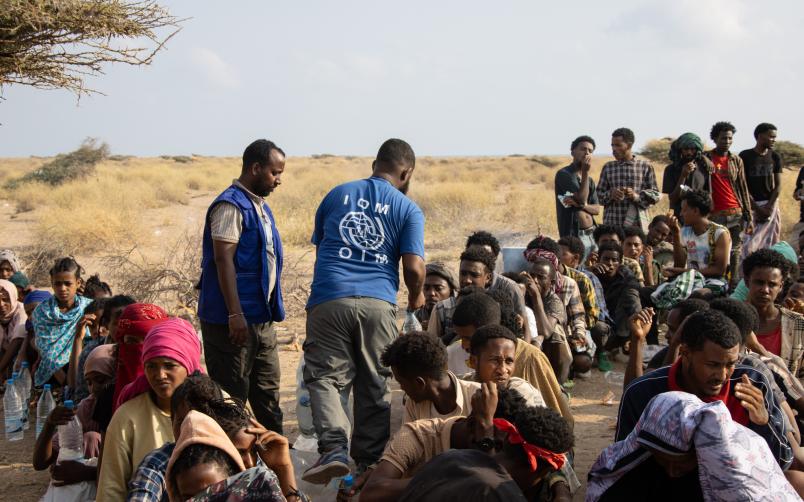

The Eastern Migration Route linking the Horn of Africa to the Arabian Peninsula through Djibouti and Yemen is considered one of the world’s most dangerous migration corridors because migrants face multiple and overlapping risks throughout their journey, the International Organization for Migration (IOM) told DNE Africa.
In an exclusive statement to DNE Africa, the UN migration agency said migrants travelling along the route are exposed to extreme environmental conditions, dangerous sea crossings, exploitation, abuse and the consequences of ongoing instability in parts of the region.
“The Eastern Migration Route, which connects countries in the Horn of Africa to the Arabian Peninsula through Djibouti and Yemen, is considered one of the world’s most dangerous migration corridors because migrants face multiple and overlapping risks throughout their journey,” IOM said.
Each year, thousands of migrants, mainly from Ethiopia and other countries in the Horn of Africa, undertake the journey in search of safety, livelihoods and economic opportunities. Many travel through remote and arid areas under extreme temperatures with limited access to water, food and healthcare.
“Along the way, many travel through remote and arid areas under extreme temperatures, often with limited access to water, food, healthcare and other essential services,” the agency said. “These conditions can lead to dehydration, illness, exhaustion and other serious health risks.”
The dangers continue at sea, where migrants cross the Bab el-Mandeb Strait between Djibouti and Yemen, frequently relying on overcrowded and unsafe vessels.
“Adverse weather conditions and hazardous sea crossings have resulted in numerous tragedies over the years,” IOM said.
Beyond environmental hazards, migrants face significant protection concerns, including physical violence, extortion, abduction, kidnapping and gender-based violence.
“Migrants travelling along the Eastern Migration Route commonly report protection concerns including physical violence, extortion, abduction, kidnapping and gender-based violence,” the agency said. “Many are also exposed to exploitation by smugglers and other actors, which can increase their vulnerability to trafficking and other forms of abuse.”
The human toll of the route has continued to rise. According to IOM, 922 migrant deaths and disappearances were recorded along the Eastern Route in 2025, nearly double the 558 reported in 2024, making last year the deadliest on record.
“The human cost remains alarmingly high,” the agency said.
Migration flows also increased during the year. IOM recorded more than 506,600 outbound movements along the Eastern Route in 2025, around 20% higher than in 2024.
In Djibouti, total migrant movements reached 522,587 in 2025, while returns from Yemen rose by 29%, reflecting growing fears of detention and limited economic opportunities in destination countries.
The situation in Yemen remains a major concern for migrants using the corridor.
“Migrants using the Eastern Migration Route may face significant challenges in Yemen, where many are in transit or become stranded with limited access to assistance, services and protection,” IOM said. “In such situations, migrants can be exposed to a range of protection risks, including violence, exploitation, extortion and other forms of abuse.”
To address humanitarian needs, IOM provides assistance through reception and transit facilities across Djibouti, including the Migration Response Center in Obock and transit centers in Tadjourah and Djibouti City.
In 2025, the organization delivered more than 42,000 life-saving and protection services to over 27,000 migrants in Djibouti, including food, healthcare and psychosocial support. It also assisted approximately 6,300 migrants who voluntarily returned to Ethiopia, including 2,768 from Djibouti.
Looking ahead, IOM called for stronger regional cooperation, expanded safe migration pathways and increased funding for humanitarian operations.
“IOM’s priority is saving lives,” the agency said. “This means sustaining life-saving humanitarian assistance along the corridor, while expanding safer migration pathways, strengthening protection services and reinforcing regional cooperation to address the root causes that drive people onto this route.”


