
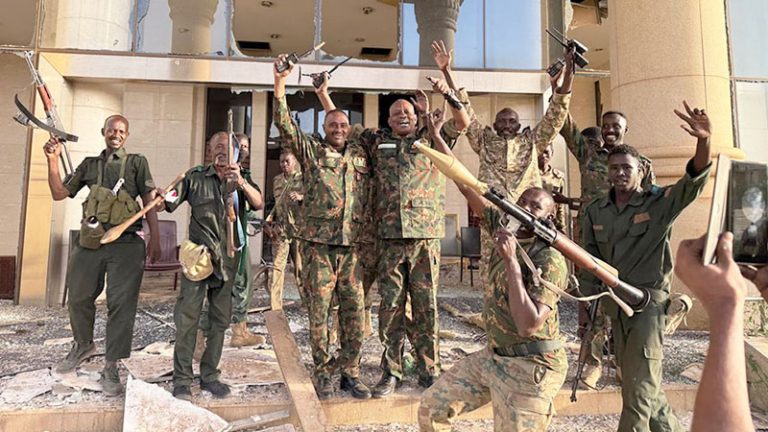

History rarely announces its turning points with trumpets. More often, it whispers through collapsing supply lines, shattered command structures, and the visible disintegration of once-feared militias. In Sudan, the long-predicted dominance of the RSF has begun to fracture, and that whisper has become unmistakable: the balance of war has shifted.
The Sudanese Armed Forces (SAF) is no longer merely resisting; it is advancing, consolidating, and decisively reshaping the battlefield. In contrast, the RSF—once portrayed as an unstoppable paramilitary force—now faces strategic collapse.
What began as a brutal contest for control is increasingly becoming a story of military reversal. The RSF’s gamble for dominance has failed; the SAF has emerged ascendant.

Momentum on the Battlefield: The RSF in Retreat
Wars are not won by rhetoric. They are won by territory, logistics, and endurance. Across northern and southern Kordofan and in multiple contested zones, the SAF has re-established control over key corridors, supply arteries, and strategic towns. Areas once claimed by the RSF have been steadily reclaimed. Encirclement operations have tightened, and strongholds have fallen or been isolated.
The RSF, built for rapid raids and urban disruption, is now trapped in a war it was never structured to win: a prolonged territorial confrontation against a national army with deep reserves and institutional cohesion.
Reports of defections, fractured command, logistical breakdowns, and funding strain have mounted. Fighters motivated by opportunism and payroll calculations now face shrinking prospects and mounting pressure. The aura of inevitability that once surrounded the RSF has evaporated. Momentum—psychological as much as military—now belongs to the SAF.
The Fall of the RSF’s Illusion of Power
At its height, the RSF leveraged mobility, asymmetric warfare, and economic networks to shock the nation. It attempted to project permanence and sought to present itself as a parallel power center. That illusion has collapsed.
As the SAF advances and severs supply lines, the RSF’s structural weaknesses have been exposed. A paramilitary force dependent on centralized patronage and fluid financing cannot withstand sustained territorial attrition. Once cut off from rapid maneuver and external lifelines, its operational coherence unravels.
The RSF is no longer expanding; it is defending. It is no longer dictating tempo; it is reacting. It is no longer projecting dominance; it is absorbing defeat. The strategic initiative has shifted decisively to the SAF.
Al-Fashir: The Symbol of Finality
All eyes now turn to Al-Fashir. Should the SAF consolidate full control there, it would represent more than a tactical victory; it would signal the definitive unraveling of RSF defensive depth across Darfur. Cities anchor legitimacy. They sustain logistics. They embody authority.
The loss of Al-Fashir would accelerate a domino effect, encouraging defections, local reconciliation deals, and the rapid collapse of remaining RSF pockets. Military history teaches a clear lesson: once a non-state armed force loses momentum and territorial continuity, collapse can be swift and irreversible. The RSF stands dangerously close to that threshold.
Regional Backing and Strategic Depth
Sudan’s war has never been isolated from regional geopolitics. Countries such as Egypt, Saudi Arabia, Eritrea, Turkey, and Pakistan have long maintained ties with Sudan’s national military establishment. Stability in Sudan affects Nile security, Red Sea shipping lanes, Horn of Africa balances, and broader regional power alignments.
The RSF, meanwhile, has been the subject of intense regional speculation regarding external political and economic links. Whether overt or discreet, such associations have become liabilities as battlefield realities shift. Perception matters in war, and the perception today is clear: the recognized national army is consolidating power while the paramilitary challenger is faltering.
Ceasefire Politics and the Question of Sovereignty
Repeated calls for a ceasefire have emerged at moments when the SAF appeared to be advancing. Supporters frame these calls as a humanitarian necessity; critics argue that premature pauses risk preserving fragmented armed actors and freezing instability in place.
The debate reflects a deeper tension between intervention and sovereignty, between negotiated stalemate and decisive resolution. What is evident is that the SAF’s growing dominance has altered diplomatic calculations. A clear battlefield outcome will force regional and international actors to recalibrate their approach to Sudan.
A Victory with Consequences for Africa
A decisive SAF victory would carry implications far beyond Khartoum. Across Africa, the persistence of heavily armed non-state actors has complicated governance and sovereignty. The defeat of a powerful paramilitary formation by a consolidated national army would send a powerful signal: attempts to capture states through irregular force are fraught with peril.
Sudan sits astride vital Red Sea corridors. Control over its coastline and hinterland carries global economic and security implications. A stabilized Sudan, under unified national authority, would reshape calculations from Cairo to the Gulf to the Horn. The implications are generational.
Victory Is a Beginning, Not an End
Yet, triumph on the battlefield carries responsibility. Infrastructure lies damaged, millions are displaced, and economic systems are strained. The SAF, having emerged militarily victorious, would inherit the burden of reconstruction, reconciliation, and reform.
Military success must translate into political legitimacy. Durable stability will depend on governance, institutional credibility, and inclusive national rebuilding. History will not judge victory by territory alone, but by what follows.
A Defining Crossroads
Sudan stands at a decisive moment. The RSF’s campaign for supremacy has faltered. Its strategic overreach has met institutional resistance. Its fragmentation is visible. Its defeat is no longer hypothetical; it is unfolding.
The SAF has emerged as the dominant force on the battlefield. If current momentum continues, the consolidation of national authority appears increasingly inevitable. This is no longer merely a struggle between rival commanders; it is a test of sovereignty, statehood, and the future balance of power in Northeast Africa.
History’s whisper has grown into a clear declaration: the RSF’s bid for control has failed. The Sudanese Armed Forces have prevailed. What remains now is the responsibility of shaping the peace that follows.
ABDIWAHAB SHEIKH ABDISAMAD Expert on Horn of Africa Geopolitics, Security, and Diplomatic Trends


