
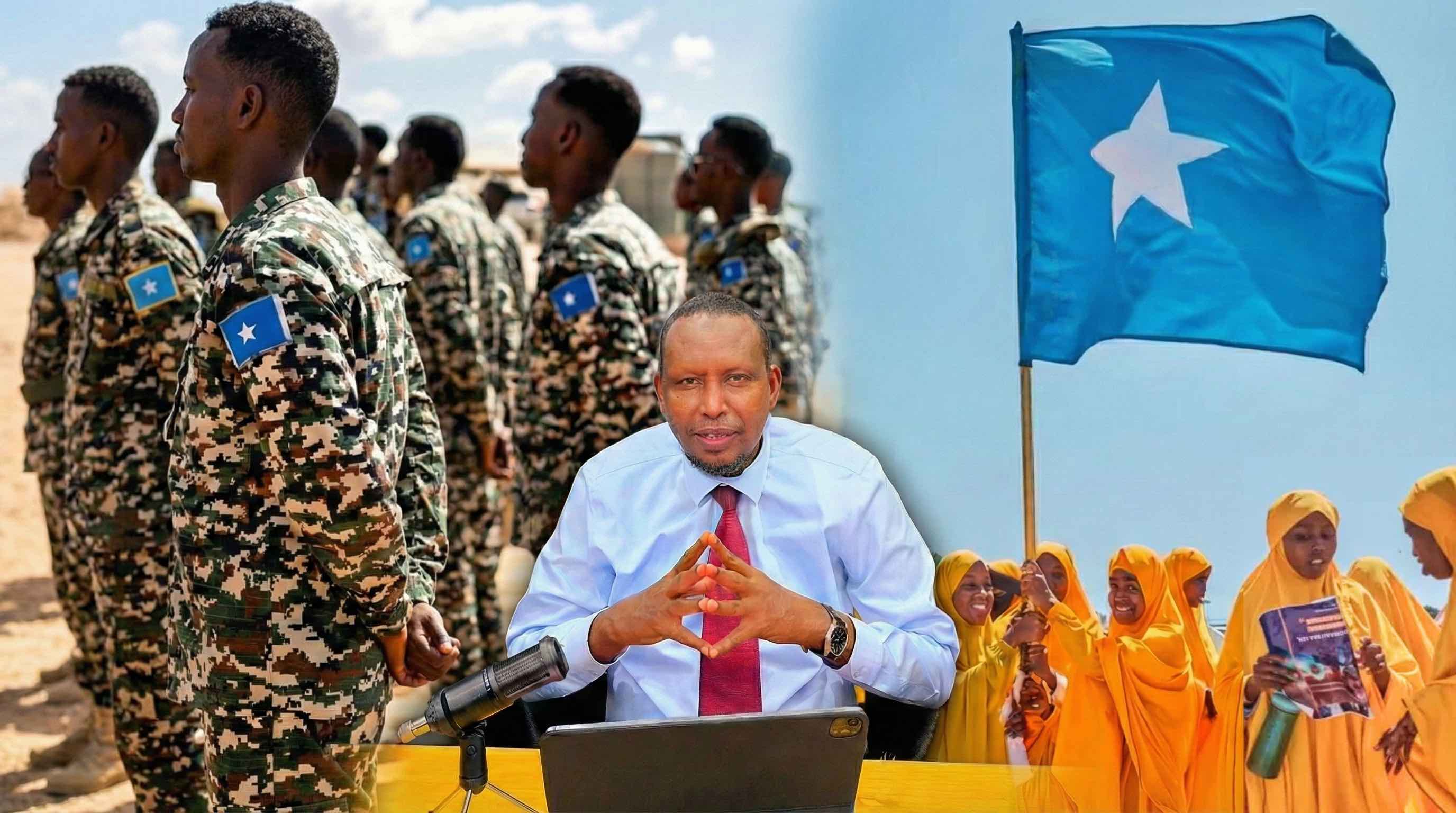

For the first time in decades, Somalia’s federal government is not pleading for recognition, it is enforcing it.
The Federal Government of Somalia’s (FGS) decision to cancel controversial port and airport agreements linked to the United Arab Emirates has triggered predictable outrage from regional administrations, foreign lobbyists, and familiar critics. Yet, beneath the noise lies a simple, legally grounded reality: these assets were never the property of regional states to sign away. Their cancellation was not an arbitrary whim; it was a move compelled by material breaches of contract and severe national security violations.
This moment marks a decisive break from an era in which Somalia’s strategic assets were quietly transformed into foreign military outposts under the thin veil of “commercial investment.”

Who Had the Authority? The Law is Clear
One fact has been deliberately obscured in the public debate: Port and airport agreements are signed by the Federal Government of Somalia, not Federal Member States.
Under Somalia’s Provisional Constitution and established international law, exclusive authority over the following rests solely with the federal government:
- National Infrastructure: Ports and airports.
- Territorial Integrity: Territorial waters and airspace.
- Security: Defense and foreign military cooperation.
Neither Somaliland, Puntland, nor any other regional administration possesses the legal mandate to conclude long-term strategic or military-linked agreements with foreign powers. Any such deals are, by definition, ultra vires—beyond their legal power—unless specifically approved by Mogadishu. The federal annulment is not an act of central overreach; it is an act of constitutional correction.
Why the Agreements Were Cancelled: Material Breach, Not Politics
The cancellation was not ideological; it was contractual. The UAE and its affiliated entities materially breached the terms of their agreements by:
- Covert Militarization: Transforming civilian ports and airports into military bases and allowing foreign intelligence entities to operate without federal consent.
- Logistical Misuse: Using Somali infrastructure as transit hubs for mercenaries and armed personnel en route to conflict zones, including Sudan.
- Bypassing Oversight: Fundamentally altering the nature of the agreements from trade-based development to unauthorized military platforms.
No sovereign state would tolerate its infrastructure being repurposed into a foreign military staging ground without authorization. Somalia’s response was not exceptional—it was long overdue.
The Jubaland Problem: Federalism is Not Personal Rule
The rejection of the federal decree by Jubaland’s leadership exposes a deeper issue: the personalization of regional authority. President Ahmed Madobe’s stance increasingly reflects a drive for political survival rather than principled federalism.
Federalism was designed to balance local governance with national unity, not to enable regional leaders to act as”sovereigns in all but name.” By opposing federal sovereignty while engaging external patrons, Jubaland’s leadership risks reducing regional autonomy into a mere bargaining chip for personal power. Somalia cannot be rebuilt if regional leaders treat national law as a buffet where they only pick what suits them.
Strategic Patience: No Immediate Force, No Retreat
Critics ask how Mogadishu intends to enforce these decisions without triggering immediate conflict. The answer lies in strategic patience. The FGS is avoiding reckless military confrontation in favor of:
- Internationalizing the legal dispute to make illegal contracts unenforceable.
- Isolating unauthorized agreements diplomatically and commercially.
- Professionalizing the Somali National Army (SNA) through Turkish-led training programs.
As the SNA evolves into a disciplined, unified force, the balance of power is shifting. The era in which regional administrations could defy Mogadishu simply because the state lacked the capacity to respond is coming to an end.
Foreign Patrons and the “Somaliland Precedent”
The most dangerous dimension of this crisis is the geopolitical engineering of recognition. Efforts to elevate Somaliland as a sovereign partner—facilitated by foreign actors—represent an existential threat to Somalia’s territorial integrity.
Mogadishu understands that once ports and military cooperation are normalized with a regional entity, political recognition follows. The federal response is preemptive: Somalia is defending its borders before they are erased on paper.
Economic Pressure is Not Economic Collapse
While Somalia’s trade with the UAE exceeded $2.2 billion in 2024, economic dependency cannot override sovereignty. The federal government is not seeking isolation; it is demanding lawful engagement. Alternative models, such as those offered by Turkey and Egypt, demonstrate that state-to-state cooperation can be built on transparent agreements and respect for Somali institutions. Capital is adaptable, but sovereignty is not. Over time, these mature partnerships will replace predatory arrangements masquerading as investment.
Conclusion: Sovereignty as a Practice, Not a Slogan
For too long, Somali statehood existed largely on paper—affirmed in speeches but undermined by illegal deals and foreign militarization. The cancellation of these deals marks the moment when sovereignty shifts from an aspiration to an enforcement.
The backlash is loud because those who benefited from ambiguity—foreign powers, middle-men, and regional elites—are finally confronting a state that is no longer “negotiable” by default. Somalia is no longer asking if it has the right to control its territory; it is exercising that right through law, strategy, and institutional rebuilding.
The message to the world is clear: Engagement is welcomed; exploitation is not. The era of informal control is closing. What follows will be more difficult and more disciplined—but it will be Somali.
Abdiwahab Sheikh Abdisamad is a leading expert on the Horn of Africa geopolitics and the Executive Director of the Afro-Asian Institute for Strategic Studies, a think tank dedicated to analyzing regional security and diplomatic trends.


