
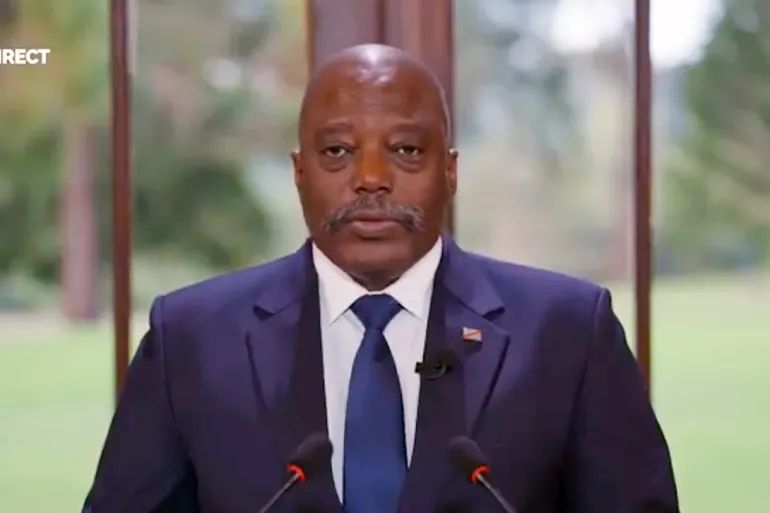

A court in Kinshasa has postponed the opening session of the highly anticipated trial of former President Joseph Kabila to 31 July, after an initial procedural hearing was held in his absence. The decision comes at a time of renewed military escalation in eastern Democratic Republic of the Congo (DRC), where clashes between government forces and M23 rebels have left several civilians dead and dozens injured.
The trial, seen as a landmark case in Congolese political and judicial history, was scheduled to begin on Friday, 25 July, following the lifting of Kabila’s parliamentary immunity in May. However, the court declared the hearing in absentia due to the former president’s nonappearance and the absence of his legal team.
Prosecutors representing the state requested a delay to review the case file, while Kabila’s party, the People’s Party for Reconstruction and Democracy (PPRD), denounced the trial as politically motivated.
Heavy Charges and Political Fallout
The charges against the former president are extensive and severe, including leading an armed rebellion, premeditated murder, conspiracy, rape, torture, and the illegal military occupation of the eastern city of Goma—a strategic regional capital in North Kivu province.
According to court documents, the prosecution is relying on testimonies from convicted members of past rebel movements, including individuals with direct ties to the M23 insurgency. Among them is Eric Nkumba, reportedly a close associate of M23 figure Cornélie Nanga, who has implicated Kabila in alleged conspiracies to destabilize the government of President Félix Tshisekedi.
Observers say the trial could reshape the political landscape in the DRC, as it directly challenges the legacy and influence of Kabila, who ruled the country from 2001 to 2019 and maintained considerable power through his political network in the years that followed.
Senior figures in the PPRD have condemned the trial as a targeted attempt to sideline Kabila ahead of future elections. Opposition lawmakers warn that the legal proceedings may deepen political divisions and raise the stakes in an already polarized national climate.
Parallel Escalation in Eastern Congo
While the capital is focused on judicial developments, the security situation in the east continues to deteriorate. Over the weekend, heavy fighting erupted between Congolese government forces and M23 rebels in Masisi territory, north of Goma, in North Kivu province.
Local sources confirmed that at least 11 people were killed, including 8 civilians, and 21 others were injured in the fighting. The clashes centered on the town of Luk, where the main health center was reportedly destroyed.
The eastern region of the DRC has been plagued by waves of violence involving armed groups, militias, and cross-border dynamics for more than two decades. The M23 rebel group, whose leadership has been linked to previous conflicts and alleged foreign support, has re-emerged in recent years as a major destabilizing force.
The United Nations and regional bodies have repeatedly called for renewed dialogue and disarmament initiatives, but the absence of a lasting ceasefire and the fragility of local governance continue to fuel the cycle of violence.
Justice and Instability Intertwined
The overlapping timelines of Kabila’s trial and military escalation in the east have raised concerns among analysts about the interconnected nature of politics, justice, and security in the DRC.
Critics argue that while the government’s pursuit of legal accountability is significant, it must be matched with efforts to stabilize the east, rebuild trust in state institutions, and ensure that justice is applied consistently—not selectively.
Human rights organizations and international observers have also urged authorities to ensure due process in the trial, warning that any perception of politicization could undermine judicial credibility at a critical juncture.
As the DRC navigates a volatile period of transition, the coming weeks will test the government’s ability to balance accountability with national cohesion. With the trial set to resume on 31 July and fighting still active in key eastern provinces, the country remains on edge—grappling with the legacies of conflict, contested power, and fragile peace.


