
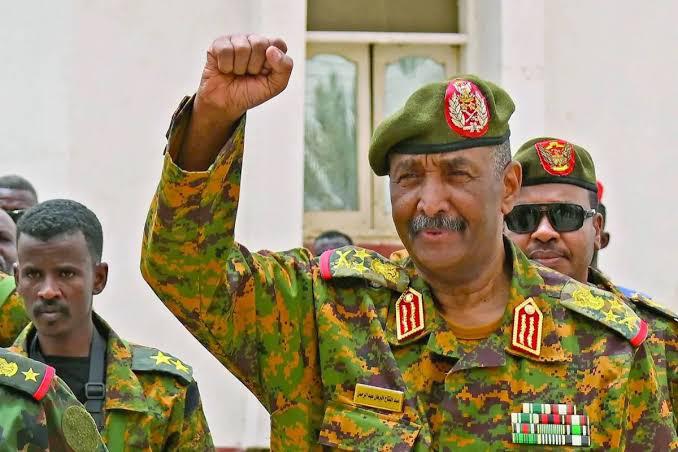

In his first visit to the capital since Sudanese Armed Forces declared it fully “liberated,” General Abdel Fattah al-Burhan arrived in Khartoum on Saturday to reassert state authority and accelerate the capital’s return to normalcy after over a year of brutal conflict.
According to state media, Burhan was received at Khartoum International Airport by senior military officials, including Chief of Staff General Mohamed Othman Al-Hussein, before heading to the army’s general command, where he was briefed on ongoing military operations and the security situation under the so-called “War of National Dignity.”
In a key directive, Burhan ordered all military formations and armed groups—whether regular or irregular—to withdraw from Khartoum within two weeks, including those affiliated with armed movements that had previously aligned with the army during the fighting. A special committee led by Sovereignty Council member General Ibrahim Jaber will oversee implementation in coordination with the army’s top command.
The move is seen as an attempt to restore security in a city still reeling from urban warfare, lawlessness, and humanitarian collapse, and to pave the way for the return of displaced civilians. Residents have repeatedly complained of widespread looting, the presence of militias, and the near-total absence of police or civil authority.
Human rights groups continue to report rampant abuses against civilians, including extrajudicial killings, arbitrary detention, torture, and digital targeting. The Sudan Human Rights Observatory has warned that fear and instability still dominate daily life, compounded by severe shortages in food, water, and medicine, as well as spiraling inflation and the collapse of public services.
Local analysts say the plan to re-establish Khartoum as the country’s functional capital faces deep structural and political hurdles, including damaged infrastructure, economic paralysis, and ongoing militia violence.
With Sudan’s civil war now in its second year, Burhan’s return to the capital may signal a new phase in the military’s efforts to reassert control—but the road to stability remains perilous.


