
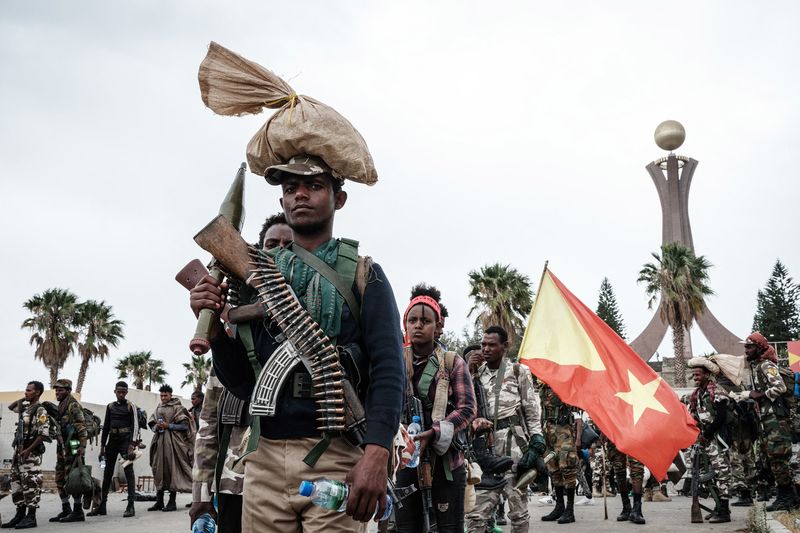

The Tigray People’s Liberation Front (TPLF) has accused the Ethiopian Federal Government of preparing for a new military offensive against the Tigray region, warning that the threat is fueling renewed “fear and anxiety” among civilians.
In a strongly worded statement released this week, the TPLF claimed that Tigrayans continue to endure what it described as “genocidal conditions,” despite the peace agreement signed in Pretoria in 2022, which formally ended the two-year war between the TPLF and federal forces.
According to the statement, survivors of the conflict are still being targeted—allegedly abducted, tortured, and killed based on their identity—and are facing worsening humanitarian conditions, including disease, displacement, and famine. However, the group did not specify who the perpetrators of these ongoing acts were.
“Even after the Pretoria Agreement was signed, the genocidal campaign has not ceased. The people living under occupation continue to be killed and harassed,” the TPLF claimed.
The group further alleged that the Ethiopian government is arming various militant groups to destabilize Tigray and divert national attention from core political issues. It called on the international community to hold the government accountable for what it described as actions that violate both the spirit and the letter of the Pretoria Agreement.
“Rather than addressing the legitimate suffering of the Tigrayan people or honoring their peaceful demands, the government continues to issue threats of renewed invasion,” the TPLF said, urging federal authorities to instead focus on reconstruction and reconciliation.
Local Authorities Respond
In a related development, the President of the Tigray Interim Administration, Lieutenant General Tadesse Worede, addressed concerns raised during a community meeting in Wukro. He acknowledged that while the region is rebuilding its armed forces, this should not be interpreted as preparation for renewed hostilities.
“We’re training our army, but we are not preparing to launch a war,” Tadesse said. “We will not start any conflict unless the federal government initiates it.”
Tadesse also downplayed the threat posed by “Netse Meret” (literally “Free Land”), a militant group formed by anti-TPLF elements allegedly supported by the Afar regional state and the federal government.
“They’re insignificant,” he stated. “We are working toward a negotiated solution to address the issue of these armed groups.”
These allegations have not been independently verified, and neither the federal government nor the Afar authorities have issued formal responses.
Who is Netse Meret?
In a separate interview with the BBC last month, Lieutenant General Gebregziabher Beyene, known by his nom de guerre “Wedi Antiru” and a commander of Netse Meret, said the group is composed of four organized divisions. He claimed their main objective is to overthrow the TPLF, which he accused of executing an internal coup, and to establish an independent military force not affiliated with any political party.
Fighting has reportedly resumed in some areas of Tigray, including Wejerat district, where clashes have been reported between TPLF-aligned forces and other armed groups.
Political Divisions Within Tigray
The situation in Tigray is further complicated by political fragmentation within the region’s leadership. The Pretoria Agreement led to the creation of an Interim Administration in Tigray, initially led by Getachew Reda, a former TPLF official who now serves as the Prime Minister’s Advisor on East African Affairs. His appointment was strongly opposed by TPLF chairman Dr. Debretsion Gebremichael.
Lieutenant General Tadesse Worede recently replaced Getachew Reda as interim leader, although the precise relationship between Tadesse’s administration and Debretsion’s TPLF faction remains unclear.
Meanwhile, Getachew Reda has launched a new political party called Tigray Democratic Solidarity (Simeret), which received provisional registration from the National Election Board of Ethiopia (NEBE) on May 26, 2025. The party is currently pursuing full registration and preparing for its founding congress.
Federal Government Perspective
Speaking before Parliament on July 3, Prime Minister Abiy Ahmed said that the Pretoria Agreement had “brought much-needed relief” to Tigray by halting daily bloodshed and initiating a path toward national unity. He reiterated the federal government’s commitment to peace and criticized what he called “misguided expectations of foreign intervention.”
“Tigray needs dialogue, not another war,” Abiy said. “We call on all Ethiopians, religious leaders, and elders to support our national dialogue and contribute to lasting peace.”
Despite these statements, many observers warn that rising tensions and sporadic clashes could lead to the resurgence of civil war in northern Ethiopia—a region still reeling from the devastating 2020–2022 conflict, which claimed thousands of lives and displaced millions.


