
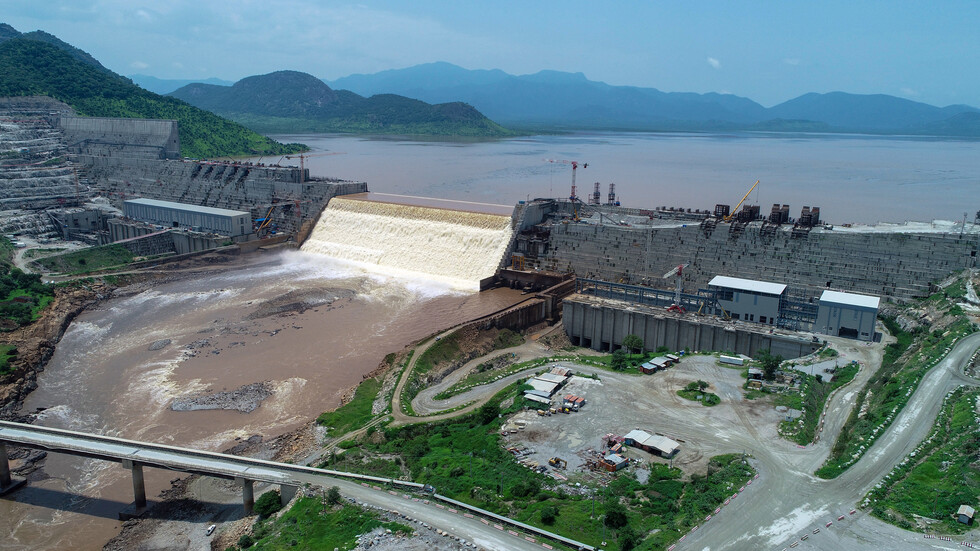

Egypt’s Minister of Water Resources and Irrigation, Dr. Hani Sewilam, said the Grand Ethiopian Renaissance Dam (GERD) remains “illegal and incomplete,” directly challenging recent statements by Ethiopian Prime Minister Abiy Ahmed.
Speaking on MBC Egypt’s Yahduth Fi Masr talk show on Thursday evening, Sewilam called on the Ethiopian government to translate its pledges of no harm to downstream nations into a binding agreement. “Egypt will not accept any tampering with its national water security,” he said, stressing Addis Ababa’s repeated violations of the 2015 Declaration of Principles signed by Egypt, Sudan, and Ethiopia.
Egypt Accuses Ethiopia of Violating International Norms
The minister asserted that the dam was constructed outside internationally recognized legal frameworks, citing unilateral filling and operation without consensus with Egypt and Sudan. “Each cubic meter stored behind the dam comes at Egypt’s expense—this is unacceptable, both legally and ethically,” Sewilam said.
Egypt has been closely monitoring developments using satellite imagery and technical analysis, according to the minister, who criticized Ethiopia’s “random and unjustified” operational decisions.
He also questioned the credibility of Ethiopia’s recent announcement that GERD will be inaugurated in September, pointing out that only 8 of 13 turbines have been installed, with 5–6 functioning irregularly.
Continued Coordination with Sudan
Sewilam reaffirmed Egypt’s ongoing coordination with Sudan, noting that the downstream country may face even greater risks due to its proximity to the dam. He warned that Ethiopia’s actions could threaten the structural integrity of Sudan’s Roseires Dam, which lies just downstream of GERD.
The minister reiterated Egypt’s stance that it supports regional development, but not at the expense of its historic Nile water rights. “We believe in cooperative solutions that respect all parties,” he said.
High Dam Still Key to Egypt’s Water Security
Sewilam praised Egypt’s Aswan High Dam as a critical buffer that has helped the country manage the impact of Ethiopia’s unilateral actions. “Without the High Dam, we would not have withstood Ethiopia’s behavior,” he said, calling the dam an “engineering masterpiece.”
He also outlined Egypt’s long-term water strategy, including a massive expansion in wastewater recycling. Egypt currently reuses 22 billion cubic meters annually, with a target of 85 billion by 2027. The minister emphasized that 90% of Egypt’s water resources originate outside its borders, underscoring the need for regional cooperation.
GERD Nearing Inauguration Amid Unresolved Disputes
Despite the ongoing diplomatic deadlock, Ethiopian Prime Minister Abiy Ahmed announced earlier this month that the GERD is “completed” and will be officially inaugurated in September. The dam, under construction since 2011, has remained a flashpoint in relations between Ethiopia and its downstream neighbors.
Talks over a binding agreement on dam operation and water allocation have repeatedly stalled, with no final deal in sight. While Ethiopia maintains that GERD is essential for its development, Egypt views the project as an existential threat to its water security.


