
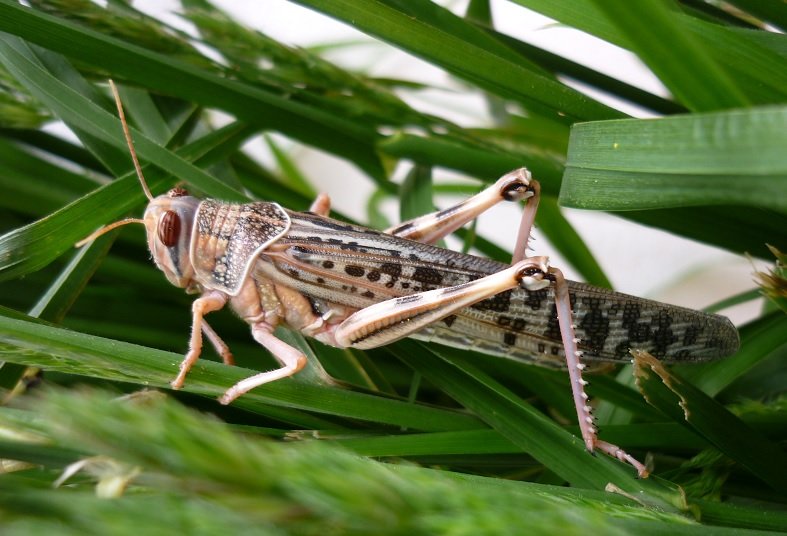

Ethiopia’s Ministry of Agriculture said on Friday it is intensifying efforts to support communities affected by desert locust outbreaks, as part of an ongoing national rehabilitation initiative under the Desert Locust Prevention and Control Project.
In a statement, the ministry said more than 1 million farmers and pastoralists have benefited from desert locust prevention measures over the past five years. The campaign included chemical spraying across 505,000 hectares of land using aircraft, vehicles, and manual tools.
The ministry said recent efforts have focused on rehabilitating communities impacted by control operations. A four-day consultative forum reviewing the project’s progress was held in Arba Minch town and concluded this week.
As part of the forum, stakeholders—including representatives from the Ministry of Agriculture, the World Bank, and regional officials—visited Umo Lante Kebele in the Western Abaya District, where they inspected preparations for the Arba Minch Transboundary Pest Control Station, a key facility under development.
The Horn of Africa was hit by the worst desert locust infestation in decades beginning in late 2019. The outbreak escalated rapidly, spreading across Ethiopia, Somalia, Kenya, and beyond—raising widespread concerns over food security.
The invasion was the most severe Ethiopia and Somalia had seen in 25 years, and Kenya’s worst in 70 years, according to the Food and Agriculture Organization (FAO). Although the worst phases occurred between 2019 and 2021, lingering effects have continued to impact agriculture and livelihoods across the region.
Between June and December 2019, an estimated 1.3 million tonnes of vegetation were lost to locust hopper bands across Ethiopia’s Amhara, Tigray, Oromia, and Somali regions, FAO figures show. By early 2021, nearly 365,000 hectares of cropland had been destroyed.
While no major desert locust activity has been reported in Ethiopia in 2025, ReliefWeb reports from July 7 indicate that swarms have shifted south into the Sahel region. Summer breeding is expected in Sudan, though Ethiopia was not listed among primary outbreak areas.
Earlier in February, desert locust activity continued in parts of Sudan, Eritrea, Niger, and Algeria, according to ReliefWeb. In Sudan, second-generation breeding persisted along the Nile River and Red Sea coast.
The FAO has issued caution-level alerts for countries including Algeria, Libya, Tunisia, Morocco, Chad, and Niger. It warned that additional rains could trigger new outbreaks in the Sahel.
“The current outbreaks are due to very favorable breeding conditions over a six-month period in the northern Sahel, following significant rainfall in August and September 2024,” said Cyril Piou, an expert with FAO’s Desert Locust Information Service (DLIS).


