
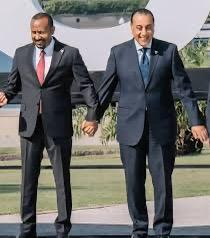

Tensions over the Grand Ethiopian Renaissance Dam (GERD) resurfaced this week after Ethiopian Prime Minister Abiy Ahmed announced that the multi-billion-dollar hydroelectric project—Africa’s largest—is now complete and set to be inaugurated during the Ethiopian New Year this September.
In remarks to Parliament, Abiy called the project a “symbol of regional cooperation and mutual benefit” and extended a public invitation to the “governments and peoples of Egypt, Sudan, and all Nile Basin nations” to attend what he described as a historic celebration of Ethiopia’s development journey.
However, Cairo swiftly responded with strong objections. Egypt’s Ministry of Water Resources and Irrigation reiterated its long-standing opposition, calling Ethiopia’s actions a “flagrant violation of international law” and part of a unilateral strategy to impose a fait accompli on the region. “Egypt firmly rejects Ethiopia’s continued policy of imposing a fait accompli through unilateral actions concerning the Nile River, which is an international shared watercourse,” the ministry said in a statement published by The Associated Press on July 4.
Egypt argues that the dam’s completion without a binding trilateral agreement with Sudan and Ethiopia undermines principles of fair cooperation and could endanger downstream water supplies. Cairo continues to cite what it calls its “historic rights” to Nile water under colonial-era treaties—agreements that Addis Ababa has never recognized.
Ethiopia, meanwhile, maintains that GERD will not harm Egypt or Sudan. Prime Minister Abiy reiterated that the dam “is not a threat, but a shared opportunity,” and emphasized that “Ethiopia’s growth does not come at the expense of our Egyptian and Sudanese brothers and sisters.”
The GERD, launched in 2011, stands 145 meters tall and houses 13 turbines, with the capacity to generate over 5,000 megawatts of electricity. Ethiopia has long claimed the project is entirely financed through domestic resources. However, in a controversial remark last month, former U.S. President Donald Trump claimed Washington financed part of the project—an assertion Ethiopian officials have firmly denied.
The dam’s location on the Blue Nile, a critical tributary of the Nile River, has been at the heart of one of Africa’s most high-stakes diplomatic standoffs. While Ethiopia sees the GERD as a pillar of national pride and economic sovereignty, Egypt has expressed concern over water security for its 110 million citizens.
Multiple rounds of African Union and U.S.-brokered talks since 2020 have failed to yield a binding agreement. The situation escalated after the collapse of Sudan’s transitional government in 2021, with Egypt and Sudan increasingly aligning their positions and pushing for international intervention.
With the dam’s construction now complete, and no trilateral accord in sight, the dispute enters a new and uncertain phase—one that could define the geopolitical dynamics of the Nile Basin for years to come.


